


Nicholas Benzor
Principal Planner & Chief Executive Officer
Table of Contents
- Geopolitical Tensions
- Employment, Inflation, & the Fed
- Earnings Report & Forward Guidance
- Market Performance
- Equities
- Fixed Income
- Commodities
- BCW Stance
September 2026 Market Commentary
Benzor Capital Wealth
Geopolitical Tensions
The Middle East remained the dominant geopolitical driver during August, with the ongoing U.S.–Iran conflict continuing to disrupt energy flows and shipping through the Strait of Hormuz. U.S. policy shifted further toward economic pressure during the month, with additional sanctions introduced alongside continued military pressure, while direct negotiations remained stalled.
Diplomatic efforts continued through Qatar and Oman, with Iran and Oman working toward a framework covering shipping access and operations through the Strait. However, those discussions had not resulted in a full normalization of shipping activity by month-end. Iran continued to dispute U.S. claims that traffic through Hormuz had returned to normal, keeping uncertainty elevated around the timing and pace of a broader recovery in Gulf energy exports.
Risks also increased around the Bab al-Mandab Strait, the strategic waterway connecting the Red Sea with the Gulf of Aden. Its importance has grown as Saudi Arabia has increasingly relied on Red Sea export routes to offset disruptions through the Strait of Hormuz. Houthi forces in Yemen have declared a blockade on Saudi shipping and recently intensified attacks on Saudi energy infrastructure and military targets, while fighting with Saudi-backed Yemeni forces has increased near territory overlooking the strait. The possibility of simultaneous disruption across both Hormuz and Bab al-Mandab represents an additional risk to global energy flows, shipping costs, and oil-price volatility.
Energy markets remained highly sensitive to these developments. Oil prices declined when diplomatic progress increased expectations for improved shipping access and moved higher when the likelihood of an agreement weakened. Tensions escalated again late in the month following additional U.S. military action near the Strait, reinforcing the continued vulnerability of global energy markets to further disruption.
Despite significant intra-month volatility, oil did not move consistently higher throughout August. Improving expectations for Gulf exports and diplomatic progress periodically offset concerns surrounding continued military escalation, resulting in a meaningful round trip in crude prices. Nevertheless, energy remained the primary transmission mechanism from geopolitical risk into broader financial markets through its impact on transportation costs, inflation expectations, consumer purchasing power, and monetary policy.
U.S.–Canada trade tensions also became a meaningful economic issue during the month after negotiations failed to produce an agreement and the United States imposed 50% tariffs on roughly $20 billion of Canadian imports. Canada subsequently suspended negotiations and announced retaliatory tariffs on approximately $20 billion of U.S. goods scheduled to take effect in September.
The dispute increased uncertainty across highly integrated North American industries, particularly steel, aluminum, autos, lumber, and manufacturing, while raising additional concerns around supply-chain costs and the longer-term direction of U.S.–Canada trade relations.
Going forward, markets will remain focused on whether the latest escalation in the Middle East leads to further retaliation, progress toward restoring normal shipping through the Strait of Hormuz, and whether U.S.–Canada trade tensions broaden further or return to negotiations.
Employment, Inflation & the Fed
The Federal Reserve remained caught between persistent inflation and signs of softness in hiring during August, creating uncertainty over whether policymakers should resume tightening or continue holding rates at the current 3.50%–3.75% range.
The policy backdrop entering the month was already relatively hawkish. At the July FOMC meeting, policymakers voted 9–3 to hold rates unchanged, with three members dissenting in favor of a 25-basis-point increase.
Labor-market concerns increased following the July employment report released in August, which showed the economy lost 23,000 jobs while June payroll growth was revised down to only 20,000. The unemployment rate declined modestly to 4.1%, although part of that improvement reflected lower labor-force participation rather than stronger underlying employment conditions.
The weaker report initially caused markets to sharply reduce expectations for a September rate increase. Other labor indicators, however, painted a somewhat more stable picture. Job openings declined to 7.36 million, but hiring improved, and layoffs remained relatively contained, reinforcing the view that the labor market was experiencing a “slow hire, slow fire” environment rather than a broad deterioration. Weekly unemployment claims also remained at historically low levels, suggesting that weaker hiring had not yet translated into widespread job losses.
Inflation data initially provided some relief. July CPI increased 0.1% month over month and 3.4% year over year, while core CPI rose 0.2% monthly and 2.5% annually. Producer prices were also softer than expected, with monthly PPI unchanged and annual producer inflation slowing materially.
However, the Fed’s preferred inflation measure provided a less encouraging signal later in the month. Headline PCE inflation remained at 3.7% year over year and core PCE at 3.3%, leaving both measures materially above the Fed’s 2% objective.
Chair Kevin Warsh reinforced those concerns during his Jackson Hole address, noting that PCE inflation had been running at a 4.1% annualized pace over the previous six months. He described the 2% inflation target as firm and fixed, argued that overall financial conditions did not appear restrictive, and indicated that policymakers would have additional work to do unless underlying inflation began moving clearly and sufficiently toward target.
Warsh also characterized the labor market as broadly consistent with full employment, shifting the balance of his remarks toward inflation as the more immediate policy concern. Markets interpreted the speech as materially hawkish, with expectations for a September rate increase rising from roughly 35% before the address to the mid-to-upper 50% range afterward.
Short-term Treasury yields moved sharply higher following the speech, while the U.S. dollar strengthened as investors priced a greater probability of additional monetary tightening. Warsh also signaled a reduced reliance on traditional forward guidance, suggesting that future policy decisions may become more explicitly data dependent and less predictable.
That shift increases the market’s sensitivity to every major employment and inflation release ahead of the September FOMC meeting.
The approaching November midterm elections are also likely to become a more visible source of policy uncertainty in the coming months. Investors will increasingly assess the potential implications for fiscal policy, taxation, regulation, trade, and the broader legislative agenda. While election periods can contribute to short-term market volatility, longer-term market performance has historically remained more closely tied to economic growth, corporate earnings, inflation, and monetary policy than to any single election outcome.
Oil prices remain an additional complication for the Fed. Continued disruption in the Middle East creates the risk that higher energy costs feed into transportation, production, and consumer prices even as other inflation categories moderate. The relationship between energy and fixed income, therefore, remains important: higher oil prices can raise inflation expectations, increase the probability of tighter monetary policy, push Treasury yields higher, and pressure bond prices.
Longer-term yields also remained elevated during August, with the 30-year Treasury reaching an intramonth high near 5.34%, reflecting a combination of persistent inflation, elevated government borrowing requirements, and greater compensation demanded for long-duration risk.
Going forward, markets will remain focused on whether incoming labor data confirm a genuine slowdown, whether inflation begins moving convincingly toward 2%, and whether resilient economic activity ultimately gives the Fed enough room to raise rates again in September.
Earnings Reports and Forward Guidance
Earnings Snapshot
The second-quarter earnings season is on the final stages by the end of August, with 97% of S&P 500 companies reporting results. Corporate fundamentals remained exceptionally strong, with 86% of companies beating EPS estimates and 77% beating revenue estimates, both above their respective historical averages.
Blended S&P 500 earnings growth reached 52.0% year over year, the strongest pace since Q2 2021 and the seventh consecutive quarter of double-digit earnings growth. Although unusually large investment-related gains materially boosted the headline figure, earnings growth remained 33.8% after excluding those effects, indicating that underlying profit growth remained broad.
Revenue growth was also strong at 15.5% year over year, the highest rate since Q4 2021 and the second consecutive quarter of double-digit revenue growth. All eleven S&P 500 sectors reported positive revenue growth, suggesting that earnings strength continued to be supported by underlying business activity rather than cost reductions alone.
Corporate profitability remained particularly strong. The S&P 500’s blended net profit margin reached a record 17.0%, compared with 14.8% in the first quarter, 12.9% one year earlier, and a 12.4% five-year average. Even after adjusting for unusually large investment gains, margins remained at historically elevated levels.
The consumer picture was somewhat more mixed. July personal consumption expenditures increased 0.2% month over month, with spending continuing to favor services while goods spending declined. Disposable personal income increased 0.5%, while the personal saving rate remained relatively low at 3.0%.
Retail and food-services sales declined 0.6% month over month in July but remained 5.0% above year-ago levels. The data therefore continued to point toward a resilient consumer, although some moderation became visible in discretionary goods spending.
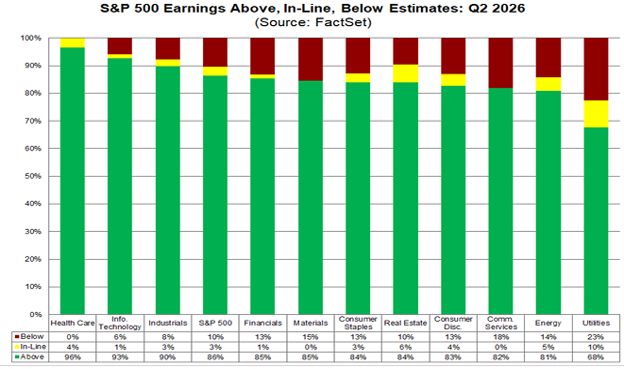
Sector-Wide Overview
- Energy produced the strongest earnings growth in the S&P 500, increasing 146.3% year over year alongside 42.4% revenue growth. Higher commodity prices and improved profitability across the sector remained the primary drivers.
- Communication Services reported 116.9% earnings growth, although unusually large investment-related gains materially boosted the headline result and overstated underlying operating growth.Consumer Discretionary earnings increased 92.4%, although non-operating investment gains similarly contributed significantly to the reported increase.
- Information Technology earnings increased 75.3%, while revenue grew 37.1%. Semiconductor and computing-related demand remained a major contributor as AI infrastructure investment continued supporting growth.
- Financials reported earnings growth of 22.0%, significantly stronger than the 5.2% expected at the end of June, reflecting stronger-than-anticipated profitability across banking and capital-markets businesses.
- Health Care was the only S&P 500 sector reporting an aggregate earnings decline, at 6.5%, although large acquisition and research-related charges were responsible for much of the weakness.
Underlying sector earnings remained positive after adjusting for those effects. Importantly, earnings growth continued broadening beyond the largest technology-oriented companies. While mega-cap growth remained a major contributor, the broader S&P 500 also generated strong profit growth, reducing concerns that market fundamentals were dependent on only a small number of companies.
Forward Outlook
Forward guidance remained unusually constructive. Of the 98 S&P 500 companies issuing third-quarter EPS guidance, 63 issued positive guidance, and 35 issued negative guidance, meaning approximately 64% of guidance was positive and 36% negative.
Analysts currently expect:
• Q3 earnings growth: +28.2%
• Q3 revenue growth: +11.7%
• Q4 earnings growth: +25.8%
• Q4 revenue growth: +11.4%
• Full-year 2026 earnings growth: +31.2%
Valuations also became somewhat more supportive despite equity-market gains. The S&P 500’s forward 12-month P/E declined to 19.6x from 20.4x at the end of June, as forward earnings estimates increased 7.4% while the index itself increased 3.1%.
Overall, earnings remained one of the strongest supports for equity markets during August. While several extraordinary gains inflated headline growth, underlying results remained strong across most sectors, margins remained historically elevated, and forward guidance continued to point toward healthy corporate profitability.
Market Performace
Equities
U.S. equity markets finished August higher despite persistent uncertainty surrounding inflation, Federal Reserve policy, and geopolitical developments.
Market performance remained resilient as investors balanced softer labor-market data against inflation that remained above the Federal Reserve’s target, while exceptionally strong corporate earnings continued providing fundamental support to risk assets.
Market strength was supported by several factors:
- Continued strength in corporate earnings
- AI-driven technology leadership
- Strong semiconductor and large-cap growth performance
- Resilient economic activity
- Continued confidence in corporate profitability
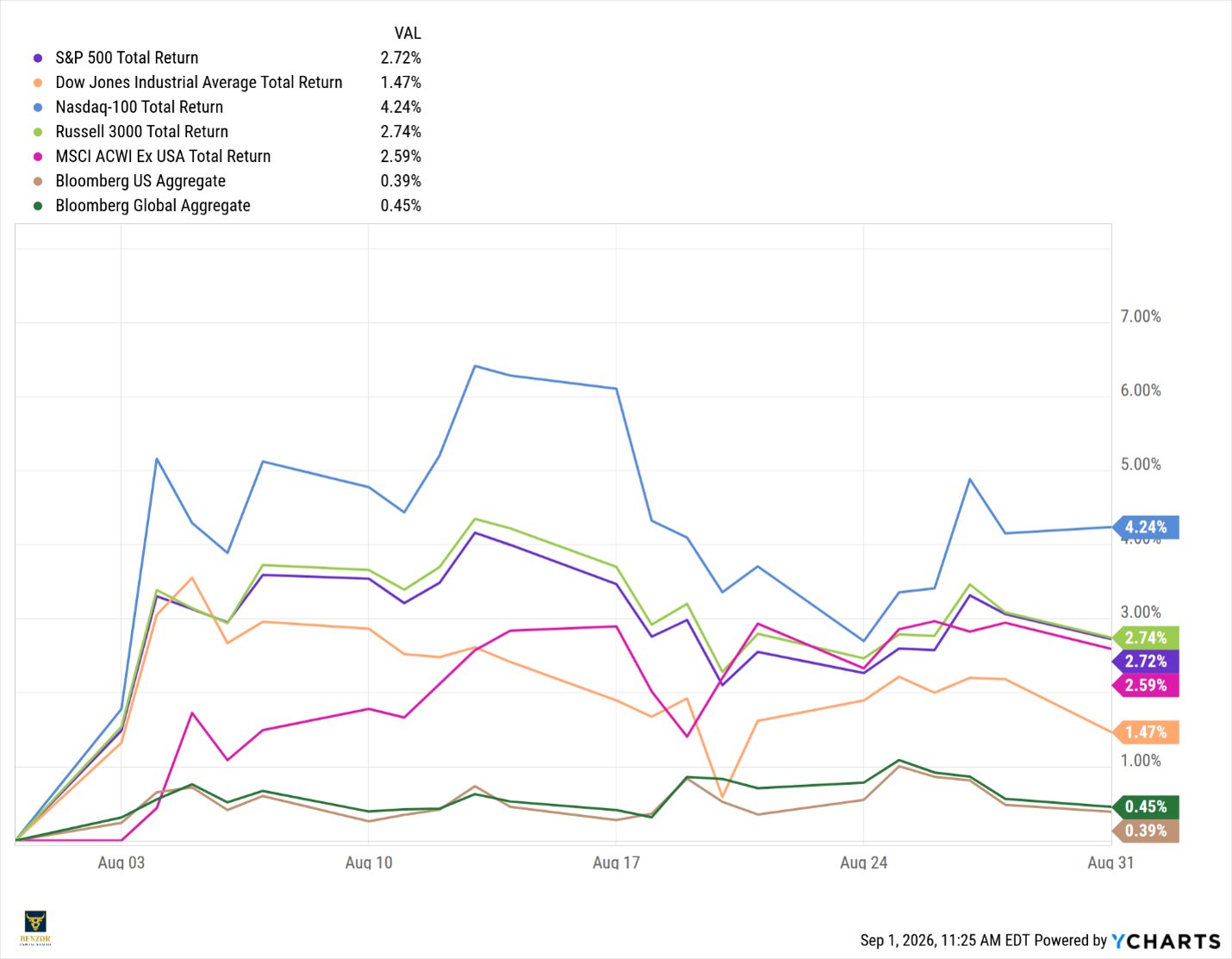
Growth-oriented equities remained in the strongest area of the market. The Nasdaq-100 gained 4.24% during August, materially outperforming the broader market as technology and AI-related companies continued benefiting from strong earnings and elevated investment demand.
The S&P 500 returned 2.72%, while the Russell 3000 returned 2.74%, showing that the broader U.S. equity market kept pace with large caps even though technology remained the primary source of leadership.
The Dow Jones Industrial Average returned 1.47%, lagging the broader indexes as its lower exposure to high-growth technology limited participation in the strongest areas of the market.
Equities experienced several periods of volatility during the month as investors reassessed labor data, inflation, energy prices, and the outlook for Federal Reserve policy. The hawkish repricing following Jackson Hole created additional pressure late in the month, but the major indexes still finished August with positive returns.
International equities also participated in the advance, with the MSCI ACWI ex USA returning 2.59%. International markets therefore kept pace with the broader U.S. market but continued to significantly trail the technology-heavy Nasdaq-100.
Overall, August demonstrated continued resilience across equity markets. Market participation extended beyond a narrow group of companies, but large-cap growth and technology remained the clearest source of outperformance, supported by strong earnings growth and continued AI-related investment.
Fixed Income
Fixed income markets remained highly sensitive to inflation, energy prices, and Federal Reserve expectations throughout August, although broad bond indexes still generated modestly positive returns for the month.
Treasury yields initially moved lower following softer employment and inflation data as investors reduced expectations for near-term Federal Reserve tightening. However, persistent underlying inflation and the hawkish message from Jackson Hole reversed part of that move late in the month.
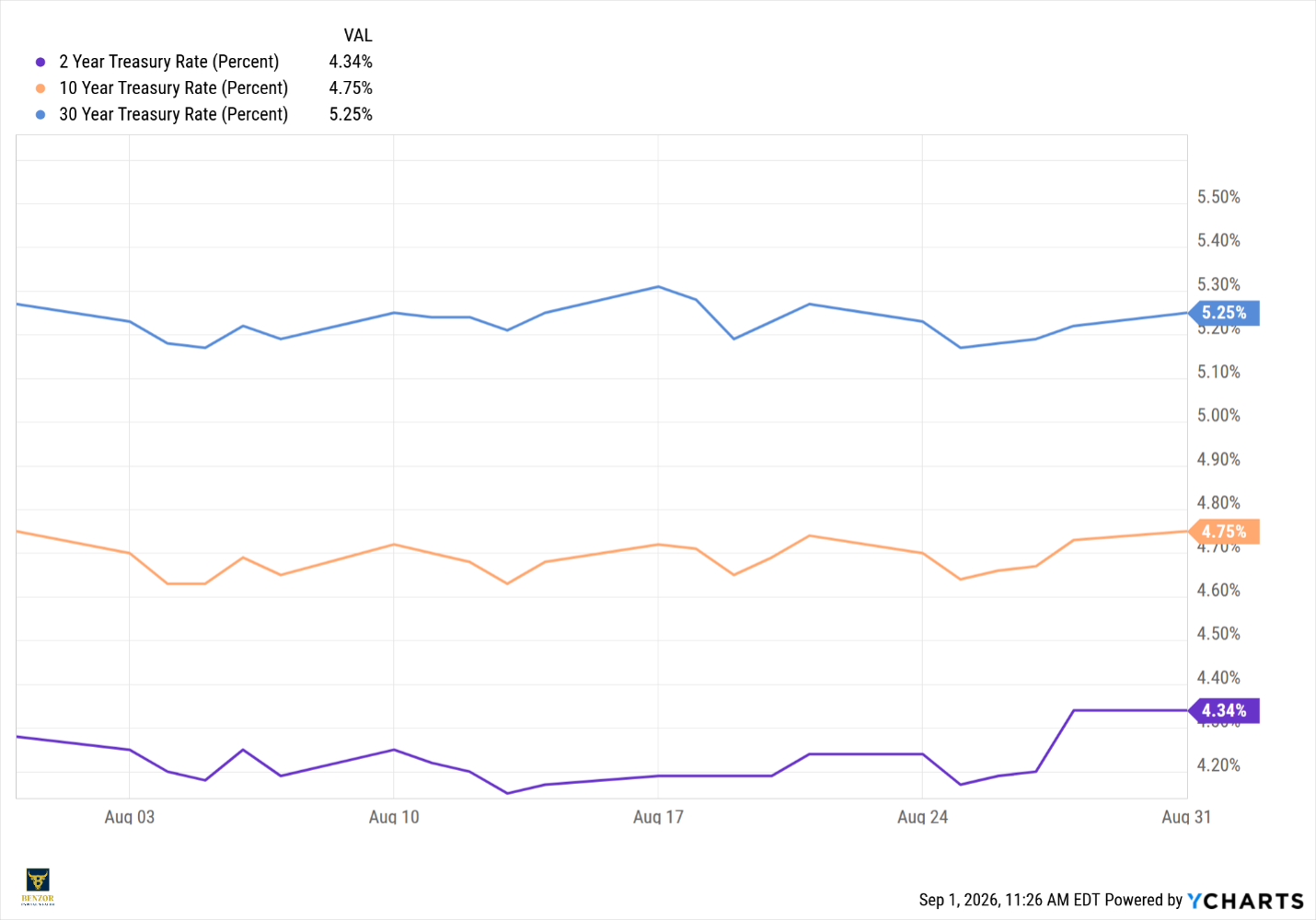
The most significant repricing occurred at the short end of the curve following Chair Warsh’s Jackson Hole remarks, as markets substantially increased the probability of a September rate hike. The 2-year Treasury finished August at 4.34%, up sharply from levels reached immediately before the speech.
Longer-term yields also remained elevated, reflecting continued concerns around inflation, government borrowing requirements, and duration risk. The 10-year Treasury ended the month at 4.75%, while the 30-year Treasury finished at 5.25% after reaching an intramonth high around 5.34%.
Despite elevated yields and the late-month hawkish repricing, broad fixed income delivered small positive returns. The Bloomberg U.S. Aggregate Bond Index returned 0.39% during August, while the Bloomberg Global Aggregate returned 0.45%.
The positive bond returns alongside relatively stable long-term yields suggest that income generation helped offset periods of price pressure during the month. However, the sharp late-August move in short-term yields reinforced the market’s sensitivity to changes in Federal Reserve expectations.
The Treasury curve remained positively sloped at month-end, with long-term yields continuing to trade substantially above short-term rates. This reflected investorS demanding additional compensation for longer-term inflation uncertainty, fiscal concerns, and duration exposure.
Overall, August produced an unusual combination of positive equity returns and modestly positive bond returns despite a more hawkish Federal Reserve outlook, highlighting the continued support provided by strong corporate fundamentals and elevated fixed-income carry.
Commodities
Energy markets remained highly sensitive to developments in the Middle East during August, particularly changing expectations surrounding Iran and shipping through the Strait of Hormuz. Houthi rebels out of Yemen also continue to increase attacks on Saudi forces, thus opening up another potential bottleneck for energy exports out of the region.
Oil prices experienced substantial intra-month volatility as markets moved between expectations for improved shipping conditions and renewed concerns over prolonged supply disruptions. The month was characterized more by a round trip in crude prices than by a sustained move higher, as diplomatic optimism periodically offset renewed military escalation.
Energy nevertheless remained one of the most important macro variables for broader financial markets because of its potential impact on headline inflation, transportation costs, corporate margins, consumer spending, and Federal Reserve policy expectations.
Periods of higher crude prices increased concerns that energy inflation could slow progress toward the Fed’s 2% target, while periods of diplomatic progress provided temporary relief to inflation expectations.
The interaction between oil prices, inflation expectations, and Treasury yields therefore remained one of the most important cross-asset relationships during August.
Market Performance — August 2026
- S&P 500 Total Return: +2.72%
- Dow Jones Industrial Average Total Return: +1.47%
- Nasdaq-100 Total Return: +4.24%
- Russell 3000 Total Return: +2.74%
- MSCI ACWI ex USA Total Return: +2.59%
- Bloomberg U.S. Aggregate Bond Index: +0.39%
- Bloomberg Global Aggregate Bond Index: +0.45%
Housing
The housing market remained under pressure during August as elevated mortgage rates continued weighing on affordability and transaction activity, even as home-price growth moderated and some measures of affordability improved.
Existing-home sales declined 1.7% month over month in July to a seasonally adjusted annual rate of 4.06 million, marking a second consecutive monthly decline. Sales nevertheless remained 0.7% above year-ago levels, suggesting activity remained relatively stable rather than entering a more severe contraction.
Home prices continued rising despite weaker transaction volumes. The median existing-home price increased 2.0% year over year to $434,100, extending the streak of annual price increases to 37 consecutive months. Limited supply continued supporting prices even as higher financing costs constrained buyer demand.
Existing-home inventory stood at 1.54 million units, representing a 4.6-month supply. Inventory conditions therefore remained tighter than would typically be associated with a fully balanced housing market, helping prevent a more meaningful decline in prices.
Forward-looking demand showed additional weakness, with pending home sales declining 2.3% month over month and 2.2% year over year in July. Contract signings declined across all four major U.S. regions, highlighting the continued sensitivity of housing demand to elevated borrowing costs.
New-home activity showed greater weakness. New single-family home sales declined 10.5% in July to an annualized rate of 607,000, while the supply of new homes increased to 9.6 months from 8.5 months in June.
The median new-home sales price fell to $393,800, down 2.3% from June and 0.9% from a year earlier. The combination of declining prices and elevated inventories suggests builders are increasingly using pricing and incentives to support demand.
Residential construction data were mixed. Housing starts declined 12.4% in July to an annualized rate of 1.239 million, while single-family starts fell 9.9%. Building permits, however, increased 5.0% to 1.443 million, providing a somewhat more constructive signal for future construction activity.
Mortgage rates remained one of the largest obstacles to a stronger housing recovery. The average 30-year fixed mortgage rate remained around the mid-6% range during August as elevated long-term Treasury yields continued preventing meaningful relief in financing costs.
Despite high mortgage rates, measured housing affordability showed some year-over-year improvement as home-price appreciation slowed and household incomes increased.
Overall, the housing market remained caught between limited existing-home supply supporting prices and elevated financing costs suppressing demand. Sales activity, pending contracts, new-home sales, and construction all showed signs of softness, while slower price growth and improving affordability provided some relief. A more meaningful housing recovery will likely remain dependent on whether long-term Treasury yields and mortgage rates can move sustainably lower.
BCW Stance
Markets remained resilient throughout August despite continued geopolitical uncertainty, persistent inflation, and a more hawkish shift in Federal Reserve expectations. Strong corporate earnings, historically elevated profit margins, and generally stable economic conditions continued to support risk assets, even as the likelihood of additional monetary tightening increased following the Jackson Hole symposium.
Corporate fundamentals remain an important source of support. Earnings growth has continued to broaden beyond the largest technology-oriented companies, while forward guidance remains constructive across much of the market. At the same time, elevated interest rates and persistent inflation reinforce the importance of remaining selective, particularly in areas where valuations have moved ahead of underlying fundamentals.
Across asset classes, August demonstrated the benefits of maintaining diversification. U.S. and international equities generated positive returns, while fixed income also produced modest gains despite elevated Treasury yields. Market leadership continues to evolve across sectors, styles, and market capitalizations, and we continue to favor portfolios that balance participation in long-term growth opportunities with exposure to areas offering attractive valuations, income, and diversification benefits.
Looking ahead, markets will be navigating a combination of Federal Reserve policy decisions, geopolitical developments, trade uncertainty, and the approaching U.S. midterm elections. Rather than positioning portfolios around any single political or economic outcome, we remain focused on durable fundamentals, appropriate diversification, and disciplined portfolio construction. Periods of volatility may create opportunities, but we continue to believe that maintaining a long-term investment framework is preferable to making reactive allocation decisions based on short-term market headlines.