

Introduction
September marked a turning point in U.S. monetary policy, with the Federal Reserve cutting rates by 25 basis points to a new target range of 4.00%–4.25%. This move, the first reduction since December 2024, was characterized by Chair Powell as a “risk-management” cut, reflecting the Fed’s growing concern over a cooling labor market and persistent, though moderating, inflation. Markets are already looking ahead, with futures pricing from the CME FedWatch tool suggesting a near-certain, 94% probability of another cut in October and a high likelihood of an additional one in December, with a 77% chance of a reduction. Should the two additional cuts occur, this would bring the target rate down to 3.50%–3.75%. While inflation remains above the Fed’s 2% target, at roughly 2.9% on the headline measure with core metrics still elevated, policymakers are weighing the balance between containing price pressures and preventing a sharper deterioration in employment conditions. The Fed’s Summary of Economic Projections also shifted its risk balance more toward labor market weakness than inflation, a subtle but meaningful change in tone. Powell emphasized that this move is not the start of an aggressive easing cycle, warning against front-loading cuts that could reignite inflation. Markets reacted with modest declines in short-term yields, steadier long-end rates, and a weaker U.S. dollar, signaling skepticism about the depth of the easing cycle.

Nicholas Benzor
Principal Planner & Chief Executive Officer

Sanskar Raheja
Investment and Financial Planning Intern

Loveth Obozokhai
Investment and Portfolio Analyst Intern
Inflation & Unemployment Trends
The latest inflation data underscored the Fed’s delicate balancing act. Headline CPI rose 0.4% month-over-month and 2.9% year-over-year in August, slightly above expectations, with energy and food—particularly gasoline—driving much of the increase. Goods inflation has moderated in recent months, reflecting improved supply chains and slower demand, but services inflation remains sticky, reinforced by elevated shelter and transportation costs. Core CPI, excluding food and energy, advanced 0.3% MoM and 3.1% YoY, with shelter continuing to be the largest single contributor, though early signs of moderation have emerged.
At the same time, labor market data has shown clearer signs of strain. Nonfarm payrolls rose by only 22,000 in August, a sharp slowdown from July’s 85,000 gain. June and July payrolls were also revised down by a combined ~50,000 jobs, suggesting weakness is not limited to a single report but reflects a broader cooling trend. The unemployment rate edged up to 4.3% from 4.2% in July, compared with 3.8% a year earlier. A Chicago Fed real-time estimate confirmed September unemployment holding at ~4.3%, with forecasts projecting a drift toward 4.5% in the coming year. While higher than previous numbers, the 4.3% unemployment still reflects what is still considered by many economists, full employment. Weekly jobless claims spiked early in the month, briefly touching near four-year highs, before easing somewhat—though continuing claims remain elevated, pointing to harder re-employment conditions. Wage growth also slowed, with average hourly earnings rising 3.8% YoY, down from 4.1% in July. This moderation reinforces the view that labor demand is cooling. For the Fed, the combination of sticky inflation and a softening labor market presented a challenging backdrop. Ultimately, policymakers opted to prioritize cushioning employment risks while maintaining vigilance on inflation, making these dynamics central to their decision to deliver September’s 25 bps rate cut.
The most recent earnings season highlighted the strength and adaptability of U.S. corporates, with nearly 80% of S&P 500 companies surpassing earnings expectations, well above the historical average of ~67%. Revenue beats were less frequent, with around 60% of companies exceeding estimates, showing that margin discipline, cost controls, and efficiency gains were more important drivers of performance than broad-based top-line expansion. On balance, results came in stronger than anticipated, providing a key catalyst for equity markets to advance during September. Strong forward guidance coupled with a decreasing rate environment could set up a strong market for Q4, 2025 and beyond.
Sector Leaders:
- Technology & Communication Services: +20–25% earnings growth, powered by strong AI, cloud, and digital demand. Companies such as Microsoft, Alphabet, and Meta set the pace, while Netflix and other digital platforms also contributed.
- Consumer Discretionary: +8–10%, supported by resilient spending in travel, leisure, and retail. Amazon, Marriott, and Nike helped lead the rebound after prior softness.
- Industrials: +6–8%, benefiting from infrastructure investment and logistics. Results from UPS, Caterpillar, and Honeywell reflected stronger demand for capital goods and transportation.
- Financials: +5–7%, with large institutions like JPMorgan and Goldman Sachs showing stability, while smaller regional banks continued to face funding cost pressures.
- Healthcare & Consumer Staples: +3–5%, delivering steady, defensive results. Johnson & Johnson, Procter & Gamble, and UnitedHealth highlighted the sector’s resilience.
Underperformers:
- Energy & Materials: –5% to –10% earnings contraction, weighed down by commodity price volatility. ExxonMobil, Chevron, and Dow Inc. all reported softer revenue trends despite cost discipline.
- Utilities: +1–2%, reflecting modest growth. Dominion Energy and Duke Energy showed steady but subdued earnings consistent with defensive positioning.
Forward Outlook
Looking ahead, corporate guidance was cautious but not pessimistic. Many management teams flagged tariff uncertainty, input cost pressures, and labor market cooling as risks to monitor, but few projected a significant deterioration in operating conditions.
SMID Companies and why we are bullish in this environment
Small- and mid-cap equities entered September trading at a meaningful valuation discount relative to large caps, with forward P/E and price-to-book ratios well below historical norms. After several years of underperformance, this gap offers notable upside potential, particularly in a market environment where investors search for relative value opportunities. The Fed’s 25-bps rate cut in September provides an additional catalyst, disproportionately benefiting SMID companies that depend more heavily on credit financing. Historical patterns suggest that these firms tend to outperform in the 12 months following the start of easing cycles, as lower borrowing costs improve access to capital and stimulate business investment. SMIDs’ revenue profile also provides a structural advantage. With a greater share of sales generated domestically, these companies are less exposed to global growth uncertainty, currency volatility, and trade-related disruptions. At the same time, they are positioned to capture tailwinds from resilient U.S. consumption, infrastructure spending, and targeted fiscal incentives across manufacturing and clean energy. Earnings trends further support the constructive outlook. In the most recent reporting season, a higher proportion of SMIDs exceeded analyst expectations compared to large caps, with double-digit revenue growth reported in industrials, technology hardware, and consumer discretionary segments. This breadth of earnings strength underscores that demand is not limited to a single sector but reflects a broader cyclical recovery. Investor flows are beginning to validate the improving fundamentals. SMID-focused ETFs and mutual funds have seen renewed inflows, while institutional positioning remains at historically low levels—creating ample room for reallocation as sentiment improves.
Looking ahead, we believe SMID companies are well-positioned to outperform the coming quarters, supported by attractive valuations, monetary policy tailwinds, and strengthening earnings momentum. Key risks remain, particularly tariff-driven input cost pressures, but their domestic revenue base provides a partial buffer against global trade shocks. We see this segment as a compelling opportunity within diversified equity allocations.
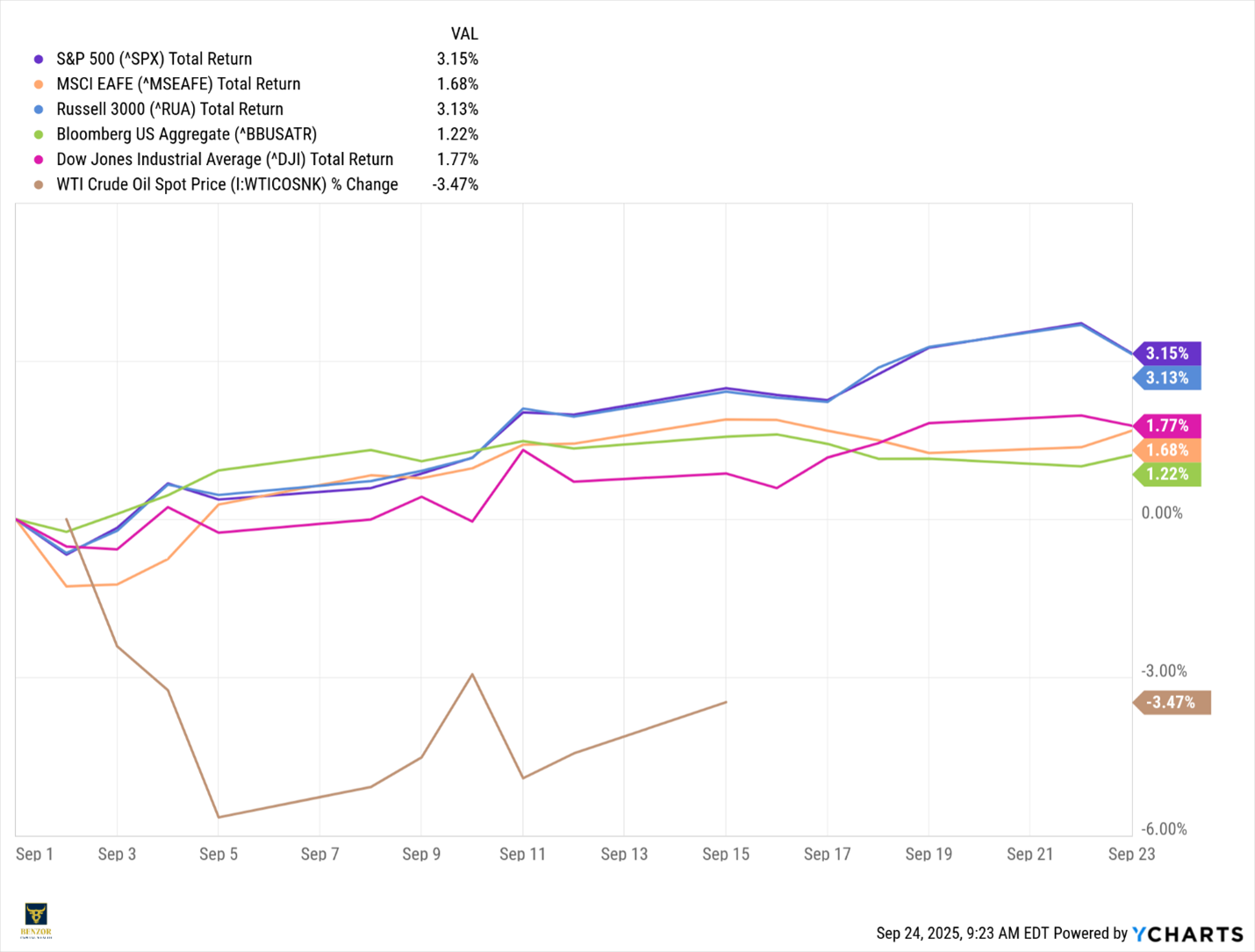
September delivered broad-based equity gains, with the S&P 500 up 3.15% and the Russell 3000 advancing 3.13%, reflecting renewed risk appetite following the Fed’s rate cut. The Dow Jones Industrial Average rose 1.77%, lagging more growth-oriented benchmarks, while fixed income also posted modest gains, with the Bloomberg Global Aggregate Bond Index up 1.22%.
Commodities were mixed: oil prices fell 3.47% month-to-date through September 15, pressured by easing demand expectations and elevated supply.
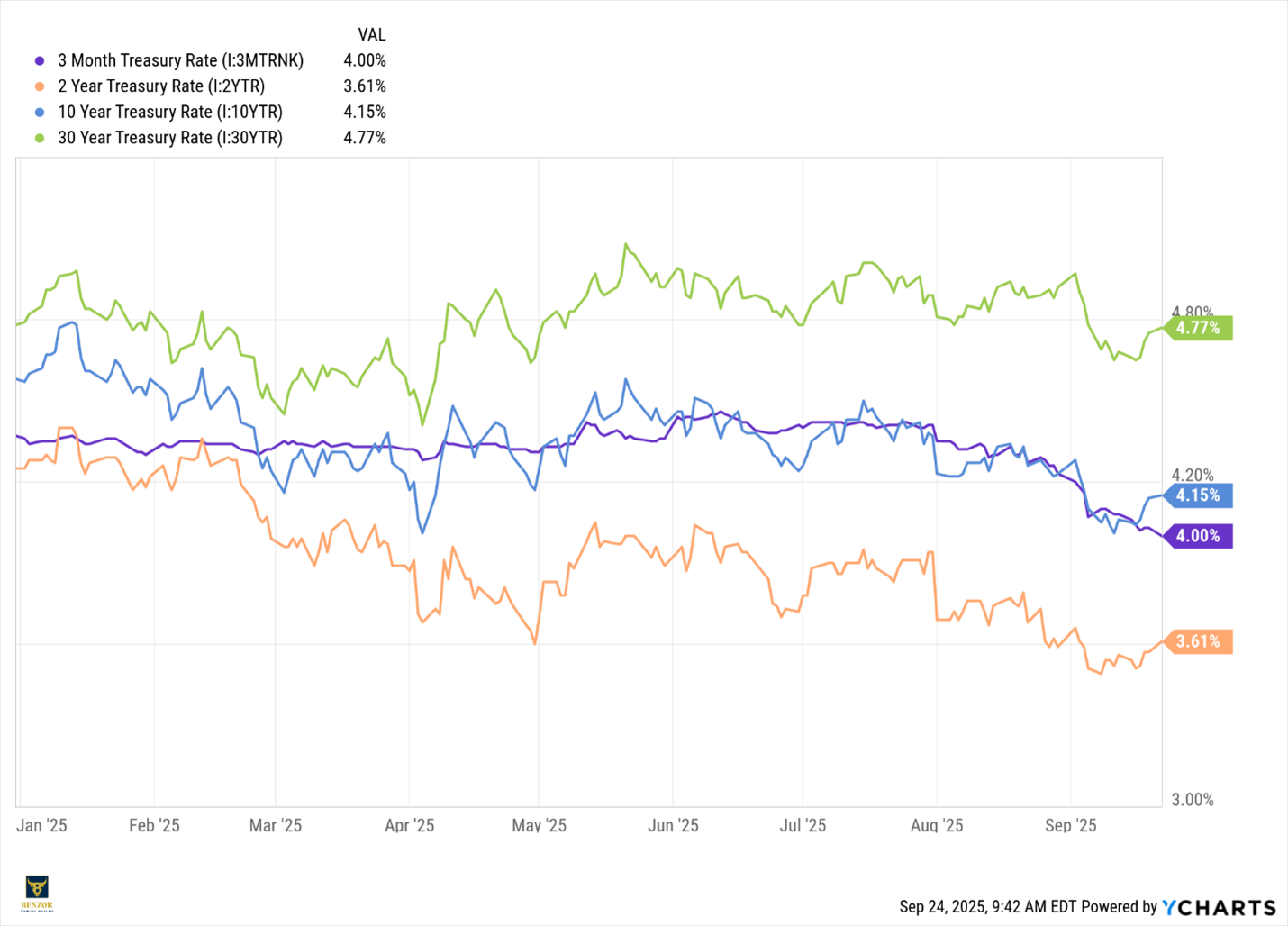
In fixed income, yields continued to decline, boosting the value of existing bond holdings in client portfolios. The 3-month Treasury ended at 4.00%, the 2-year at 3.61%, the 10-year at 4.14%, and the 30-year at 4.66%—maintaining a modestly inverted curve that reflects late-cycle dynamics.
High yield bonds stand to be among the primary beneficiaries of the current market environment. The Fed’s September rate cut has eased borrowing costs across the credit spectrum, directly improving refinancing conditions for below-investment-grade issuers. This reduction in funding pressure, combined with stronger equity performance, lowers perceived default risk and supports investor confidence in the asset class. Historically, high yield has delivered strong relative performance in the early stages of easing cycles, as credit spreads tighten and capital markets reopen more fully to smaller and more leveraged borrowers. Today, spreads remain attractive compared to investment grade debt, offering investors an opportunity to capture incremental yield without relying solely on duration. That said, we continue to emphasize caution and rigorous research. Credit selection is critical in this environment, as certain sectors remain vulnerable to margin pressures and tariff-related cost increases. For well-diversified portfolios, however, high yield exposure offers the potential for enhanced total return, benefiting from both carry and price appreciation as financial conditions loosen further into 2025.
Private credit continues to stand out in the current environment, offering higher yields than traditional public fixed income while remaining less sensitive to daily market volatility. The Fed’s September rate cut further enhances its appeal, as investors look for sources of incremental income in a lower-rate backdrop.
Importantly, private credit is becoming increasingly accessible to retail investors, broadening the opportunity set beyond institutional portfolios. Employer-sponsored retirement platforms are beginning to introduce private credit strategies, allowing individuals to access institutional-style opportunities within their own plans. For investors with longer time horizons and lower liquidity needs, this trend provides both diversification benefits and attractive return potential.
For investors with longer time horizons and the ability to accept lower liquidity, private credit provides not only attractive yield opportunities but also diversification benefits relative to public bonds and equities. The asset class continues to benefit from strong fundamentals, including conservative underwriting standards, floating-rate structures, and enhanced collateral protections, which help mitigate downside risks. As the cycle shifts toward lower policy rates, private credit stands well-positioned to remain a critical component of portfolio construction, balancing income needs with resilience against broader market volatility.
September marked a decisive shift for markets and the economy as the Federal Reserve delivered its first rate cut since 2024, citing signs of labor market cooling even as inflation holds above target. The move, paired with softer payroll data and upward pressure from tariffs, reflects the Fed’s effort to strike a balance between growth and price stability. Equity markets welcomed the policy pivot, with earnings strength in technology, consumer discretionary, and industrials reinforcing confidence, though energy and commodity-linked sectors continued to lag.
Looking ahead, lower rates should provide support for rate-sensitive sectors and for smaller companies that rely more heavily on credit markets, while diversification through alternatives such as private credit remains key in buffering volatility. At Benzor Capital Wealth, we remain focused on maintaining discipline while leaning into opportunities created by easing policy, ensuring client portfolios are positioned for both near-term uncertainty and the longer-term structural trends shaping the economy.