

Introduction
October was a month of transition for both markets and policymakers, as investors navigated the effects of continued monetary easing, a prolonged government shutdown, and shifting global trade dynamics. Confidence remained supported by strong corporate earnings and improving inflation trends, even as uncertainty persisted around future Fed actions and fiscal negotiations. Despite volatility early in the month, sentiment improved toward month-end, with equities advancing, yields moderating, and global growth indicators showing tentative signs of stabilization heading into the final quarter of 2025.

Nicholas Benzor
Principal Planner & Chief Executive Officer

Sanskar Raheja
Investment and Financial Planning Intern

Loveth Obozokhai
Investment and Portfolio Analyst Intern
The Fed lowered the federal-funds target range by 25 basis points to 3.75%-4.00%, marking the second cut of the year and reinforcing a tilt toward supporting a cooling labor market. The decision parallels the earlier September cut but includes a more cautious forward guide. Importantly, Chair Jerome Powell stated that a rate reduction in December is “not a foregone conclusion”, and the Fed’s members are reportedly divided on the path ahead. Meanwhile, the ongoing government shutdown, which has delayed key economic data, adds a new layer of uncertainty around monetary-policy timing.
The Fed’s balance of risks has shifted perceptibly, from inflation concerns topping the agenda, to labor market and growth dynamics gaining precedence in internal forecasts. Headline inflation remains above target, though recent data shows signs of moderation. Short-term yields initially rose modestly following the Fed’s statement, reflecting markets’ recalibration of expectations for additional easing. The dollar strengthened slightly, while rate-sensitive sectors held firm, underscoring investor confidence that policy will remain supportive into year-end.
Government Shutdown: Causes and Market Impact
A full federal government shutdown began on October 1 after Congress failed to agree on appropriations legislation. Stalemate over funding, foreign-aid rescissions, and policy riders drove the impasse, resulting in furloughs across agencies and a disruption of key data releases, notably the delay of the September CPI report.
Markets promptly reacted: equity futures dropped, the dollar softened, and gold rose as investors moved to safe-haven assets. Shutdown-linked uncertainty has weighed on near-term risk appetite, and estimates suggest the drag could reach $15 billion per week in lost economic output if the shutdown lingers. Delays to economic data complicate policymaker and investor decision-making, amplifying market volatility.
Should the shutdown persist throughout November, risks increase for Thanksgiving travel and early holiday spending:
- Travel & Logistics: TSA and air-traffic controller furloughs may cause delays and disruptions at airports and for freight transit. Such delays on flights and at security lines have already been seen at airports in the New York City Area such as Newark, JFK, Laguardia as well as Nashville and Houston airports.
- Consumer Spending: Missed federal paychecks may curb discretionary holiday purchases.
- Retail Sales: Softness may emerge in early-season sales, pushing retailers to deepen discounts and compress margins.
Resolution requires passage of either a full appropriations bill or a continuing resolution to restore agency funding. A protracted shutdown would further dampen consumer sentiment and weigh on economic activity, particularly heading into the high-impact holiday season.
Inflation & Labor Market Dynamics
Due to the shutdown, September CPI data was released nearly two weeks late, with headline inflation (+0.3% MoM, +3.0% YoY) tracking just below forecasts but rising vs. August’s +2.9% YoY. Core CPI rose by 0.2% MoM and 3.0% YoY, showing some improvement compared to last month’s 3.1%. Goods inflation has eased thanks to better supply chains, but services costs, notably shelter and transportation, remain sticky.
Labor market data continues to reflect cooling:
- Nonfarm Payrolls: August and September readings showed smaller monthly gains and downward revisions to prior months, reinforcing the moderation trend.
- Unemployment Rate: Edged up to 4.3%, projected to rise to 4.5% over the coming year.
- Wage Growth: Annualized pace slowed to 3.8%, down from last summer’s 4.1%, pointing to softer labor demand.
Recent trends indicate a challenging backdrop for policymakers, underscoring why the Fed is prioritizing employment stability while remaining vigilant on inflation. Market consensus expects continued, measured easing, provided further labor market weakness appears, and inflation pressures continue to subside.
Earnings Season: Q3 Highlights and Sector Trends
As of the end of October, 64% of S&P 500 companies have reported actual results for the third quarter, marking a more complete picture of corporate performance. The season has been strong overall but mixed in magnitude—with the share of positive earnings surprises above historical norms, though the size of those surprises is somewhat below trend. 83% of companies have reported actual EPS above estimates, exceeding both the 5-year average (78%) and the 10-year average (75%); 79% have reported revenues above expectations, also surpassing the 5-year (70%) and 10-year (66%) averages; Aggregate EPS results are 5.3% above analyst forecasts, below the 5-year average of 8.4% and the 10-year average of 7.0%, reflecting tighter expectations and narrower beats.
- Technology & Communication Services: Led earnings growth, with robust cloud, AI, and digital platform demand. Companies like Microsoft, Alphabet, and Meta outpaced, while Netflix and peers saw streaming gains.
- Consumer Discretionary: Held up well, supported by travel and retail spending ahead of holidays. Amazon, Marriott, and Nike led the segment.
- Industrials: Benefited from infrastructure investment and logistics demand. UPS, Caterpillar, and Honeywell delivered strong results.
- Financials: Mixed results, large, diversified banks stayed stable due to fee income, smaller banks continued to feel funding cost and credit risk pressure.
- Energy & Materials: Earnings underperformed due to commodity price declines; discipline on costs helped mitigate impact.
- Healthcare & Staples: Provided steady, defensive returns, serving as ballast for index-level results.
Forward Outlook
Management guidance is cautious, tariff uncertainty, moderate hiring trends, and consumer cost-consciousness remain front of mind. Yet, healthy margins and improving supply chains, plus anticipated lower policy rates, support a constructive outlook for Q4 and beyond.
Holiday Season & Spending Habits
The November–December period typically accounts for ~19% of annual retail sales, with last year’s total near $994 billion (+4% YoY). For 2025, spending is projected to rise 3.5–4%, slightly below trend as households remain cost-conscious amid higher borrowing costs.
Online sales continue to gain share, now over 25% of total retail activity, while spending strength is expected in essentials, toys, and personal electronics. If the government shutdown extends into November, delayed paychecks and weaker sentiment could slow early-season shopping, prompting heavier discounting and narrower margins.
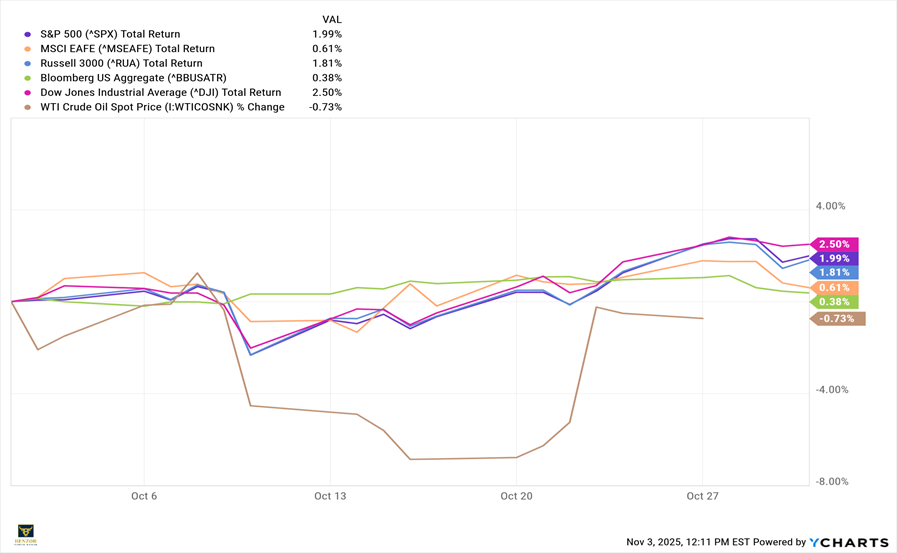
Equity markets delivered solid gains in October, overcoming macro volatility from the ongoing U.S. government shutdown and cautious Federal Reserve signaling. The S&P 500 rose 1.99%, supported by resilient corporate earnings and growing optimism around a “soft landing” scenario. The Dow Jones Industrial Average outperformed with a 2.50% total return, reflecting strength in industrial and financial names, while the Russell 3000 advanced 1.81% as mid- and small-cap performance improved alongside easing credit expectations. International equities also moved higher, with the MSCI EAFE Index gaining 0.61%, aided by stabilizing economic indicators across Europe and Japan. Fixed income posted modest positive returns, as the Bloomberg U.S. Aggregate Bond Index rose 0.38%, reflecting modest yield compression and improved risk sentiment following the Fed’s dovish tone. Commodities remained mixed. WTI crude oil fell 0.73% for the month amid softening demand expectations, rising inventories, and uncertainty over global growth momentum.
Overall, October’s performance underscored the market’s ability to digest policy shifts and geopolitical developments, with lower yields, steady earnings, and easing inflation supporting a constructive multi-asset environment heading into year-end.
Treasury yields drifted lower in October, contributing to bond market gains and maintaining a modestly inverted curve characteristic of late-cycle dynamics.
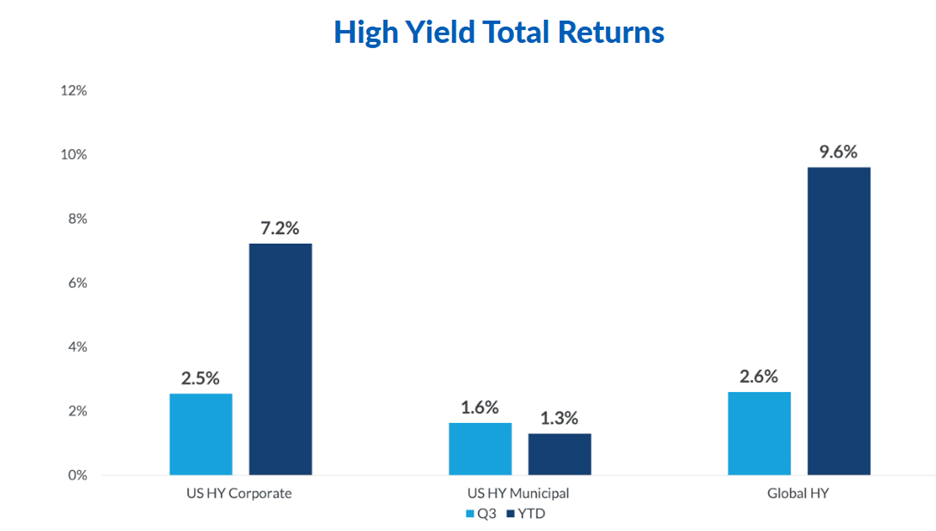
Sources: Bloomberg US High Yield Total Return Unhedged USD Index, Bloomberg High Yield Municipal Bond Index Total Return Index Value Unhedged USD, Bloomberg Global Aggregate High Yield Total Return Value Unhedged USD Index as of 9/30/2025.
High yield debt posted robust returns in October, supported by the September Fed rate cut, which eased refinancing pressures across the credit spectrum and improved sentiment for lower-rated issuers. U.S. high yield corporates returned approximately 0.4% for the month, outperforming Treasuries of similar duration as spreads remain attractive relative to investment-grade bonds. Default risk perceptions are gradually falling, and credit upgrades outpaced downgrades for a third consecutive month, positioning high yield for cyclical outperformance as capital markets increasingly reopen for smaller borrowers
Private credit continues to offer competitive yields and diversification benefits, its appeal further enhanced by greater accessibility for retail investors through employer retirement platforms and managed accounts. Conservative underwriting, floating-rate features, and robust collateral structures all favor sustained resilience during the easing cycle.
On October 25, the United States and China reached an agreement in principle addressing several pivotal trade issues, with particular emphasis on rare earth materials—the backbone for advanced technology, defense systems, and clean energy manufacturing. The agreement, unveiled after months of negotiations, aims to stabilize supply chains that have faced persistent disruptions and strategic uncertainty over the past several years.
Key Elements of the Agreement
- Rare Earth Materials: China agreed to reduce export bottlenecks and guarantee more reliable shipments of rare earths, which are essential for semiconductors, electric vehicles, renewable energy, and military technology. The U.S. secured commitments to allow a predictable flow of critical minerals, helping to lower costs and uncertainty for American manufacturers and technology firms.
- Tariffs and Market Access: Both sides committed to moderating certain tariffs and to opening new channels for investment—particularly in midsize manufacturing and advanced tech. This creates openings for American exporters into Chinese markets while offering Chinese firms a clearer path for U.S. direct investment.
- Transparency & Compliance: The agreement stipulates improved regulatory transparency and mechanisms for compliance review, reducing the risk of sudden market disruptions and offering companies greater ability to plan for long-term projects.
Market and Sector Implications
The announcement triggered a positive response across key sectors:
- Tech & Industrials: Stocks tied to semiconductors, battery, and defense supply chains outperformed the following news, reflecting reduced input risk and improved sourcing certainty.
- Clean Energy: Developers of electric vehicles, wind turbines, and grid infrastructure stand to benefit from lower volatility in procurement and potential cost reductions on vital components.
- Manufacturing: Greater clarity on tariffs and rare earth access should allow for leaner inventories, more stable production cycles, and higher investment in advanced manufacturing initiatives.
This deal marks a foundational step in recalibrating the bilateral relationship, illustrated by direct commitments in areas critical to long-term innovation and national security. By reducing dependence on risky supply lines, both nations position themselves to better weather global market shifts heading into the holiday retail and investment season. While follow-through and full legislative implementation remain pending, the progress signals improved sentiment and tailwinds for risk assets and forward-looking industries.
October extended the momentum of policy easing, as the Federal Reserve maintained its cautious but supportive stance in response to moderating inflation and a cooling labor market. Despite headwinds from the government shutdown and geopolitical uncertainty, markets demonstrated resilience, helped by solid corporate earnings, improving forward guidance, and progress on U.S.–China trade relations. Rate-sensitive sectors, SMID equities, and credit markets benefited from falling yields, while energy and commodity-linked areas lagged amid softer global demand.
Looking ahead, lower policy rates and improving liquidity conditions should continue to support cyclical and credit-sensitive assets into year-end. At Benzor Capital Wealth, we remain focused on balanced participation, leaning into quality equities and fixed income, while maintaining exposure to private credit as a key buffer against volatility. Our positioning reflects discipline, selectivity, and diversification as central pillars for navigating the next stage of the cycle.