


Nicholas Benzor
Principal Planner & Chief Executive Officer
Table of Contents
- Geopolitical Tensions
- Employment, Inflation, & the Fed
- Earnings Report & Forward Guidance
- Market Performance
- Equities
- Fixed Income
- Commodities
- Housing
- BCW Stance
November 2026 Market Commentary
Benzor Capital Wealth
Geopolitical Tensions
The Middle East remained a major source of geopolitical uncertainty during October, with the ongoing U.S.–Iran conflict disrupting energy markets and shipping activity around the Strait of Hormuz. Diplomatic efforts continued throughout the month, but disagreements over sanctions relief, Iran’s nuclear program, and maritime access prevented a lasting settlement. The absence of a comprehensive agreement kept uncertainty elevated around one of the world’s most important energy transportation routes.
Tensions also intensified around the Bab al-Mandeb Strait, as Saudi-backed forces launched counteroffensives against Houthi positions in Yemen. Toward the end of October, Houthi forces claimed additional strikes against Saudi energy infrastructure, including the Ras Tanura and Rabigh refineries and the East-West Pipeline. These developments raised concerns about the security of regional oil exports and the potential for disruptions across both the Red Sea and Persian Gulf shipping corridors.
The Russia–Ukraine conflict continued despite ongoing diplomatic efforts, with attacks on energy infrastructure undermining prospects for a durable ceasefire. The European Union and United Kingdom introduced additional sanctions targeting Russia’s energy sector, shadow fleet, and sanctions-evasion networks, increasing pressure on Russian energy exports while maintaining uncertainty around global supply conditions.
U.S.–China trade relations showed signs of improvement during October as negotiations progressed ahead of the November APEC summit. Both countries explored reciprocal tariff relief and opportunities to stabilize trade relations, although disagreements over rare-earth supplies, technology restrictions, and investment continued to complicate negotiations. While diplomatic progress provided some relief to broader trade uncertainty, the possibility of renewed restrictions remained an important consideration for global supply chains.
Going forward, markets will remain focused on U.S.–Iran negotiations, the security of critical Middle Eastern shipping routes, and developments in Russia–Ukraine. Sustained elevated energy prices could reinforce inflationary pressures, influence monetary policy expectations, and contribute to additional volatility across global financial markets.
U.S. Midterm Elections and Market Expectations
As the November 3 midterm elections approached, political uncertainty became an increasingly important consideration for financial markets. Prediction markets increasingly favored a Democratic takeover of Congress, assigning approximately a 67% probability that Democrats would control both chambers as of October 30. These expectations suggested that investors were increasingly considering the potential implications of a shift in congressional control for the administration’s legislative agenda and broader fiscal and regulatory policy.
A Democratic-controlled Congress could constrain the administration’s ability to advance major legislative initiatives while increasing congressional oversight. Market participants were also evaluating potential sector-specific implications, including tighter scrutiny of artificial intelligence and data-center expansion, changes to energy policy, and possible obstacles to cryptocurrency and financial deregulation. While changes in congressional leadership could influence individual industries, the eventual market impact would depend on the scope and implementation of resulting policies.
Historically, U.S. equities have generally performed well following midterm elections, regardless of which party controls Congress. Beyond the immediate market reaction, the election could have broader implications for U.S. foreign policy, inflation, and investment trends. Changes in congressional control may influence trade relations with China, sanctions policy, defense spending, and energy security, potentially affecting global supply chains and commodity prices. Domestically, greater scrutiny of AI infrastructure investment, semiconductor export restrictions, and energy policies could influence the pace of data-center expansion and capital allocation across technology-related industries. These developments could also affect inflation expectations and the Federal Reserve’s policy outlook, although their ultimate market impact would depend on the extent of legislative changes and their implementation
Employment, Inflation & the Fed
The Federal Reserve maintained its federal funds target range at 3.75%–4.00% during its October 27–28 meeting, following September’s 25-basis-point increase. The decision passed by a 10–2 vote, with two officials favoring another rate hike. Chair Kevin Warsh emphasized the resilience of economic activity alongside persistent inflationary pressures, reinforcing expectations that monetary policy could remain restrictive until inflation demonstrates more sustained progress toward the Federal Reserve’s 2% target.
Inflation data released during October highlighted the challenges facing policymakers. September Producer Price Index inflation increased 1.3% month-over-month and 6.3% year-over-year, marking the largest monthly increase since March 2022. Energy prices remained the primary contributor, rising 10.8%, while gasoline prices surged 20.3%. Core PPI, excluding food, energy, and trade services, increased 0.5%, suggesting that underlying price pressures extended beyond the immediate impact of higher energy costs.
Consumer inflation also strengthened. September CPI increased 0.6% month-over-month and 3.7% year-over-year, compared with 3.4% in August. Core CPI rose 0.3% month-over-month and 2.6% year-over-year, indicating that underlying inflation remained elevated despite moderating price pressures in certain categories. Gasoline prices increased 9.1%, accounting for more than half of the monthly headline CPI increase and highlighting the growing impact of energy costs on household purchasing power.
Labor-market conditions remained relatively stable despite a continued slowdown in hiring. September nonfarm payrolls increased by just 29,000, while the unemployment rate edged higher to 4.2%. Weekly unemployment claims, however, continued to indicate limited layoffs. Initial claims declined to 194,000 for the week ending October 24, while continuing claims fell to approximately 1.70 million. These figures reinforced the characterization of the labor market as a low-hire, low-fire environment, with employers remaining cautious about expanding their workforces but generally reluctant to reduce existing staffing levels.
The combination of subdued hiring and persistent inflation has created a more difficult policy environment for the Federal Reserve. Prolonged oil-related inflation could also feed into broader pricing decisions and inflation expectations, making it more challenging for policymakers to distinguish temporary supply-driven pressures from more persistent underlying inflation.
Going forward, markets will closely monitor incoming employment and inflation reports alongside the Federal Reserve’s December policy meeting. Additional tightening remains a possibility if inflation fails to moderate, while evidence of a more pronounced labor-market slowdown could complicate the outlook for future policy decisions.
Earnings Reports and Forward Guidance
Earnings Snapshot
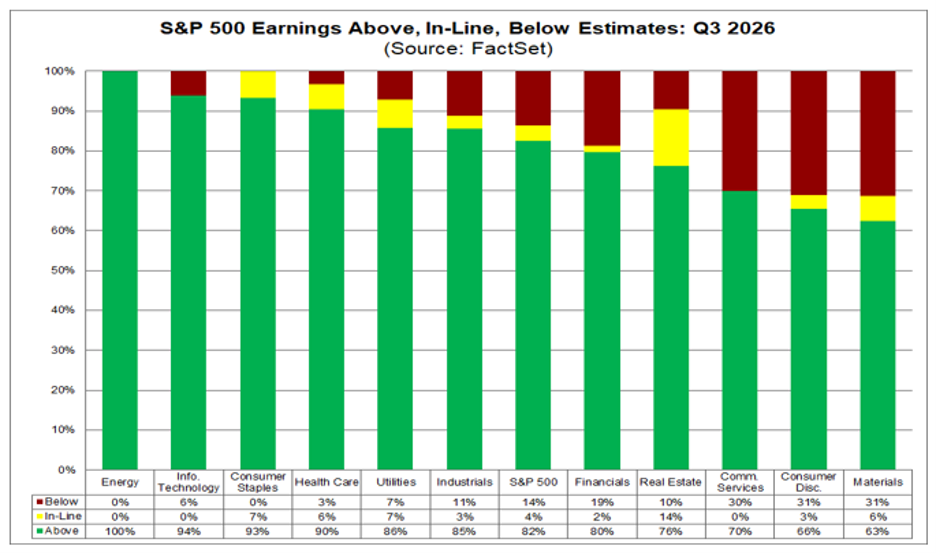
Third-quarter earnings season progressed substantially during October, with approximately 60% of S&P 500 companies reporting results by month-end. Corporate fundamentals remained strong, with 82% of companies exceeding earnings-per-share estimates, above the five-year average of 78%, while 70% exceeded revenue estimates, matching the five-year historical average.
Earnings growth also broadened across sectors, with all 11 S&P 500 sectors reporting positive year-over-year earnings growth, and 7 recording double-digit gains. However, performance remained uneven, with Energy and Information Technology contributing significantly to aggregate growth while several consumer-oriented sectors experienced more moderate expansion.
Sector Highlights
- Energy generated the strongest earnings growth of any S&P 500 sector, increasing 146.4% year-over-year alongside 28.5% revenue growth. Higher oil prices remained the primary driver, with refining and marketing earnings increasing by 536%, integrated oil and gas earnings rising by 138%, and exploration and production earnings advancing by 72%. The sector’s performance reflected the substantial impact of elevated commodity prices on energy profitability.
- Information Technology reported 67.5% earnings growth and 41.9% revenue growth, the strongest revenue expansion among all eleven sectors. Semiconductors and semiconductor equipment remained the primary growth drivers, with earnings increasing by 132% as demand for AI infrastructure and computing capacity continued to expand.
- Materials earnings increased 30.6%, while revenues advanced 8.5%. Metals and Mining led with 56% earnings growth, followed by Containers and Packaging at 41% and Chemicals at 25%.
- Communication Services reported 20.5% earnings growth alongside 16.0% revenue growth. However, the sector’s earnings growth estimate declined sharply from 51.5% at the end of September, reflecting significant non-operating investment losses and other one-time charges.
- Industrials earnings increased 20.4%, compared with 14.6% expected at the end of September, while revenues rose 10.9%. Stronger-than-anticipated results across industrial businesses contributed to upward earnings revisions, suggesting continued resilience despite elevated borrowing costs, input-price pressures, and uncertainty surrounding global economic activity.
- Financials reported earnings growth of 5.5%, compared with just 2.8% expected at the end of September, while revenues increased 7.1%. Better-than-expected results supported positive earnings revisions, although the sector’s net profit margin declined modestly to 20.2% from 20.5% a year earlier.
- Health Care earnings increased 5.2%, while revenues rose 5.3%. Earnings expectations improved during the final week of October following positive results across the sector. However, profitability remained under pressure, with the sector’s net profit margin at 7.9%, below its five-year average.
- Consumer Staples and Consumer Discretionary reported earnings growth of 5.1% and 2.9%, respectively. Revenue growth remained positive in both sectors, at 6.3% and 5.5%. However, Consumer Discretionary recorded the lowest revenue beat rate among all eleven sectors at 48%, suggesting uneven consumer demand and greater pressure on discretionary spending despite continued overall economic resilience.
Importantly, the combination of strong earnings growth and weakness in technology-oriented equities highlighted a growing distinction between corporate fundamentals and market valuations. While earnings continued expanding across most sectors, investors increasingly focused on the sustainability of future growth, capital efficiency, and the ability of companies to convert investment spending into meaningful free cash flow.
Forward Outlook
Forward earnings guidance remained relatively constructive despite increased market volatility. Of the 47 S&P 500 companies issuing fourth-quarter EPS guidance, 28 provided positive guidance and 19 issued negative guidance, representing approximately 60% positive and 40% negative guidance.
This marked the third consecutive quarter in which analysts raised earnings estimates during the first month, suggesting continued confidence in corporate profitability despite elevated macroeconomic uncertainty.
Analysts currently expect:
- Q4 2026 earnings growth: +28.4%
- Q4 2026 revenue growth: +13.1%
- Full-year 2026 earnings growth: +32.9%
- Full-year 2026 revenue growth: +13.0%
- Full-year 2027 earnings growth: +16.3%
- Full-year 2027 revenue growth: +9.6%
Looking into 2027, earnings growth is expected to moderate from 2026’s unusually strong pace, although Information Technology (+42.3%) and Health Care (+22.6%) are projected to remain significant contributors to growth. Meanwhile, Energy and Communication Services face more challenging year-over-year comparisons, with analysts anticipating earnings declines across both sectors.
Market Performance
Equities
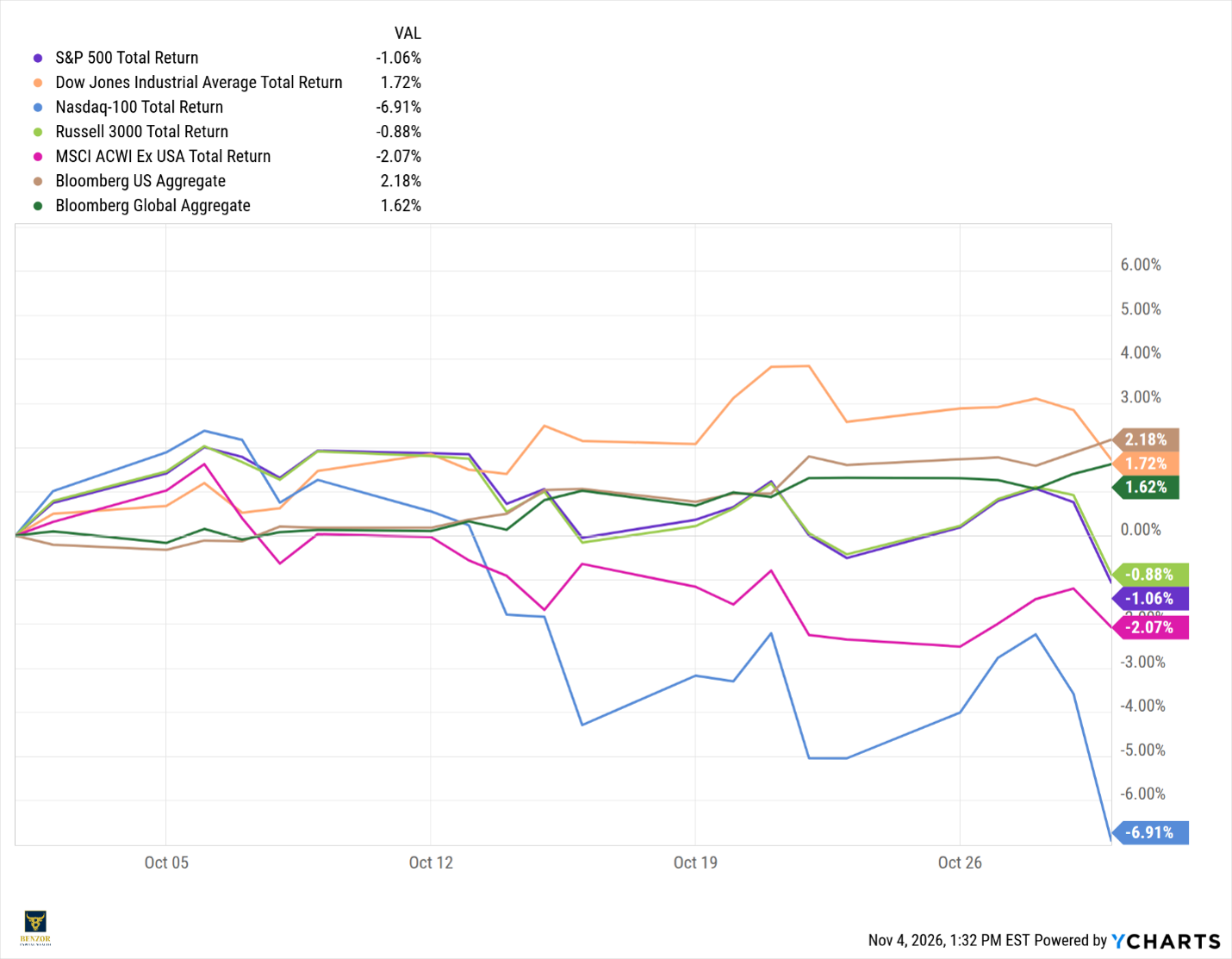
U.S. equity markets experienced a significant shift in leadership during October, as weakness across large-cap technology and AI-related companies contrasted with greater resilience in defensive and value-oriented sectors. Following several months of technology-led market performance, investors increasingly reassessed elevated valuations, accelerating infrastructure expenditures, and the sustainability of future earnings growth.
Technology-sector sentiment weakened as concerns intensified around the scale of AI-related capital investment and the growing reliance on external financing to support infrastructure expansion. While underlying demand for cloud computing, semiconductors, and AI-related services remained strong, investors became increasingly focused on the timing of returns on investment, free cash flow generation, and whether future earnings growth would justify substantial capital spending commitments.
Third-quarter earnings reports contributed to this shift. Several major technology businesses announced elevated capital expenditure plans, prompting investors to reassess the relationship between revenue growth, profitability, and future financing requirements. The resulting market reaction suggested that strong headline earnings were no longer sufficient to support valuations without convincing evidence of sustainable cash flow and capital efficiency.
Sector performance reflected this shift in investor preferences. Energy, Consumer Staples, Utilities, and Health Care demonstrated relative strength as market participants sought to reduce exposure to highly valued growth companies and increase allocations toward businesses with more stable earnings, defensible cash flows, and lower sensitivity to changes in growth expectations.
Overall, October represented a significant reversal from September’s technology-led market environment. While corporate fundamentals remained relatively strong, investor priorities shifted toward earnings quality, capital efficiency, valuation discipline, and diversification. The month’s performance demonstrated that even companies operating in industries with attractive long-term growth prospects remain vulnerable when valuations and investment expectations move ahead of near-term financial returns.
Fixed Income
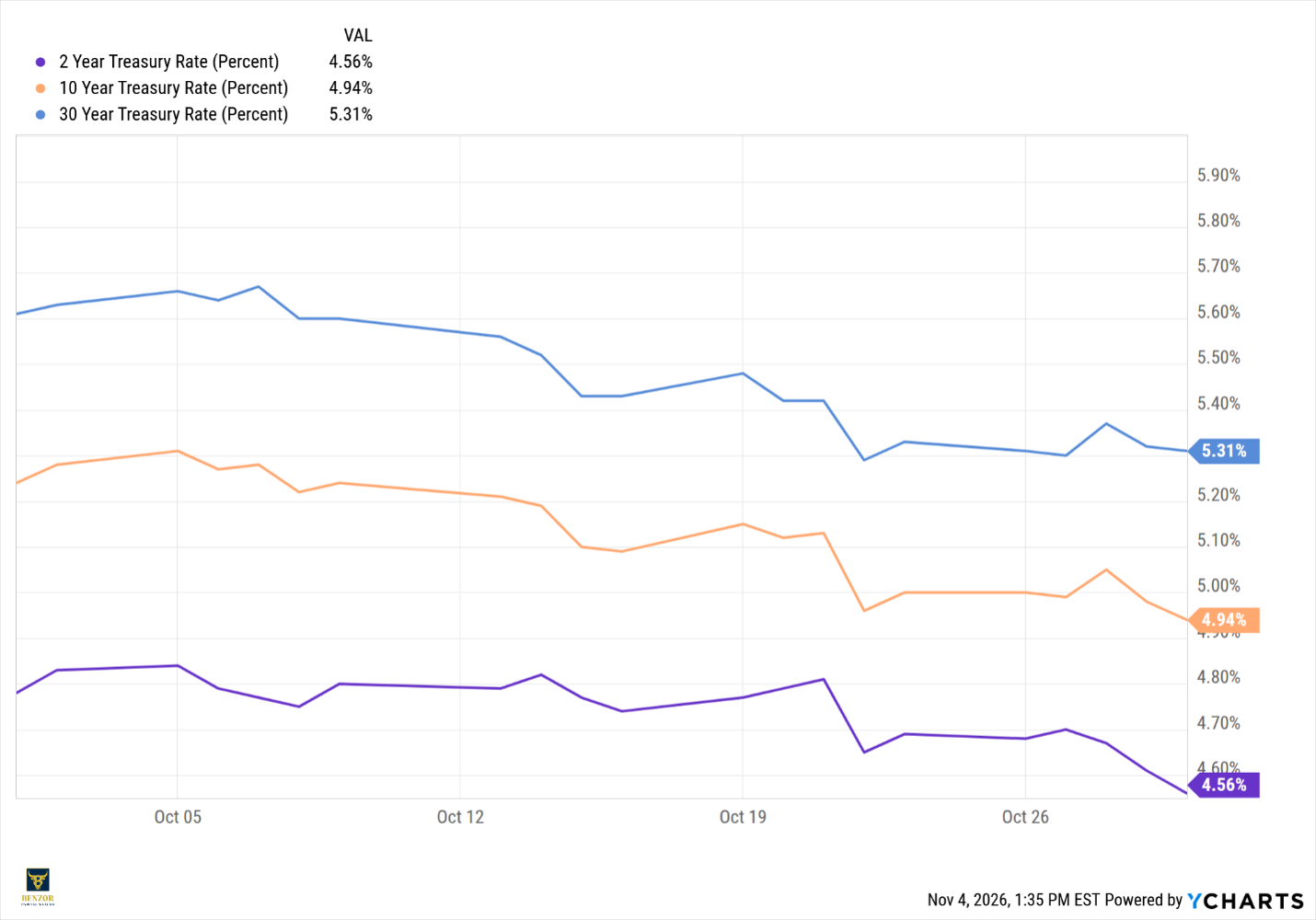
Fixed income markets experienced a strong recovery during October, reversing September’s losses as Treasury yields declined across the yield curve. The reversal reflected increased demand for government bonds amid heightened equity-market volatility, changing investor risk preferences, and continued uncertainty surrounding inflation and Federal Reserve policy.
The correction in technology and AI-related equities encouraged investors to reassess portfolio risk and increase exposure to assets offering greater stability and predictable income. This shift supported demand for U.S. Treasuries and contributed to a broad decline in yields across short-, intermediate-, and long-term maturities.
Federal Reserve expectations remained an important influence on bond-market performance. Although the central bank left interest rates unchanged at its October meeting, persistent inflation and elevated energy prices continued to support expectations that monetary policy could remain restrictive for an extended period. At the same time, slower hiring and increased equity-market volatility contributed to demand for government bonds.
Overall, October reinforced the importance of maintaining balanced fixed-income exposure. While Treasury yields remain sensitive to inflation data, fiscal conditions, and Federal Reserve expectations, the month’s recovery demonstrated the role that duration and high-quality bonds can play in offsetting periods of heightened equity-market volatility.
Commodities
Energy markets remained highly sensitive to geopolitical developments throughout October, particularly continued uncertainty surrounding Iran, the Strait of Hormuz, and broader Middle Eastern shipping conditions. Renewed military escalation and threats to regional energy infrastructure supported crude oil prices, maintaining a substantial geopolitical risk premium.
Oil prices increased materially during the month as concerns surrounding production disruptions, shipping security, and the potential for further regional escalation outweighed expectations for near-term supply normalization. The continued conflict around the Strait of Hormuz and Bab al-Mandeb reinforced the vulnerability of global energy markets to disruptions across multiple major transportation routes.
The impact of higher energy prices extended beyond commodity markets. Rising crude oil and refined-product costs increased transportation, manufacturing, and production expenses while placing additional pressure on household purchasing power. These developments contributed to stronger headline inflation and raised concerns about the possibility of more persistent price pressures.
Energy markets also remained closely connected to Federal Reserve expectations. Sustained elevated oil prices could complicate progress toward the central bank’s inflation target, increasing the likelihood that monetary policy remains restrictive for longer. However, despite the inflationary impact of higher energy prices, increased demand for government bonds during October contributed to declining Treasury yields.
Overall, October highlighted the continued importance of geopolitical developments in determining commodity prices and inflation expectations. Energy supply risks remained a significant source of uncertainty for financial markets, with potential implications for corporate profitability, consumer spending, monetary policy, and global economic growth.
Housing
The U.S. housing market remained under pressure during October as elevated mortgage rates, persistent affordability challenges, and weakening buyer demand continued to constrain residential activity. Although borrowing costs eased toward month-end, the average 30-year fixed mortgage rate finished October at 7.24%, compared with 6.17% a year earlier, maintaining a significant financing burden for prospective homeowners.
Existing-home sales showed modest improvement in the latest available data, increasing 1.5% in September to a seasonally adjusted annual rate of 3.99 million. However, sales remained 2.2% below year-earlier levels, indicating that overall transaction activity continued to be constrained by elevated borrowing costs and affordability pressures.
Forward-looking demand weakened more substantially. Pending home sales declined 7.3% month-over-month and 11.3% year-over-year in September, with contract signings falling across all four major U.S. regions.
Residential construction also weakened. September housing starts declined 5.2% to an annualized pace of 1.22 million units, while building permits fell to approximately 1.40 million.
Home prices nevertheless remained relatively resilient despite subdued transaction activity. The S&P Case-Shiller National Home Price Index increased 2.1% year-over-year in August, although appreciation continued to lag the broader inflation rate. Slower price growth provided some relief to affordability pressures, but elevated financing costs and high absolute home prices continued preventing a meaningful recovery in housing demand.
The divergence between weakening sales activity and relatively stable home prices highlighted the structural challenges facing the housing market. Limited affordability and elevated mortgage rates continued suppressing demand, while the reluctance of existing homeowners with lower mortgage rates to sell helped prevent a more substantial increase in available supply.
Overall, October continued to demonstrate the housing market’s sensitivity to borrowing costs and household purchasing power. While declining Treasury yields toward month-end offered some potential relief, sustained improvement will likely depend on lower mortgage rates, improving affordability, and greater stability in consumer finances. Until those conditions materialize, residential activity is likely to remain subdued, with builders continuing to rely on incentives and pricing adjustments to support demand.
BCW Stance
October highlighted a shift in market sentiment as investors reassessed elevated technology valuations, accelerating AI-related capital expenditures, and the sustainability of future earnings growth. Despite increased volatility and weakness across growth-oriented equities, underlying corporate fundamentals remained resilient, with strong earnings growth and healthy profit margins continuing to support the broader market.
We believe corporate earnings remain an important foundation for market performance, although the widening divergence between earnings growth and stock-price reactions reinforces the importance of selectivity. While long-term investment opportunities in technology and artificial intelligence remain attractive, greater scrutiny of capital spending, financing requirements, and cash flow generation suggests that valuation discipline will become increasingly important. At the same time, persistent inflation, elevated energy prices, and a cautious Federal Reserve continue to present risks to the economic outlook.
Across asset classes, October reinforced the benefits of maintaining diversified portfolios. We continue to favor a balanced approach that maintains exposure to long-term growth opportunities while emphasizing earnings quality, attractive valuations, income generation, and prudent risk management.
Looking ahead, markets will navigate continued geopolitical uncertainty, the November midterm elections, incoming economic data, and evolving Federal Reserve policy expectations. Rather than attempting to anticipate short-term political or market outcomes, we remain focused on disciplined portfolio construction, appropriate diversification, and opportunities created by changing market conditions. We believe maintaining a long-term investment perspective while remaining responsive to shifts in market fundamentals will be essential as investors position for the remainder of 2026 and into 2027.