


Nicholas Benzor
Principal Planner & Chief Executive Officer

Sanskar Raheja
Investment and Financial Planning Intern

Loveth Obozokhai
Investment and Portfolio Analyst Intern
Government Shutdown and Economic Impact
The United States recently emerged from a 43-day federal government shutdown, which concluded on November 13, 2025—now the longest shutdown on record. Although the government has resumed full operations, the economic and market impacts continue to unfold across multiple sectors. Transportation was among the most visibly affected areas. Airport operations faced staffing shortages, extended delays, and reduced processing capacity, weighing on airline profitability during a critical travel period. For carriers already navigating tighter margins, the shutdown amplified existing operational challenges. Household activity was also impacted. Over six weeks without pay placed financial strain on federal workers, resulting in softer discretionary spending. Although back pay has since been issued, the temporary loss of income reduced year-end consumption at a time when household savings remain historically thin. Perhaps the most significant macroeconomic consequence was the delay in federal data reporting. Investors operated with limited visibility into official inflation, labor, and output metrics throughout much of Q4. With agencies now catching up, the December 18 inflation report is expected to be a major market mover as markets recalibrate expectations for early 2026.
Federal Reserve Outlook and Policy Evolution into Year-End
The Federal Reserve continued its measured pivot toward policy easing in the second half of 2025. After reducing rates by 25 basis points in September to 4.00%–4.25%, the Fed cut rates again at its October 29 meeting, lowering the target range to the current 3.75%–4.00%. These adjustments reflect rising concerns about slowing labor market momentum, moderating inflation, and the economic drag created by the prolonged shutdown.
Market expectations point toward another round of easing at the December 10 meeting. The CME FedWatch Tool (as of November 30) shows:
- 4% probability of a cut to 3.50%–3.75%
- 6% probability of no change
- 0% probability of a hike
This marks a significant increase in confidence compared with earlier in the fall, reflecting:
- Unemployment rising to 4.4%
- Softer wage growth
- Shutdown-related weakness in consumption
- Inflation trending closer to target
These developments align with the shift we identified in September, when the Fed’s Summary of Economic Projections began emphasizing employment risks more heavily than inflation persistence. Markets now expect additional cuts in March 2026, with the potential for another by mid-summer, which would place the federal funds rate closer to 3.00%–3.25% by the end of next year.
Inflation and Employment Landscape
Labor market conditions have begun to soften meaningfully. The unemployment rate has risen to 4.4%, marking a notable shift after several years of historically tight conditions. While the unemployment rate still is below the 5% rate threshold deemed by many economists as “cautionary”, Job openings have declined, hiring rates have slowed, and wage pressures have eased signs that the labor market is finally cooling in response to tighter financial conditions earlier in the cycle. Inflation remains above target but continues to moderate. Goods inflation remains subdued, while services inflation—particularly in shelter—continues to decline gradually. In an attempt to provide reprieve on consumer pricing, the current Trump Administration has cut tariffs on goods such as coffee, bananas, beef, and orange juice, among many other goods. Markets are highly focused on the December 18 inflation report, which will provide one of the first uninterrupted data points since the government reopened.
Market Performance
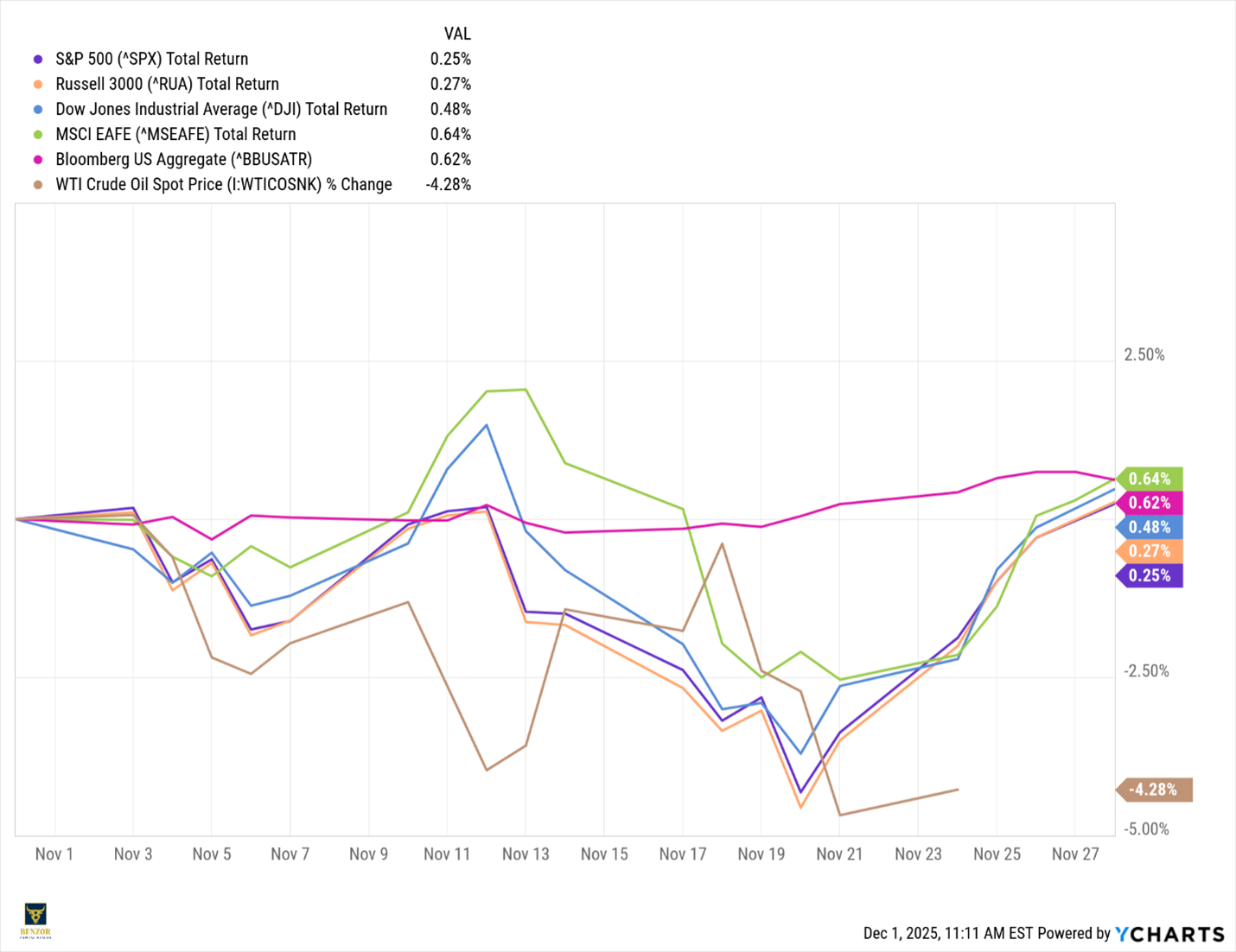
Overview U.S. equity markets displayed a dynamic performance throughout November, marked by strong early gains, a sharp bout of mid-month volatility, and a powerful rebound in the final weeks of the month.
The month began on solid footing, with the S&P 500, Nasdaq Composite, and Dow Jones Industrial Average extending their upward trajectory from prior months. Investor sentiment was supported by easing inflation pressures, and strong corporate earnings cycle.
Between November 13 and November 18, markets experienced meaningful turbulence. Concerns about an emerging “AI bubble” and stretched valuations within large-cap technology triggered a broad sell-off, causing the Dow Jones to fall nearly 800 points during the period.
Markets recovered sharply in the final week of November. The rebound was driven in large part by Nvidia, which reported an exceptional 62% year-over-year revenue increase, significantly surpassing analyst expectations. Nvidia’s results helped restore investor confidence and reignited momentum across major indices.
International equities posted modest gains in November, with the MSCI EAFE rising 0.64% for the month. Fixed income delivered positive performance, supported by falling yields as expectations for near-term Federal Reserve rate cuts strengthened. The Bloomberg U.S. Aggregate Bond Index gained 0.62%. Commodities remained weak in November, though the decline moderated compared to October. WTI crude oil fell 4.28% for the month, an improvement from the 6.79% drop recorded in October, as softer global demand expectations and elevated inventories continued to pressure energy markets.
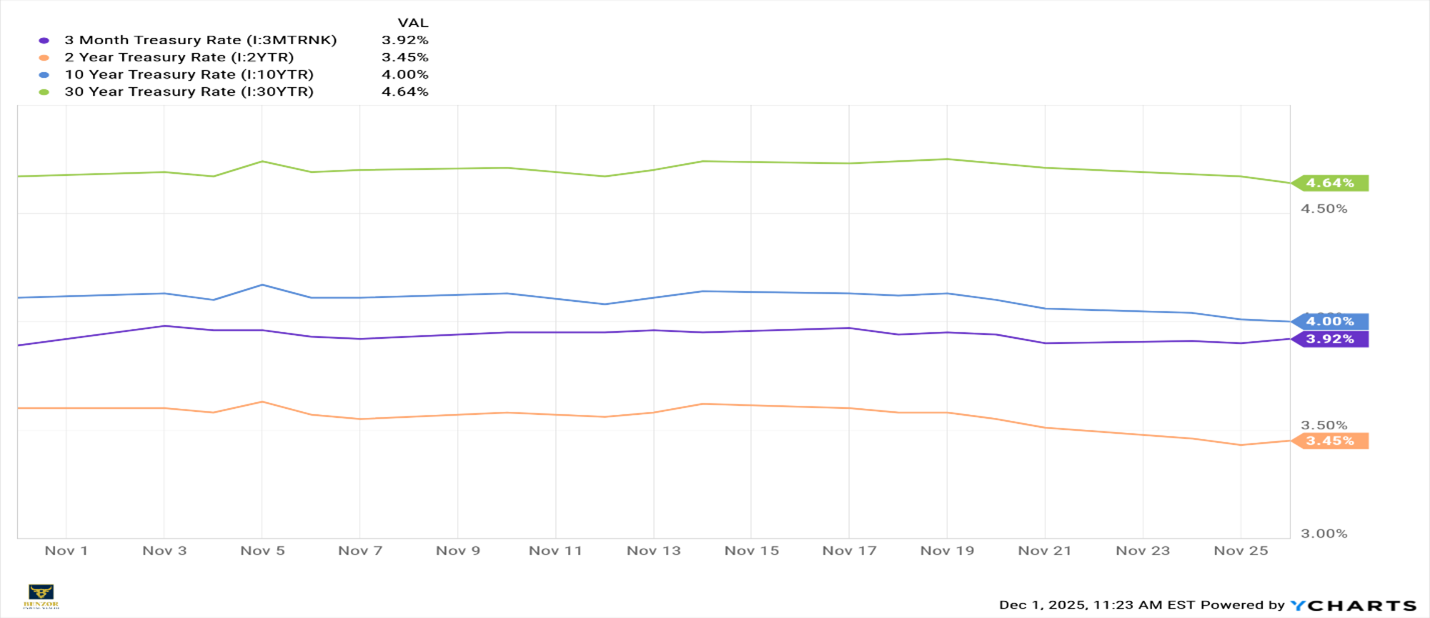
Treasury yields moved modestly lower across the curve in November, reflecting a continued shift in market expectations toward a December rate cut and softer macroeconomic conditions.
Earnings Overview: S&P 500, MAG 7 and SMID
S&P 500 earnings remained strong through November, with results tracking well above historical averages. As of November 7, 91% of companies had reported Q3 results, and 82% delivered earnings above estimates—exceeding both the 5-year (78%) and 10-year (75%) averages. The magnitude of earnings beats came in at 7.0%, matching the 10-year average.
The blended earnings growth rate for Q3 rose to 13.1%, marking the fourth consecutive quarter of double-digit year-over-year earnings growth. Revenue performance was also solid: 77% of companies beat revenue expectations, and the blended revenue growth rate improved to 8.3%, the strongest since Q3 2022.
Earnings strength was broad-based, led by Information Technology, Financials, Utilities, Materials, and Industrials, while Communication Services remained the primary laggard. Forward expectations remain constructive, with analysts projecting earnings growth of 7.5% in Q4, and 11.6% for full-year 2025. The forward 12-month P/E of 22.7 remains above long-term averages.
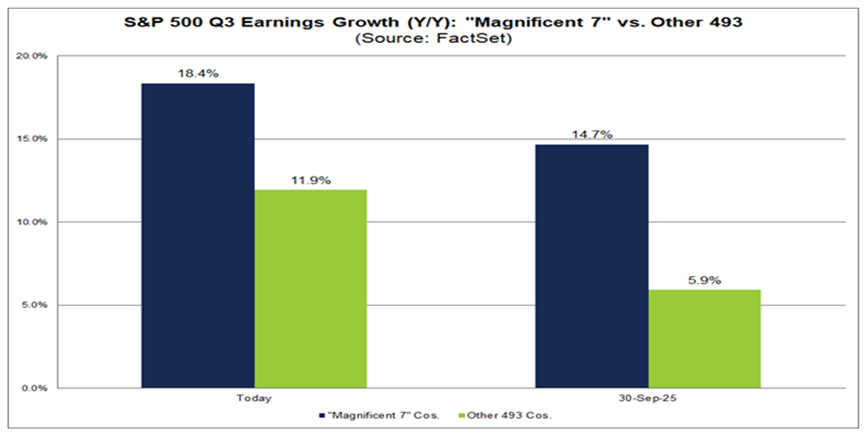
The “Magnificent 7” posted their weakest collective earnings growth since Q1 2023, delivering an aggregate increase of 18.4%—well below their recent four-quarter average of 28.8%. In aggregate, earnings reported by the “Magnificent 7” companies exceeded estimates by 2.6%, compared to 6.6% for all S&P 500 companies.
Much of the moderation was attributable to Meta Platforms, which reported a substantial negative EPS surprise ($1.05 vs. $6.72) due to a one-time, non-cash income tax charge of $15.93 billion. This event materially reduced the group’s aggregate earnings growth. Excluding Meta, the remaining six companies would have posted a substantially stronger 30.4% growth rate.
Despite the softer headline number, Nvidia, Alphabet, Amazon, and Microsoft remained among the largest positive contributors to S&P 500 earnings growth for the quarter, highlighting the continued influence of mega-cap technology leadership.
Earnings for small- and mid-cap companies were more varied, as these firms tend to be more sensitive to financing costs and economic uncertainty. While Many SMID companies posted solid results, the segment did not match the strength of large-cap earnings. Performance was overshadowed by volatility linked to concerns about tech valuations, with SMIDs participating in the late-month rebound but to a lesser degree than large-cap technology.
2026 Outlook: Guidance, Market Targets & Rate Environment
Looking ahead to 2026, market guidance remains constructive, supported by expectations of steady earnings growth, cooling inflation, and an increasingly accommodative Federal Reserve. Wall Street strategists maintain a broadly optimistic stance, with most forecasting continued gains across major equity indices as macro conditions stabilize.
Consensus targets for the S&P 500 generally fall in the 7,500–7,800 range for year-end 2026 indicating a bullish outlook for the index. Nasdaq projections also mirrors this optimistic tone, with analysts expecting another year of strong performance driven by secular growth in cloud computing, artificial intelligence, and enterprise spending.
The rate environment remains a central pillar of the 2026 outlook. Markets continue to price in additional Federal Reserve cuts, with expectations that the policy rate could trend toward the 3.00%–3.25% range by mid- to late-2026. A lower rate backdrop should ease financing conditions, support capital spending, and provide a meaningful tailwind for rate-sensitive segments such as small- and mid-cap equities, housing, and industrial activity. BCap Wealth continues to monitor these industries and see them as great industry opportunities for 2026.