


Nicholas Benzor
Principal Planner & Chief Executive Officer
Table of Contents
- Geopolitical Tensions
- Employment, Inflation, & the Fed
- Earnings Report & Forward Guidance
- Market Performance
- Equities
- Fixed Income
- Commodities
- BCW Stance
June 2026 Market Commentary
Benzor Capital Wealth
Geopolitical Tensions
The Middle East remained the dominant geopolitical driver for markets during the month as developments surrounding U.S.–Iran negotiations and regional military actions drove volatility across energy and rates markets. Investor sentiment shifted multiple times throughout the month between expectations of de-escalation and renewed concerns after additional U.S. strikes in southern Iran disrupted optimism around peace negotiations. Markets remained highly focused on the Strait of Hormuz given its importance to global energy transportation and the potential impact of reopening shipping routes.
Energy markets experienced significant volatility as oil prices moved sharply based on changing expectations around negotiations and supply restoration. Brent crude briefly moved back toward the $100 per barrel level during periods of escalation before retreating on renewed deal expectations. Progress in diplomatic discussions later in the month temporarily reduced energy concerns, leading to declines in oil prices as markets began pricing lower probabilities of prolonged disruption. Despite signs of improving negotiations, markets remained cautious as shipping normalization and energy supply recovery were expected to take time even under a successful agreement scenario.
While higher oil prices continue influencing global inflation expectations, the U.S. remains better positioned than many developed economies due to its role as the world’s largest oil producer. U.S. crude production averaged approximately 13.5 million barrels per day during 2025 representing roughly one-fifth of global production and the country has remained a net exporter of petroleum products in recent years. As a result, domestic energy markets are less vulnerable to supply disruptions than many import-dependent regions, though global oil prices continue to influence transportation costs, inflation expectations, and consumer spending.
Higher oil prices became the primary transmission mechanism into broader markets, increasing concerns around transportation costs, inflation persistence, and the potential impact on monetary policy expectations. Treasury yields and inflation expectations reacted alongside oil price movements as investors reassessed the likelihood and timing of future Federal Reserve easing.
Equity markets remained resilient despite geopolitical headlines, supported by continued strength in earnings and large-cap growth sectors, though risk appetite remained sensitive to geopolitical developments. Going forward, markets will likely remain focused on progress in regional negotiations, stability of energy supply routes, and whether elevated energy prices begin translating into broader inflation pressure.
Employment, Inflation & the Fed
Economic data released during the month presented a mixed backdrop, with labor conditions continuing to moderate while inflation pressures accelerated and shifted market expectations around monetary policy. The Employment Situation Report showed payroll growth slowed to +115k, unemployment increased to 4.3%, and wage growth moderated to +0.2% MoM / +3.6% YoY, supporting the view that labor markets continue normalizing rather than deteriorating.
JOLTS data showed job openings remained stable at 6.9 million, while hires increased to 5.6 million, indicating labor demand remained resilient despite slower headline employment growth. Quits totaled 3.2 million and layoffs and discharges remained contained at 1.9 million. Weekly labor data also remained constructive, with initial jobless claims remaining near cycle lows and continuing claims declining to 1.782 million, below expectations and reinforcing the view that layoffs remain limited despite restrictive policy conditions.
Inflation returned to the center of market focus during the month following stronger-than-expected price data. CPI accelerated to +0.6% MoM and +3.8% YoY, marking the highest annual reading since May 2023. Energy prices increased +3.8% MoM and accounted for more than 40% of the monthly headline increase. Core CPI remained comparatively more stable at +0.4% MoM and +2.8% YoY, suggesting underlying inflation continued improving despite renewed pressure from energy-related categories.
Producer inflation strengthened further, with PPI increasing +1.4% MoM and +6.0% YoY, reflecting broad-based cost pressures across goods and services. Finally, demand goods increased +2.0%, supported by energy (+7.8%) and gasoline (+15.6%), while final demand services increased +1.2%, representing the largest increase since March 2022. The Personal Consumption Expenditures (PCE) index — the Federal Reserve’s preferred inflation measure — was released on May 28, with April headline PCE coming in at +0.4% MoM and +3.8% YoY, while core PCE (ex-food and energy) rose +0.2% MoM and +3.3% YoY. Both monthly readings came in at or below consensus expectations, offering tentative evidence that the energy-driven inflation shock may be beginning to moderate from March’s elevated pace. Annual rates nonetheless remain well above the Fed’s 2% target, reinforcing the higher-for-longer policy environment..
As of late May, CME FedWatch reflected markets pricing a near-certain hold at the June 16–17 FOMC meeting, with near-term rate cut expectations largely removed following hotter inflation data and the transition to new Federal Reserve leadership. Investors continued adjusting to Kevin Warsh’s appointment as Federal Reserve Chair, with his policy stance viewed as more hawkish on inflation and supportive of continued balance sheet normalization. While Chair Warsh may influence the direction of policy discussions, Federal Reserve decisions remain committee driven. With Jerome Powell remaining on the Board of Governors and several members continuing to express caution around inflation risks, markets increasingly recognize that achieving a majority in favor of policy easing may prove more difficult in the near term, reinforcing expectations that rates could remain elevated for longer than previously anticipated.
Going forward, markets will likely remain focused on whether inflation pressures—particularly energy-driven inflation—begin moderating while labor market conditions continue gradually normalizing.
Earnings Reports and Forward Guidance
Earnings Snapshot
Q1 2026 earnings season served as one of the strongest positive offsets for equity markets during the month despite higher inflation, restrictive monetary policy, and geopolitical uncertainty.
As of late May, approximately 94% of S&P 500 companies had reported results, with 84% exceeding EPS estimates, remaining above both the 5-year average (78%) and 10-year average (76%) and marking the highest beat rate since Q2 2021. Reported companies delivered approximately 28.4% year-over-year earnings growth, representing the strongest earnings growth environment since Q4 2021 and extending the trend of broad corporate resilience.
Revenue trends also remained constructive, with approximately 81% of companies exceeding revenue expectations, reflecting continued resilience in underlying demand. Profitability remained a major strength and continued to be supported by pricing power, AI and infrastructure investment, margin discipline, operational efficiencies, and continued resilience in consumer and enterprise spending.
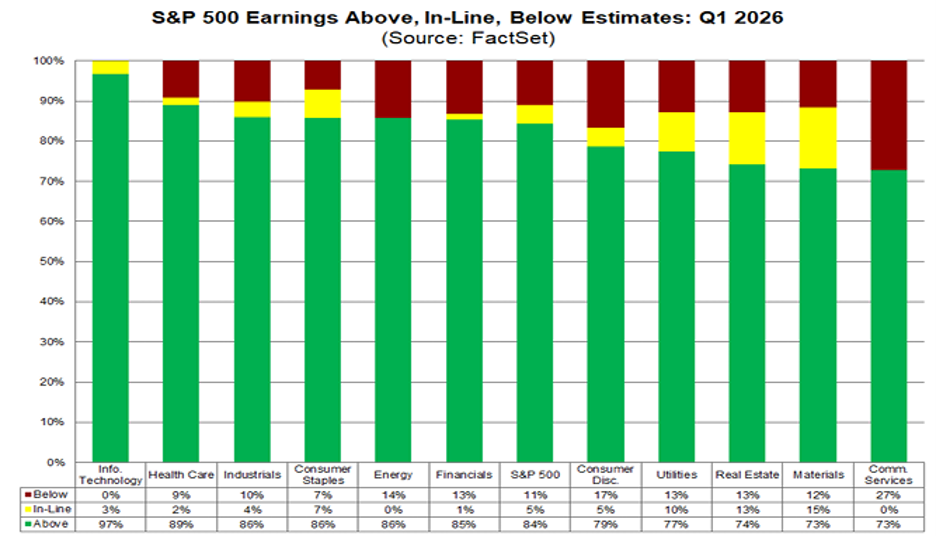
Sector-Wide Overview
Technology remained the dominant earnings growth driver, supported by semiconductor demand, AI deployment, hyperscaler spending, enterprise software, and digital infrastructure investment. Continued acceleration in capital expenditure plans and monetization of AI-related investment remained important contributors to both revenue growth and margin expansion.
Communication Services continued outperforming through advertising strength, platform monetization, and broader large-cap ecosystem performance. Digital advertising demand and improving engagement trends continued supporting earnings growth across major platform businesses.
Financials delivered solid results supported by resilient credit conditions, stable profitability, and improved capital markets activity. Higher-for-longer interest rates continued supporting net interest income while deal activity and market participation improved from prior periods.
Consumer Discretionary remained constructive overall, although sector performance reflected increasing divergence across consumer segments and spending categories. Sector performance was also partially influenced by one-time and policy-related items, suggesting underlying demand conditions may be somewhat softer than headline growth figures imply.
Health Care continued providing stable defensive earnings support amid broader macroeconomic uncertainty. Demand remained supported by structural healthcare spending trends and continued emphasis on efficiency and innovation.
Industrials continued benefiting from infrastructure spending, aerospace and defense demand, manufacturing investment, and reshoring activity. Order backlogs and continued capital investment remained supportive of forward revenue visibility across the sector.
Energy remained supported by elevated oil prices, though forward outlooks became increasingly sensitive to commodity volatility and geopolitical developments. Companies continued emphasizing capital discipline and shareholder returns rather than aggressively expanding production.
Importantly, earnings strength broadened meaningfully beyond large-cap technology, helping support broader market participation and reinforcing market resilience.
Forward Outlook
Forward guidance remained mixed-to-constructive, with management commentary becoming incrementally more cautious despite strong historical results. For Q2, guidance remained nearly evenly split between companies issuing positive and negative outlook revisions, suggesting companies remain constructive but increasingly selective in forward expectations.
Management commentary increasingly highlighted persistent inflation pressures, labor and wage costs, oil and commodity volatility, geopolitical uncertainty, elevated financing costs, and potential moderation in consumer spending as emerging risks. Analysts are currently projecting S&P 500 earnings growth of approximately 19.9% for Q2, 23.2% for Q3, and 20.7% for Q4, implying approximately 21.0% full-year 2026 earnings growth expectations. Markets will likely focus increasingly on margin sustainability, breadth of earnings growth, and guidance durability rather than headline earnings beats alone.
Overall, Q1 earnings season materially exceeded expectations on both breadth and magnitude and remained an important driver supporting equity market resilience.
Market Performace
Equities
U.S. equity markets continued moving higher during May, supported by exceptionally strong Q1 earnings results, improving market breadth, and continued confidence in corporate fundamentals despite renewed inflation pressures and higher Treasury yields. Market performance remained resilient even as expectations for near-term Federal Reserve easing were pushed further out following stronger inflation data and the transition to new Federal Reserve leadership.
Market strength was driven by exceptionally strong Q1 corporate earnings, AI-driven technology leadership, broadening sector participation, continued economic resilience despite inflation pressures, and improving corporate profitability and margin durability. Growth-oriented sectors, particularly Technology and Communication Services, continued leading performance, supported by AI investment, semiconductors, digital infrastructure demand, and strong earnings delivery.
Broader market participation improved during the month, with Financials, Industrials, and select cyclical sectors contributing more meaningfully to overall returns rather than gains remaining concentrated within a narrow group of large-cap companies. Small- and mid-cap participation also improved modestly, though higher interest rate expectations continued creating a more challenging backdrop for rate-sensitive segments. Small-cap equities remained an important contributor during the year. While performance has experienced periods of interest-rate sensitivity, attractive relative valuations, improving earnings expectations, and broader market participation continue supporting the long-term case for the asset class. International equities participated in gains as well, although U.S. markets continued outperforming many global peers due to stronger corporate profitability, superior earnings momentum, and greater exposure to growth-oriented sectors.
Fixed Income
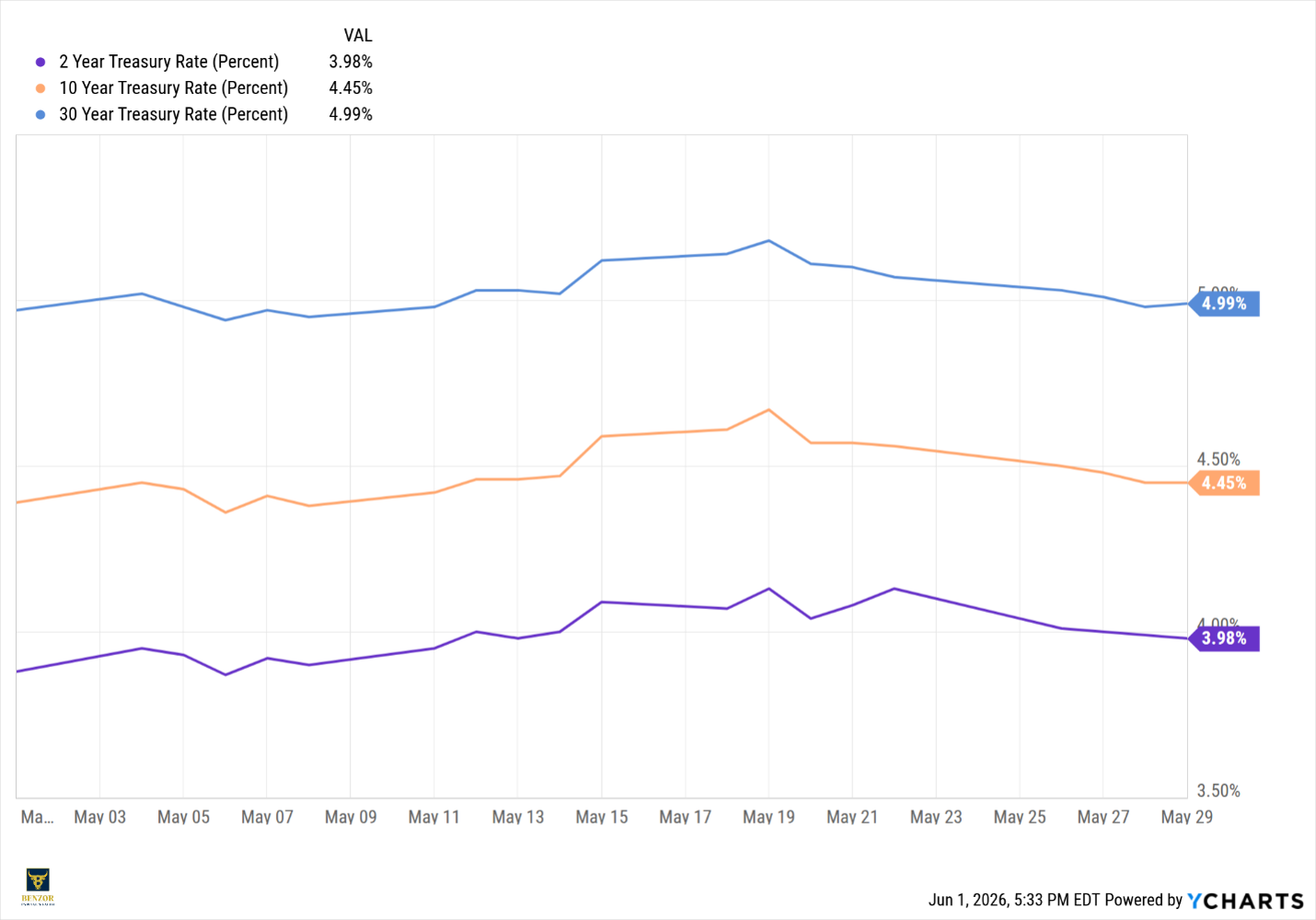
Fixed income markets remained under pressure during May as stronger inflation data, elevated oil prices, and reduced expectations for Federal Reserve easing pushed Treasury yields higher. Higher CPI and PPI readings alongside rising energy prices caused markets to reassess the pace of disinflation and increasingly shift toward a higher-for-longer interest rate environment.
Oil became an important transmission mechanism into bond markets during the month. Rising crude prices increased concerns around transportation, manufacturing, and broader input costs feeding into inflation, reducing confidence that price pressures would normalize quickly. As inflation expectations moved higher, investors pushed out expectations for rate cuts and Treasury yields moved higher across the curve, contributing to lower bond prices—particularly for longer-duration assets.
By month-end, Treasury yields remained elevated with the 2-Year Treasury at 4.01%, 10-Year Treasury at 4.50%, and 30-Year Treasury at 5.03%. The rise in long-end yields reflected markets demanding additional compensation for inflation uncertainty and duration risk rather than concerns around immediate economic weakness.
Commodities
Energy markets remained highly sensitive to geopolitical developments throughout May, with Middle East tensions and changing supply expectations contributing to elevated volatility. Oil prices became one of the most important macro variables during the month given their direct implications for inflation expectations, interest rate pricing, and consumer costs. Commodity market developments increasingly influenced broader market expectations around inflation persistence and Federal Reserve policy assumptions.
Gold faced a more complex dynamic during the month. While elevated inflation and geopolitical uncertainty would typically support bullion, expectations for tighter monetary policy and a higher-for-longer rate environment offset traditional safe-haven demand and weighed on performance.
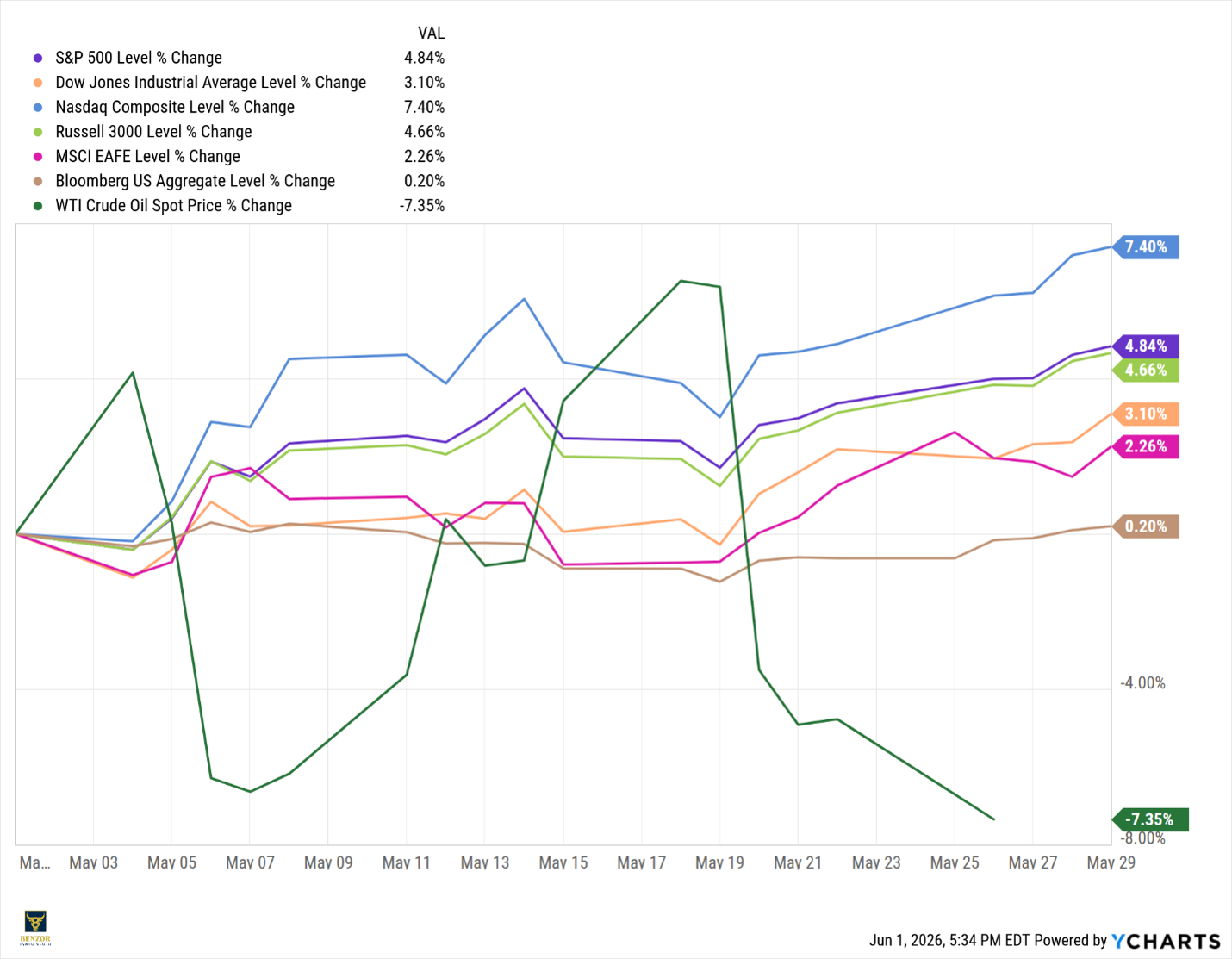
Market Performance (Month-To-Date)
- S&P 500: +4.84%
- Dow Jones Industrial Average: +3.10%
- Nasdaq Composite: +7.40%
- Russell 3000: +4.66%
- MSCI EAFE: +2.26%
- Bloomberg U.S. Aggregate Bond Index: 0.20%
- WTI Crude Oil: -7.35%
Housing
Housing activity remained constrained during the month as elevated mortgage rates continued weighing on affordability despite resilient labor markets and stable consumer conditions. At the same time, several housing indicators suggested conditions may be stabilizing rather than deteriorating further.
Mortgage markets became increasingly sensitive to inflation expectations and Treasury market movements, with the average 30-year fixed mortgage rate increasing to 6.51% as of May 21, reaching the highest level in roughly nine months. Higher mortgage rates largely reflected upward movement in longer-duration Treasury yields following stronger inflation data and reduced expectations for near-term Federal Reserve easing.
Existing home sales showed modest improvement during the month, increasing 0.2% month-over-month to a seasonally adjusted annual rate of 4.02 million units, broadly in line with expectations and suggesting housing demand remained more resilient than financing conditions alone would imply.
Home prices remained resilient despite slower transaction activity, with the median existing home price reaching $417,700, increasing 0.9% year-over-year and marking the 34th consecutive month of annual home price appreciation, highlighting continued supply-demand imbalance across many markets. Although prices increased year over year, we see the overall trend of home prices moderating to more normalized levels following the COVID spike in home pricing.
Construction activity remained mixed. Total housing starts came in above expectations, though underlying composition showed some softness as single-family housing starts declined 9.0% month-over-month to 930,000 units, reflecting continued sensitivity to financing costs and affordability pressures.
A divergence within housing markets continued to emerge, where higher-end and cash-supported demand remained relatively resilient while affordability pressures continued weighing more heavily on entry-level and mortgage-sensitive buyers. This dynamic continued contributing to uneven activity across regions and price segments.
Going forward, markets will likely focus on whether moderating inflation and stabilization in Treasury yields can improve affordability conditions, lower mortgage financing pressure, and support a broader recovery in housing activity.
BCW Stance
Markets continued to demonstrate resilience during the month despite a more challenging macroeconomic backdrop marked by elevated inflation, higher interest rate expectations, geopolitical uncertainty, and tighter financial conditions. Strong corporate earnings, healthy profitability, resilient consumer activity, and stable labor market conditions remained important supports for market performance even as expectations for policy easing moderated.
While recent market gains have been supported by improving earnings breadth and continued investment in long-term growth drivers, elevated valuations in select areas and a higher-for-longer interest rate environment continue reinforcing the importance of maintaining a disciplined investment approach. Importantly, earnings growth has broadened beyond a narrow group of large-cap companies, supporting a healthier and more balanced market environment than observed in prior years.
Across asset classes, market leadership may continue evolving as economic conditions and policy expectations adjust. We continue emphasizing diversification across asset classes, sectors, investment styles, and market capitalizations while maintaining a selective approach to opportunities supported by durable fundamentals and long-term growth characteristics. We continue to see attractive opportunities in areas of the market where valuations remain reasonable relative to underlying earnings potential and where improving participation supports a broader market advance.
As always, we remain focused on disciplined portfolio construction and avoiding reactive positioning decisions, recognizing that periods of volatility can create both challenges and opportunities for long-term investors.