

Introduction
July marked a pivotal month across global markets, policy arenas, and the investment landscape. Trade negotiations, monetary policy expectations, and groundbreaking legislation all converged to shape sentiment and strategy. Markets responded favorably to strong corporate earnings, resilient economic data, and continued enthusiasm around innovation—particularly in artificial intelligence and digital finance. Meanwhile, the signing of the “One Big Beautiful Bill” and the GENIUS Act signaled major shifts in fiscal and regulatory priorities, with implications for taxation, capital investment, and the digital asset ecosystem. At the same time, ongoing tariff negotiations and evolving inflation dynamics continued to influence the Federal Reserve’s cautious stance, with rate cuts now expected later in the year—if not deferred to 2026. Against this backdrop, Benzor Capital Wealth remains focused on disciplined portfolio construction, balancing opportunity with risk, and aligning client strategies with the structural trends shaping the economy and markets.

Nicholas Benzor
Principal Planner & Chief Executive Officer

Sanskar Raheja
Investment and Financial Planning Intern

Loveth Obozokhai
Investment and Portfolio Analyst Intern
As the global trade landscape continues to shift, key developments are unfolding ahead of the U.S.–China 90-day tariff pause expiration on August 1. Despite sustained negotiations, no comprehensive deal has been finalized with China, though a limited agreement on rare-earth and magnet exports was reached in June. Japan made notable progress, announcing a finalized trade agreement on July 22, while deals with the UK and India are advancing steadily. Meanwhile, the European Union remains at an impasse, with no formal resolution in place; EU officials are preparing retaliatory measures should talks collapse. In Southeast Asia, Vietnam has secured a framework agreement that sets tariffs at 20%—or 40% for trans-shipped goods—down from the previously threatened 46%, offering some stability for regional trade. However, broader uncertainty persists as Brazil, Canada, and Mexico remain in ongoing diplomatic talks without finalized agreements. As these negotiations continue to unfold, BCW remains vigilant, positioning portfolios with resilience and agility to navigate the evolving macroeconomic environment.
Big Beautiful Bill
The “One Big Beautiful Bill” was officially signed into law on July 4, 2025, marking a significant transformation in U.S. tax and fiscal policy. The legislation extends current tax brackets, enhances the standard deduction, and temporarily raises the SALT deduction cap to $40,000 for 2025–2026, giving high-income households in high-tax states more take-home income for the next two years, with a higher phase-out for higher-income taxpayers. The cap returns to lower levels after 2029. It also restores immediate expensing for capital investments, extends R&D tax credits, and makes the 20% qualified business income deduction permanent, with expanded income thresholds. Families benefit from a child tax credit of $2,200 per child, while education and workforce development are supported through expanded Pell Grant eligibility. On energy, the bill shifts priorities toward nuclear, and fossil fuel projects, maintains clean energy incentives, and makes the Opportunity Zone program permanent to foster long-term investment in underserved communities. The estate tax exemption will rise to $15 million in 2026. While these measures are expected to stimulate investment, consumer spending in the short term, they are projected to increase the federal deficit by $3.3–$3.5 trillion over the next decade, which could elevate borrowing costs and complicate the debt ceiling by intensifying fiscal pressures.
On July 18th the U.S solidified its leadership in digital finance with the signing of the GENIUS Act, the first federal framework for payment of stablecoins. The Act introduces a national licensing system for issuers, mandating full 1:1 reserve backing in the US dollars or short-term treasuries and aligns federal and state rules to eliminate regulatory fragmentation. Importantly, it strengthens consumer protection by granting stablecoin holders’ priority over other creditors in the event of insolvency and subject issuers to the Bank Secrecy Act, mandating full AML/KYC compliance. The GENIUS Act is part of a broader legislative push that includes the CLARITY Act, which defines when digital tokens transition from securities to commodities, and the Anti-CBDC Surveillance State Act, which prohibits the federal reserve from issuing a retail central bank digital currency. Together, these laws form a coordinated framework aimed at securing US dominance in digital finance while safeguarding innovation, privacy and the foundational role of the US dollar.
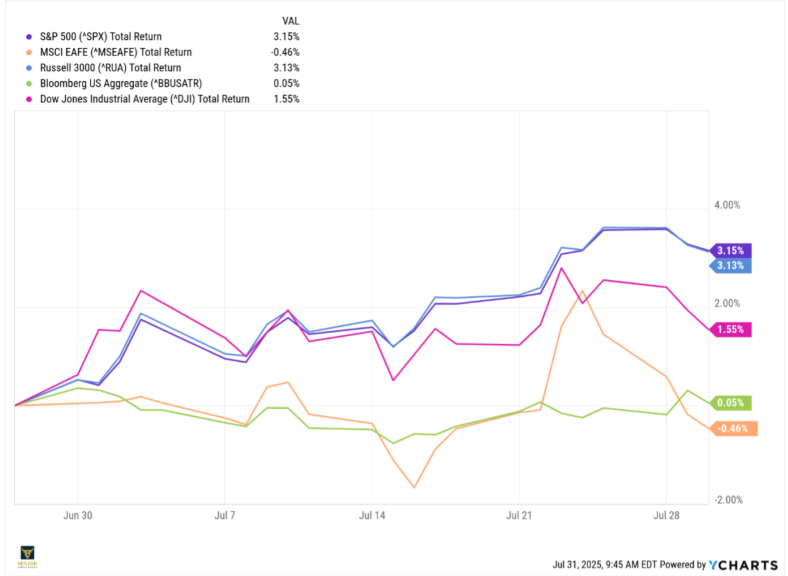
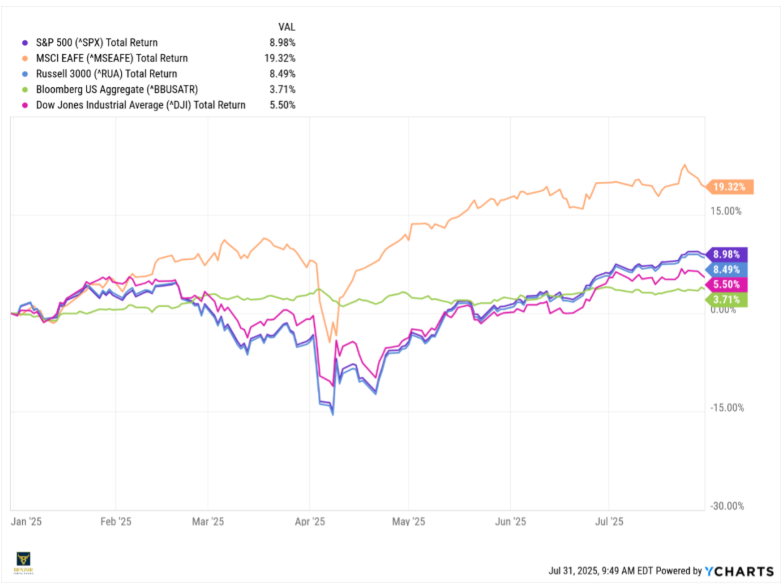
The U.S equity market advanced in July, with major indices continuing their upward trajectory on the back of strong corporate earnings, resilient economic data, and persistent enthusiasm around artificial intelligence and tech innovation. The S&P 500 climbed 3.15% month-to-date and is now up 8.98% year-to-date, reaching new highs as investor sentiment was buoyed by widespread earnings beats and optimism around future growth. The Russell 3000 mirrored this strength, rising 3.13% in July and 8.49% YTD, reflecting broad-based participation across sectors and market capitalizations.
The Dow Jones Industrial Average posted a 1.55% gain for the month and is up 5.50% YTD. It peaked within the month with a 2.8% gain before retreating slightly due to renewed concerns over Federal Reserve policy, softening consumer sentiment, and fresh tariff announcements targeting Asian trade partners. Despite this pullback, the index remained supported by strength in the industrial and financial sectors.
International equities were more mixed. The MSCI EAFE Index, which tracks developed markets outside the U.S. and Canada, ended the month with a modest -0.46% return but remains up an impressive 19.32% YTD. The index rallied within the month but gave back gains due to technical resistance, renewed trade tensions, and inflation concerns in Europe. Still, improving macroeconomic conditions in Japan and parts of Europe provided some support.
In fixed income, the Bloomberg U.S. Aggregate Bond Index posted a slight 0.05% gain for July and is up 3.71% YTD. While Treasury yields rose mid-month, weighing on bond prices, the index benefited from stable credit spreads and continued demand for high-quality fixed income. The bond market remained relatively muted as investors awaited clearer signals from the Federal Reserve regarding future rate policy.
Overall, July’s market performance was underpinned by a strong second-quarter earnings season, with a majority of reporting companies exceeding expectations. Positive surprises in retail sales and labor market data reinforced optimism around a potential soft landing, while momentum in mega-cap tech and AI-linked companies continued to drive index-level gains.
The second quarter earnings season continued to unfold with notable strength across several sectors, offering a clearer picture of the current economic landscape. Financials, Communication Services, and Information Technology led the way, supported by higher net interest income, digital advertising strength, and AI-driven growth. This momentum was echoed in consumer-facing sectors, where spending remained resilient, particularly in travel and premium services—despite signs of evolving consumption patterns.
In the consumer staples and discretionary space, pricing strategies helped offset softer volume growth, while demand for experiences and services continued to support discretionary earnings. Industrials and autos also delivered solid results, though some were impacted by trade-related costs. Nevertheless, the sector outlook remains constructive, with many firms reaffirming their growth expectations.
Technology earnings were mixed. Cloud computing and AI-related services remained key growth drivers, prompting increased capital investment across the sector. However, some
segments, including hardware and cybersecurity, issued cautious guidance amid delayed enterprise spending and operational disruptions.
Energy, on the other hand, reported the steepest year-over-year earnings decline among all sectors, down approximately 25%, driven by lower oil prices and margin pressure. It was also the only sector to post a revenue decline. Materials and Industrials also underperformed, reflecting broader economic softness and tariff-related headwinds.
Overall, five of the eleven sectors reported year-over-year earnings growth, led by Communication Services (+32%), Information Technology (+18%), and Financials (+2.4%). The remaining six sectors saw earnings decline, with Energy experiencing the most significant drop. The quarter has highlighted sector-specific resilience, with early signs pointing to continued momentum in AI, cloud, and consumer services.
Federal Reserve officials continue to signal caution as they assess the economic impact of renewed global trade tensions and inflation trends. With headline inflation in June rising 0.3% month-over-month and 2.7% year-over-year, largely driven by tariff-sensitive goods and energy. Core CPI, which excludes food and energy, rose a modest 0.2% month-over-month and 2.9% year-over-year, suggesting that underlying inflation pressures remain contained. Following the conclusion of the July FOMC meeting, the Federal Reserve opted to hold interest rates steady at 4.25%-4.5%, maintaining its current policy stance while signaling a data-dependent approach for future adjustments. However, the meeting revealed a notable shift: two FOMC members dissented, favoring a rate cut, signaling growing internal pressure to ease policy if inflation continues to moderate.
While some Fed members are waiting for more concrete evidence of sustained, tariff-driven inflation before adjusting policy, many expect the first rate cut could come as early as September—assuming incoming data supports further softening in price pressures. However, with inflation still trending below the 3% threshold, there remains a realistic scenario in which rate cuts are deferred until 2026, especially if economic growth remains stable.
Earnings season has also begun to reflect the broader inflation narrative, with several companies citing cost pressures—particularly from tariffs and energy—as key factors compressing margins. This emerging trend reinforces the importance of closely monitoring corporate earnings in the coming weeks, as it may provide a clearer signal on how persistent inflationary forces are impacting profitability and, ultimately, monetary policy expectations ahead.
Fixed Income
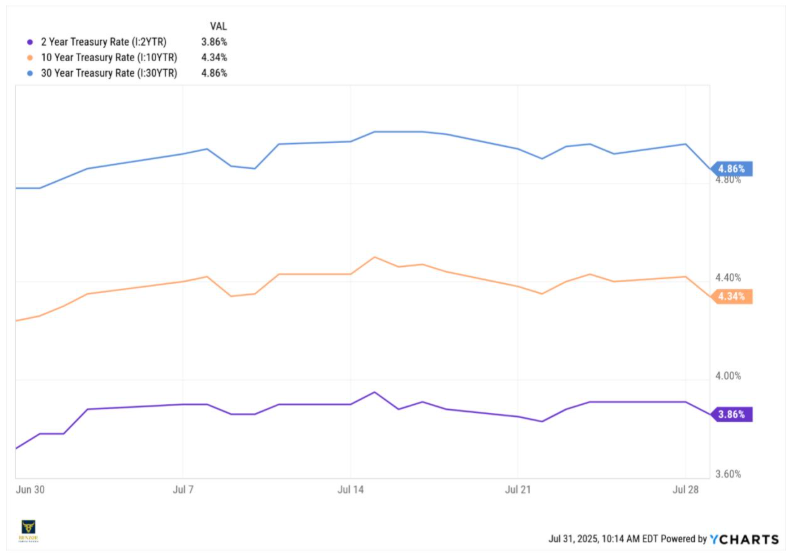
Yields across the fixed income market drifted upward in July, reflecting shifting expectations around inflation and Federal Reserve policy. The 2-Year Treasury yield rose to approximately 3.86%, up from 3.72% at the end of June, as sticky inflation readings reduced market confidence in near-term rate cuts. The 10-Year yield also moved higher to around 4.34%, compared to 4.24% a month earlier, while the 30-Year yield climbed to 4.86%, up from 4.78%, reflecting longer-term concerns around debt sustainability, rising issuance, and the broader fiscal outlook. The yield curve steepened slightly, with long-term rates rising faster than short-term ones—signaling that markets are beginning to price in persistent inflation pressures, a gradual path toward policy easing, and renewed demand for long-duration assets as investors navigate heightened economic uncertainty. Credit spreads remained largely stable, with investment-grade bonds supported by solid corporate balance sheets, though high-yield valuations appear tight, offering limited cushion if macro risks escalate.
BCap Stance on Market
At Benzor Capital Wealth, we remain optimistic yet disciplined in our outlook as equity markets reach new all-time highs. July saw continued momentum in U.S. equities, supported by strong earnings, robust consumer spending, and the passage of new legislation. While inflation came in a little hotter than expected and bond yields edged higher, the broader macro picture remains positive. We continue to favor high-quality equities with strong fundamentals and exposure to innovation, particularly in technology, industrials, and financials. Recent legislation, including the “One Big Beautiful Bill” and the GENIUS Act, reinforces our conviction in sectors benefiting from investment incentives and digital infrastructure development. As we enter the second half of 2025, we are confident in our portfolio positioning but remain alert to policy shifts, global risks, and evolving Fed guidance. Our commitment is to navigate this dynamic environment with clarity and conviction, delivering tailored strategies aligned with our clients’ long-term goals.
Disclosure: These are the opinions of Nicholas Benzor and not necessarily those of Cambridge, are for informational purposes only, and should not be construed or acted upon as individualized investment advice. The indices mentioned are unmanaged, do not incur fees, and cannot be invested into directly.