


Nicholas Benzor
Principal Planner & Chief Executive Officer
Table of Contents
- Federal Reserve
- Inflation & Unemployment
- Earnings
- Geopolitical Outlook
- Market Overview
- Benzor Capital Wealth Stance
February 2026 Market Commentary
Benzor Capital Wealth
Federal Reserve
The Federal Reserve delivered a 25 basis point rate cut in December, lowering the target range and marking a continuation of its shift away from restrictive policy. The decision was framed as a risk-management move, reflecting moderating inflation trends alongside signs of cooling in the labor market.
At its January 28–29, 2026, meeting, the Federal Reserve held rates steady, as widely expected, opting to pause and assess incoming economic data following last year’s easing. In its statement and Chair Powell’s press conference, the Fed reiterated its emphasis on data dependence and policy flexibility, avoiding any commitment to a fixed path for future rate cuts.
Policymakers emphasized that future adjustments will depend primarily on the trajectory of inflation and labor-market conditions, rather than market expectations or calendar timing. The Fed acknowledged that inflation remains elevated, while labor conditions continue to cool gradually, reinforcing a balanced assessment of risks.
According to the CME Group FedWatch Tool, markets continue to price a high probability that rates remain unchanged through at least the March meeting, reflecting expectations for an extended near-term pause.
Looking ahead to 2026, market pricing and Fed communication point to a gradual and measured easing cycle, with policymakers preferring to let prior rate cuts fully filter through the economy before making additional adjustments. Policy is expected to stabilize near neutral levels, barring a material shift in inflation or employment trends. This outlook is subject to change with the recent announcement that President Donald Trump has nominated Kevin Warsh as the next Chairman of the Federal Reserve, with his appointment expected to take effect around May 2026 upon the conclusion of Jerome Powell’s term and pending Senate confirmation
Inflation & Unemployment
Inflation remains above the Fed’s long-term target, with headline PCE inflation at 2.8% (released January 22, 2026), indicating that inflation remains elevated and largely unchanged from prior readings, rather than showing meaningful easing. Core PCE inflation also registered 2.8% (released January 22, 2026), underscoring persistent underlying price pressures despite progress from peak levels.
With the January data now available, attention has shifted to whether future PCE releases demonstrate sustained progress toward the Fed’s 2% target, which will remain a key input for monetary policy decisions in the months ahead.
The labor market has shown further signs of cooling, with the unemployment rate at approximately 4.4% (last released January 9, 2026), ticking modestly higher from the previous month. Nonfarm payroll growth slowed in the most recent report (released January 9, 2026), suggesting easing labor-market tightness rather than outright deterioration.
The next employment report, due February 6, 2026, will serve as a key input for expectations surrounding the Fed’s March policy decision. Fed officials continue to characterize the risk balance as inflation risks still present, while employment risks are increasingly tilted to the downside, reinforcing a cautious and data-dependent policy stance.
Earnings
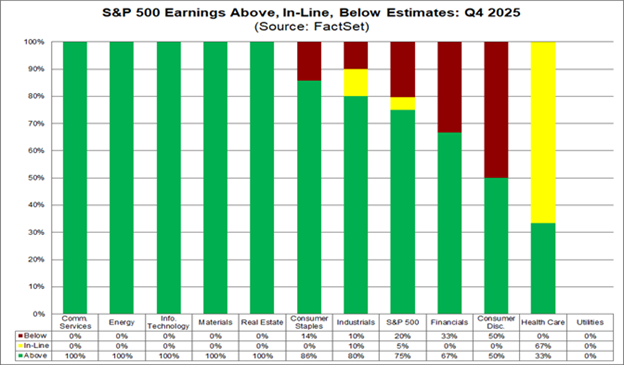
Early results from the Q4 2025 earnings season have been encouraging. Among the several S&P 500 companies that have reported so far, total earnings are up 17.2% year-over-year, supported by 7.5% revenue growth, reflecting strong early earnings momentum.
This initial reporting cohort has exceeded expectations at a higher-than-average rate, supporting optimism for the quarter. Approximately 88.2% of reporting companies have beaten EPS estimates, while 72.5% have exceeded revenue expectations, signaling strength across both profitability and top-line performance. The gap between EPS and revenue beats suggests that cost discipline, efficiency gains, and margin management remain key drivers of earnings outperformance.
Sector Highlights
- Financials: One of the strongest early-reporting sectors, supported by resilient net interest income, improved capital markets activity, and disciplined expense management. Results have reinforced confidence in balance-sheet strength and capital flexibility, even as credit conditions remain an area of focus heading into 2026.
- Information Technology: Continued earnings momentum driven by sustained investment in AI, cloud infrastructure, and enterprise software, alongside improving operating leverage. Markets are closely evaluating how elevated investment levels translate into productivity gains and longer-term revenue growth.
- Industrials: Benefited from infrastructure spending, easing supply-chain pressures, and steady demand across transportation and logistics. Backlogs and order visibility remain supportive, helping offset pockets of cyclical uncertainty.
- Materials: Performance has been mixed but generally resilient, reflecting improved pricing discipline and cost controls despite commodity price volatility. Results suggest margins are being protected even in a less favorable pricing environment.
- Consumer Discretionary: Results point to continued resilience in travel, leisure, and experience-oriented spending, even as consumers remain price-sensitive. Companies are navigating demand shifts through targeted pricing strategies and selective promotional activity.
- Consumer Staples & Healthcare: Delivered steady, defensive earnings largely in line with expectations, helping balance overall index performance. These sectors continue to provide stability amid broader economic and policy uncertainty.
- Energy: Results have been more uneven, reflecting fluctuations in commodity prices and global supply dynamics. However, capital discipline and shareholder-return frameworks continue to support cash-flow stability.
- Communication Services: Remains one of the weaker-performing sectors this earnings cycle, with results lagging broader index growth. Despite this, selective improvement in advertising-related activity suggests potential stabilization rather than further deterioration.
At the index level, blended earnings growth for Q4 remains in the high-single-digit range, consistent with recent quarters of steady expansion. Revenue growth continues to track in the mid-to-high single digits, supporting the sustainability of earnings growth into 2026.
Forward Outlook
Forward guidance remains measured but constructive, with management teams acknowledging macro, policy, and geopolitical uncertainties while maintaining expectations for continued earnings growth.
Investors are increasingly focused on how corporate spending intentions and guidance are shaping forward expectations as the earnings season evolves. Recent macro and earnings commentary highlights that spending on AI infrastructure, data centers, and productivity enhancements is being interpreted as a key driver of future growth. This dynamic has introduced a nuanced view of spending in the market: higher investment is generally seen as supportive of long-term earnings power, even as some analysts express caution around the timing and returns on that investment.
This market reaction reflects a broader theme in 2026 earnings outlook commentary: investors are not only digesting headline beats, but also shifting focus toward corporate spending trajectories and strategic investment priorities as indicators of future earnings durability and competitive positioning
Analyst revisions and early results suggest earnings momentum remains intact, supporting a favorable backdrop for equities as the year progresses.
Geopolitical Outlook
- Greenland
Geopolitical focus intensified early in the month after the U.S. administration elevated Greenland to a national security priority, citing concerns around Arctic shipping lanes, defense coverage, and access to strategic natural resources. Tensions escalated when the U.S. signaled the potential for new tariffs on European countries, raising concerns about renewed U.S.–EU trade friction.
At the World Economic Forum in Davos, U.S. officials indicated progress with NATO partners, noting that a framework for a future agreement had been discussed, helping ease immediate market concerns. Despite this messaging, the European Union subsequently halted approval of a broader U.S.–EU trade agreement, underscoring that negotiations remain unresolved.
More recently, U.S. officials confirmed that a deal framework is now in place, focused on security cooperation and long-term economic development, though key details, including governance, resource access, and implementation timelines — remain pending. Markets have interpreted these developments as a de-escalation of tariff risk, while recognizing that Greenland remains a live geopolitical issue rather than a finalized resolution.
- Venezuela
Venezuela remained a secondary but notable geopolitical focus, particularly for energy markets, as policy shifts raised the prospect of incremental Venezuelan oil supply returning to global markets. While headlines have driven short-term market reactions, structural constraints suggest any production increase is likely to be gradual.
- Broader Background
Trade relations between the U.S. and Canada drew attention after U.S. officials raised the possibility of imposing significant tariffs on Canadian goods should Canada pursue certain trade arrangements with China. Although no policy action has been taken and Canadian officials have pushed back on the premise, the rhetoric has added a layer of uncertainty to North American trade relations.
Meanwhile, China–U.S. tensions continue to sit in the background, with trade policy and strategic competition remaining ongoing sources of uncertainty.
The Russia–Ukraine conflict persists as well, contributing to elevated global risk awareness, though markets have largely adapted to its prolonged nature and continue to treat it as a background risk rather than a primary market driver.
Market Overview
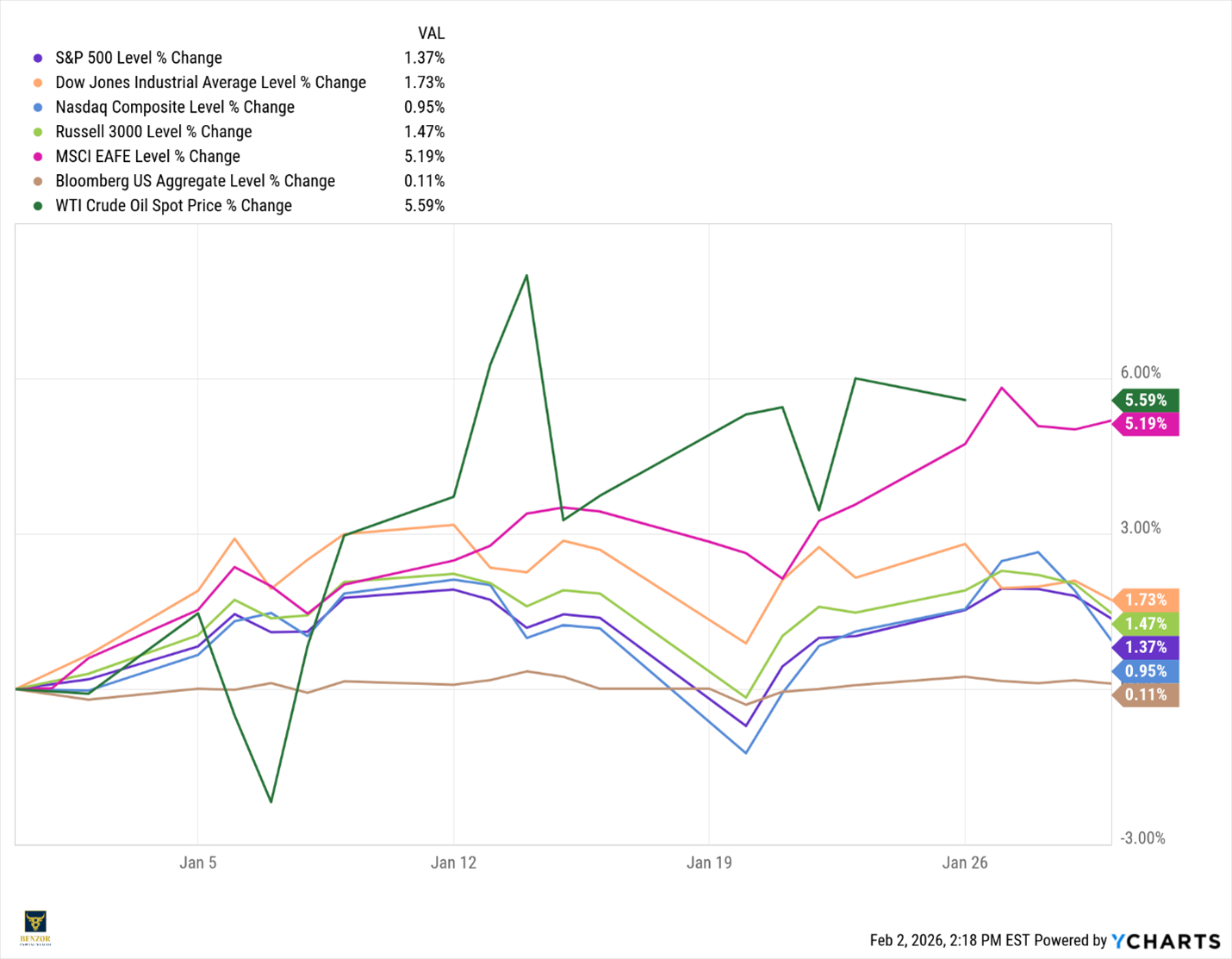
- January Market Performance (Month-to-Date)
- S&P 500: +1.37%
- Dow Jones Industrial Average: +1.73%
- Nasdaq Composite: +0.95%
- Russell 3000: +1.47%
- MSCI ex-U.S.: +5.19%
- Bloomberg U.S. Aggregate Bond Index: +0.11%
- WTI Crude Oil: +5.59%
- Equities
U.S. equity markets delivered a modestly positive but mixed performance in January, reflecting a transition from the strong year-end rally into a more fundamentals-driven environment. Early-month trading was supported by easing inflation trends, stable economic growth, and expectations for a Federal Reserve policy pause. Volatility increased mid-month as investors reacted to earnings results, valuation sensitivity in growth-oriented sectors, and elevated geopolitical headlines. Market leadership became more selective, with sector rotation playing a larger role than broad index gains. International equities posted solid gains, supported by currency dynamics and comparatively attractive valuations.
- Fixed Income
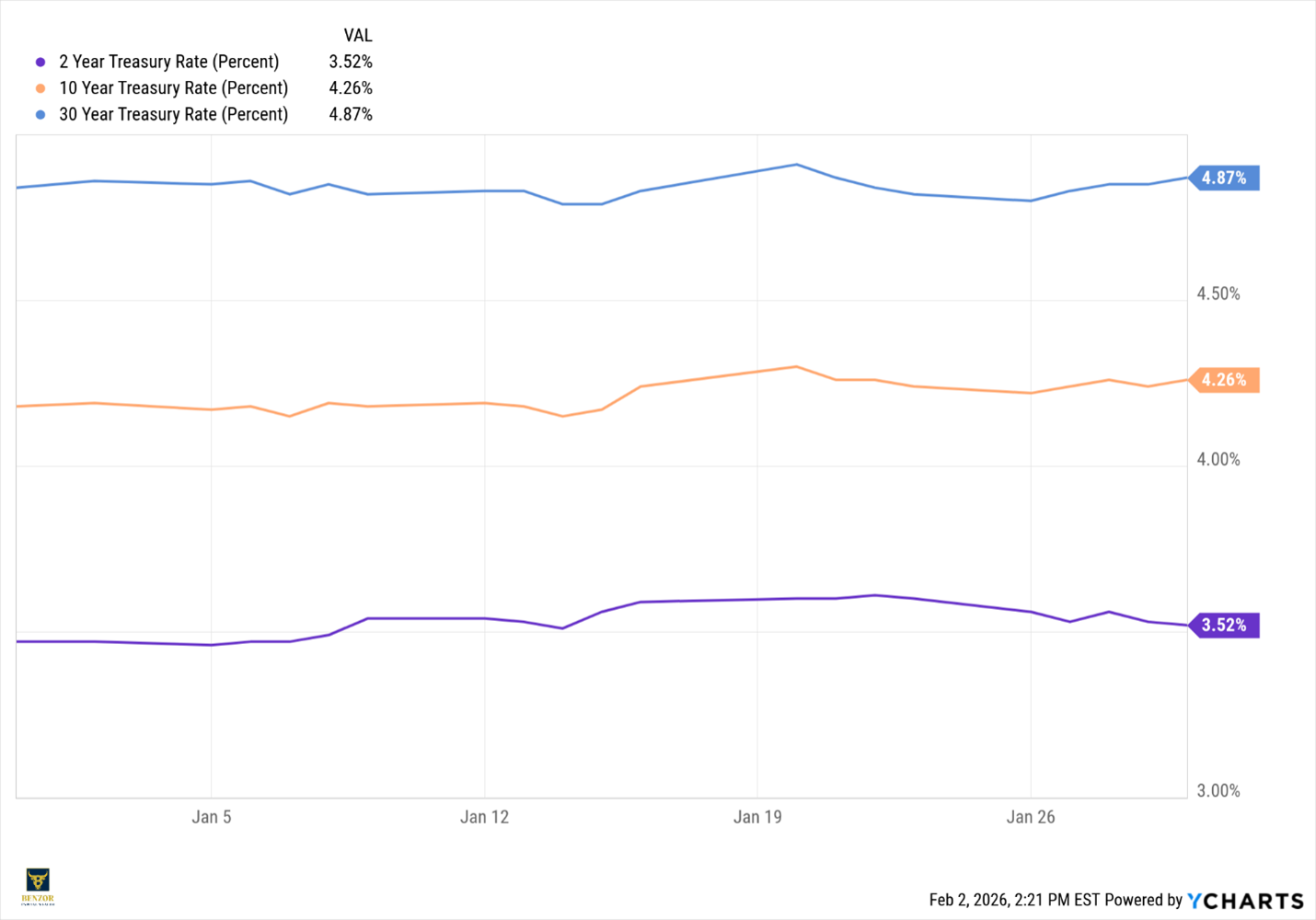
Fixed income markets delivered largely flat performance, as Treasury yields moved within a narrow range amid balanced inflation data and a cooling but resilient labor market. Credit markets remained orderly, with corporate spreads relatively contained due to solid earnings fundamentals and manageable default expectations, reinforcing stability across fixed income allocations.
- Commoditites
Commodity performance was divergent but broadly constructive, with notable strength in industrial and precious metals. Gold and silver rallied for most of the month, supported by heightened geopolitical uncertainty, continued central bank demand, and their role as defensive assets amid policy and election-related risks. Copper prices also advanced, reflecting optimism around global infrastructure spending, electrification trends, and expectations for sustained demand tied to energy transition and industrial activity. However, with the announcement of the new FED Chair, Kevin Warsh, prices dropped significantly to end the month. Energy prices rebounded during the month, supported by supply dynamics and geopolitical considerations, though volatility remains elevated. Analyst expectations suggest that supportive demand trends, constrained supply, and macro uncertainty could continue to underpin metals prices in the near term, even as broader commodity markets remain sensitive to growth and policy developments.
Benzor Capital Wealth Stance
January reinforced an important theme for investors: markets are transitioning away from momentum-driven gains toward an environment that rewards fundamentals, selectivity, and discipline. While geopolitical headlines and policy uncertainty contributed to near-term volatility early in the year, market behavior has continued to reflect confidence in earnings durability, a stabilizing inflation backdrop, and a Federal Reserve that is increasingly comfortable taking a measured approach. In our view, these conditions support constructive market participation rather than defensive positioning.
As 2026 unfolds, BCap Wealth believes opportunities will increasingly emerge from broader participation across sectors and market capitalizations, particularly as efficiency gains from technology and automation continue to take hold. While the path forward is unlikely to be linear, with elections, policy debates, and global developments shaping sentiment, we expect volatility to create opportunity rather than risk for long-term investors. We remain constructive on both U.S. and international, while maintaining a disciplined, holistic approach focused on aligning portfolios with our clients’ long-term financial goals.