


Nicholas Benzor
Principal Planner & Chief Executive Officer
Table of Contents
- Geopolitical Tensions
- Employment, Inflation, & the Fed
- Earnings Snapshot
- Market Performance
- Equities
- Fixed Income
- Commodities
- Housing & Home-Buying Season
- BCW Stance
May 2026 Market Commentary
Benzor Capital Wealth
Geopolitical Tensions
The U.S.–Iran conflict remained a key driver of market volatility in April, following U.S. and Israeli military strikes on Iranian strategic assets earlier this year and the subsequent escalation into broader regional instability. Iran’s retaliatory actions, including disruptions to shipping traffic through the Strait of Hormuz, created one of the most significant global energy supply shocks in recent history, as roughly 20% of global oil and LNG trade typically passes through this corridor. Although ceasefire negotiations and temporary diplomatic pauses helped reduce immediate fears of full-scale regional war, shipping volumes through Hormuz remained constrained, keeping oil markets highly volatile.
The United States’ continued naval presence and Iran’s intermittent restrictions on commercial shipping sustained what markets increasingly viewed as a prolonged energy security risk rather than a short-term geopolitical event. Oil prices surged sharply during the height of the conflict, with Brent crude surpassing $100 per barrel and gasoline prices in the U.S. rising above $4 per gallon, creating direct inflationary pressure on consumers, transportation, and industrial sectors. Higher energy prices significantly complicated the Federal Reserve’s inflation outlook, as rising fuel and logistics costs risk delaying progress toward lower inflation and extending higher interest rate expectations.
Beyond direct commodity effects, the conflict also heightened global recession concerns by pressuring corporate margins, reducing consumer confidence, and increasing uncertainty across supply chains and manufacturing sectors. Markets increasingly shifted focus from the military conflict itself to its macroeconomic consequences, particularly regarding inflation persistence, consumer spending pressure, and the broader risk of prolonged commodity-driven economic instability. While recent diplomatic developments have improved short-term sentiment, the ongoing U.S.–Iran confrontation remains a major macro risk, with energy markets, inflation expectations, and monetary policy highly sensitive to further escalation or disruption.
Employment, Inflation & the Fed
April economic data reinforced that the U.S. labor market remains resilient despite moderating hiring trends. The March employment report, released April 3rd, showed nonfarm payrolls increasing by 178,000 jobs, while the unemployment rate edged down to 4.3%, reflecting continued labor market stability. Weekly jobless claims throughout April remained relatively low, though somewhat volatile. For the week ending April 18, initial claims rose to 214,000 and continuing claims to 1.82 million, while more recent data for the week ending April 25 showed initial claims declining to 189,000 and continuing claims to 1.785 million, reinforcing that layoffs remain historically contained.
Inflation data released during the month highlighted renewed pressure driven largely by energy prices. March CPI data, released April 10th, showed headline inflation rising 0.9% month-over-month and 3.3% year-over-year, reflecting a sharp acceleration driven primarily by higher gasoline costs. Core CPI increased 0.2% month-over-month and 2.6% year-over-year, indicating that underlying inflation pressures remain more contained but still above the Federal Reserve’s long-term target.
Similarly, March PPI data, released April 14th, showed producer prices rising 0.5% month-over-month and 4.0% year-over-year, marking the fastest annual increase since early 2023 and highlighting persistent upstream cost pressures. Core PPI rose 0.2% month-over-month and 3.6% year-over-year, suggesting that underlying producer inflation remains elevated even outside of volatile energy components.
The primary driver across both CPI and PPI was a sharp increase in energy prices, with gasoline rising over 21% at the consumer level and more than 15% at the producer level, largely tied to geopolitical tensions and supply disruptions. This energy-driven inflation surge raised concerns that broader disinflation progress could stall, particularly if elevated oil prices persist. As a result, sticky inflation combined with resilient employment data continues to complicate the Federal Reserve’s policy outlook, reducing confidence in the timing of near-term rate cuts. Treasury yields remained volatile as markets recalibrated expectations for future monetary policy, reinforcing a higher-for-longer rate environment.
Earnings Reports and Forward Guidance
Earnings Snapshot
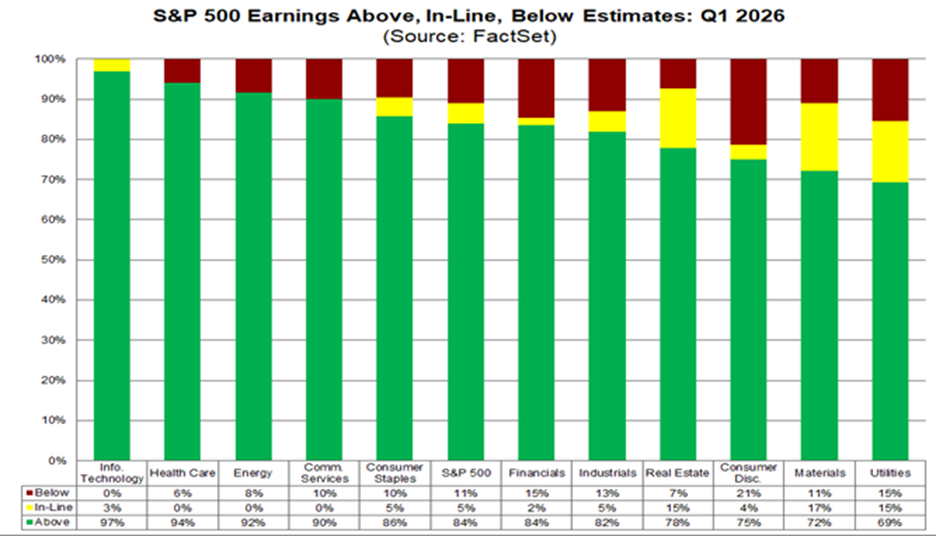
Q1 2026 earnings season has delivered exceptionally strong results, providing one of the most powerful fundamental supports for equity markets in recent years despite elevated inflation, restrictive monetary policy, and geopolitical uncertainty. As of early May, approximately 72% of S&P 500 companies have reported results, with 78% exceeding EPS estimates and 62% beating revenue expectations, both in line with or slightly above historical averages.
The blended earnings growth rate for the S&P 500 currently stands at approximately 12.8% year-over-year, marking the highest growth rate since Q4 2021 and reflecting a meaningful acceleration from expectations at the start of the quarter. Earnings have surprised consensus by roughly 23%, with revenues increasing approximately 11% year-over-year and outperforming projections.
Profitability remains a major strength, supported by pricing power, AI and infrastructure investment, consumer resilience in key segments, margin discipline, and operational efficiencies. Net profit margins also remain near historic highs, reinforcing broad corporate earnings durability.
Sector-Wide Overview
- Technology remained the dominant earnings growth engine, driven by semiconductors, hyperscaler capital expenditures, AI deployment, enterprise software demand, and continued strength in digital infrastructure and cloud spending. Mega-cap technology companies were the primary contributors to overall S&P 500 earnings growth.
- Communication Services also delivered strong performance, supported by digital advertising recovery, platform monetization, and broader large-cap technology ecosystem strength.
- Financials posted solid results, benefiting from higher-for-longer interest rates supporting net interest income, stable consumer credit conditions, and resilient capital markets activity.
- Consumer Discretionary remained a major contributor, though performance continued to diverge between higher-income and lower-income consumers, with inflation and financing costs weighing on more price-sensitive segments.
- Industrials continued benefiting from infrastructure spending, aerospace & defense demand, reshoring initiatives, and ongoing capital investment trends.
- Materials benefited from stronger industrial demand and commodity pricing support, contributing to broader earnings strength.
- Energy remained supported by elevated oil prices, though forward outlooks remain more sensitive to geopolitical volatility and commodity price fluctuations.
- Health Care and Consumer Staples continued to provide stable defensive earnings support amid broader macroeconomic uncertainty.
Forward Outlook
Forward guidance remains broadly constructive, though corporate leadership teams continue to highlight several macroeconomic risks, including persistent inflationary pressures, wage growth, energy volatility, geopolitical uncertainty, and higher financing costs. Companies with strong pricing power and exposure to secular growth themes such as AI, infrastructure, and defense remain best positioned.
At the same time, more consumer-sensitive and margin-sensitive sectors may face pressure if inflation remains elevated or if oil prices continue rising. The key macro risk remains that sustained energy-driven inflation could delay Federal Reserve easing and weigh on earnings momentum in the second half of 2026.
Overall, Q1 earnings season has exceeded expectations and reinforced corporate resilience, providing a strong foundation for equity markets even as broader macroeconomic uncertainties persist.
Market Performace (Month-to-Date)
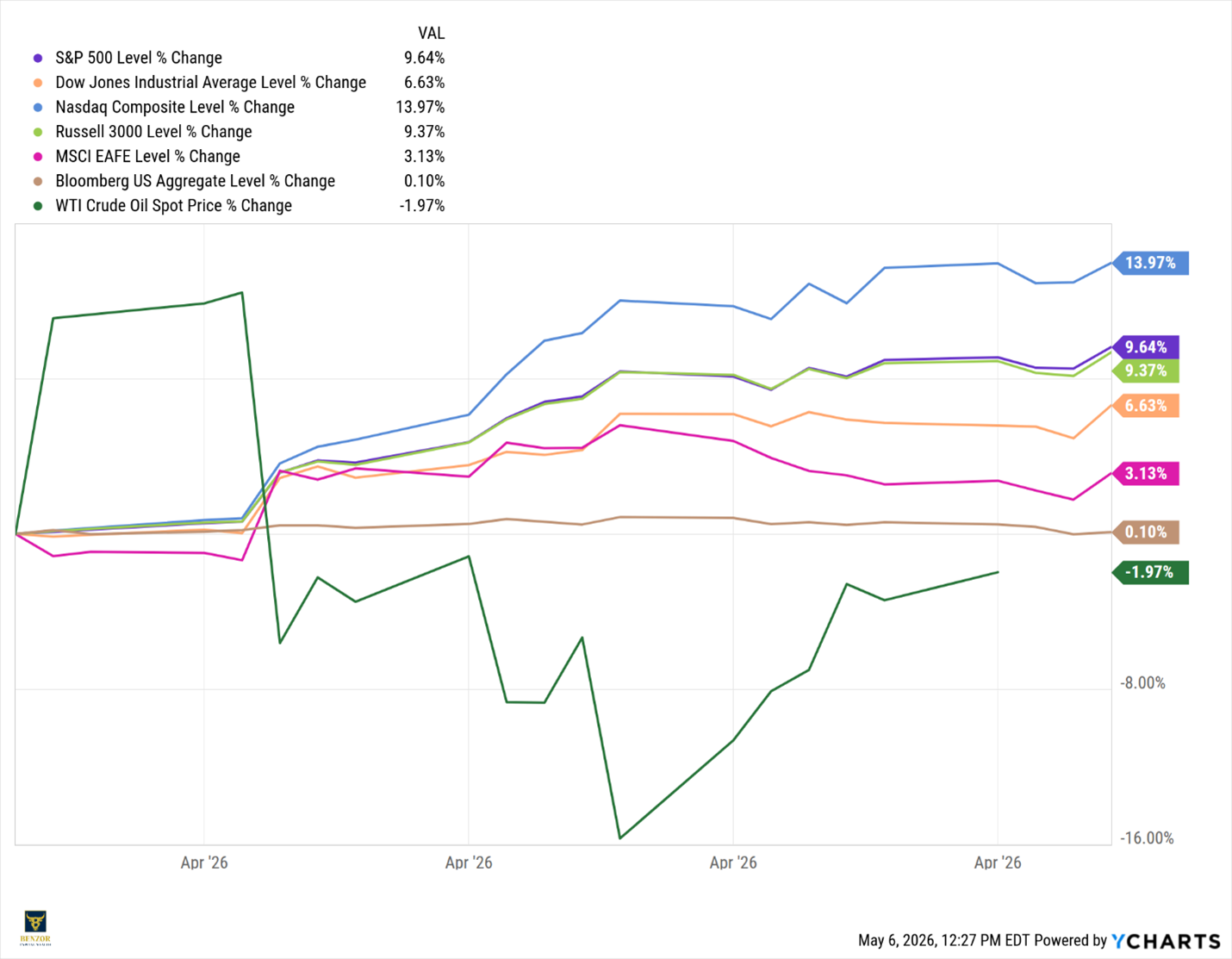
S&P 500: +9.64%
Dow Jones Industrial Average: +6.63%
Nasdaq Composite: +13.97%
Russell 3000: +9.37%
MSCI EAFE: +3.13%
Bloomberg U.S. Aggregate Bond Index: +0.10%
WTI Crude Oil: -1.97%
Equities
U.S. equity markets delivered an exceptionally strong rebound in April, with Wall Street posting its best monthly performance since the 2020 pandemic recovery as investor sentiment improved following March weakness. The rally was supported by a combination of exceptionally strong Q1 earnings, continued AI-driven leadership, improving market breadth, and resilient economic data despite elevated inflation and interest rate uncertainty.
Growth-oriented sectors, particularly technology and communication services, led gains, driven by strength in semiconductors, hyperscaler capital expenditures, and continued momentum in AI-related infrastructure and enterprise demand. Mega-cap companies played a significant role in lifting index-level performance, though market participation broadened meaningfully as the month progressed.
Cyclical sectors such as industrials and financials also contributed to upside, supported by infrastructure spending, capital markets activity, and improving investor risk appetite. Small- and mid-cap equities participated in the rally, though performance remained somewhat more volatile due to sensitivity to financing conditions and interest rate expectations.
International equities also advanced during the month; however, they continued to lag U.S. markets as uneven global growth, ongoing geopolitical uncertainty, and weaker economic momentum in parts of Europe and China weighed on relative performance.
Fixed Income
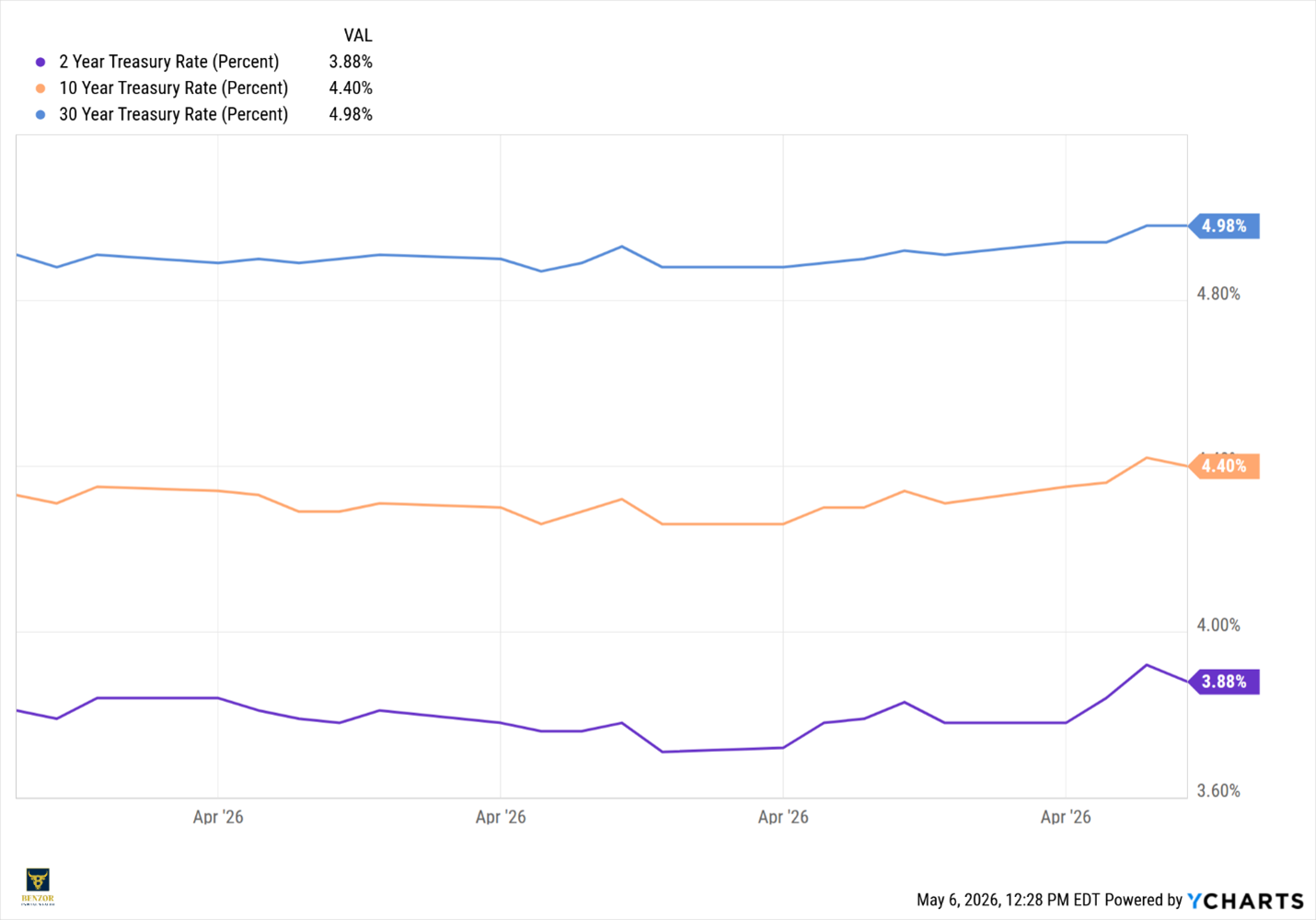
Fixed income markets remained challenged throughout April as persistent inflation pressures and rising oil prices continued to push Treasury yields higher, weighing on bond prices. Stronger-than-expected economic data, particularly in labor markets, further reduced confidence in near-term Federal Reserve rate cuts and contributed to a repricing of interest rate expectations.
Rate volatility remained elevated, with significant movements across the yield curve as investors adjusted to a higher-for-longer policy outlook. Longer-duration assets were particularly sensitive to these shifts, resulting in continued pressure across core bond allocations.
Despite elevated yields improving long-term income opportunities, bonds provided limited diversification benefits during the month, as both equities and fixed income were influenced by the same inflation and rate-driven dynamics. Credit markets, however, remained relatively stable, with spreads contained, reflecting continued confidence in corporate balance sheets and broader economic resilience.
Commodities
Energy markets remained highly volatile during April, driven primarily by geopolitical tensions and concerns surrounding supply disruptions, particularly in key oil-producing regions. Oil prices experienced sharp intra-month movements as markets responded to developments in the U.S.–Iran conflict and broader Middle East instability, leading to elevated risk premiums in energy markets.
Higher oil prices became a key macroeconomic variable, contributing to renewed inflation concerns and influencing expectations around Federal Reserve policy. The rise in energy costs also has broader implications for transportation, manufacturing, and consumer spending, reinforcing its importance within the overall market narrative.
Commodity volatility extended beyond energy, influencing broader market sentiment and contributing to fluctuations in inflation expectations. Gold remained well supported throughout the month, benefiting from its role as both a hedge against geopolitical uncertainty and a store of value amid persistent inflation risks and currency volatility.
Housing & Home Buying Season
The U.S. housing market remained under pressure throughout April as elevated mortgage rates, affordability constraints, and limited resale inventory continued weighing on activity during the spring home buying season. Existing home sales declined to approximately 3.98 million annualized units in March, reflecting the continued impact of higher borrowing costs. Mortgage rates remained elevated near 6.3%–6.4%, continuing to pressure affordability for first-time and middle-income buyers.
Tight housing inventory remained a major structural challenge, as many homeowners remained locked into lower-rate mortgages and were reluctant to sell. New homebuilders continued to outperform the resale market by offering incentives, though financing costs still constrained broader demand. Home prices remained relatively resilient due to limited supply, though appreciation trends have moderated.
Higher ownership costs, including insurance, taxes, and financing, continue contributing to persistent shelter inflation, while regional disparities remain evident, with stronger activity in select Sunbelt markets. Overall, the housing market remains constrained by affordability and supply dynamics, making it a key macroeconomic pressure point for both consumers and policymakers.
BCW Stance
Recent market activity reflects a dynamic environment shaped by a combination of strong corporate earnings, evolving inflation trends, and ongoing geopolitical developments. While earnings have remained resilient and broadly supportive of valuations, external factors, particularly energy price volatility and shifting policy expectations, continue to influence overall market sentiment.
Corporate results have provided a stable foundation, with broad participation across sectors, highlighting the underlying strength of the earnings cycle. At the same time, inflation data and interest rate expectations remain key variables, with markets continuing to adjust to incoming economic information.
In this environment, we continue to emphasize diversification across asset classes and sectors, alongside a selective approach within equities. Concentration in certain areas of the market reinforces the importance of maintaining balanced exposures, incorporating both growth-oriented and more stable segments.