


Nicholas Benzor
Principal Planner & Chief Executive Officer
Table of Contents
- Geopolitical Tensions
- Employment, Inflation, & the Fed
- Market Overview
- Equities
- Fixed Income
- Commodities
- Earnings Reports and Forward Guidance
- Sector Highlights
- Tax Time in the US
- Housing Market
- BCW Stance
April 2026 Market Commentary
Benzor Capital Wealth
Geopolitical Tensions
Geopolitical tensions in the Middle East escalated significantly through February and March following coordinated U.S. and Israeli strikes targeting Iranian nuclear, military, and energy-related infrastructure, prompting retaliatory actions across U.S. bases, Israel, and key Gulf-region energy assets. The situation evolved into a broader regional risk event, with disruptions reported across major energy-producing areas including Qatar, Saudi Arabia, and the UAE, raising concerns around the stability of critical global energy corridors.
Attacks on key oil and gas infrastructure, combined with disruptions in the Strait of Hormuz—which facilitates roughly 20% of global oil trade—amplified concerns around potential supply shocks and introduced heightened uncertainty into global energy markets. Shipping activity through the region became more volatile, with rerouting and delays contributing to logistical disruptions and increased transportation costs. These developments reinforced the strategic importance of the region and heightened sensitivity across global commodity markets.
Oil markets reacted sharply, with prices rising from the mid-$70s to above $100 per barrel during the month before stabilizing, reflecting a combination of supply risk premiums and shifting expectations around the duration of the conflict. Energy price volatility became a key transmission channel through which geopolitical developments influenced broader financial markets, particularly via inflation expectations and interest rate outlooks.
Despite ongoing diplomatic efforts, continued tensions and elevated military activity in the region have kept markets highly sensitive to further escalation or potential de-escalation developments. The situation remains fluid, with market reactions closely tied to both headline risk and any changes in the trajectory of the conflict.
Employment, Inflation & the Fed
Inflation and labor market data presented a mixed but still resilient backdrop during the month, highlighting the complexity of the current macro environment. Producer prices rose 0.7% month-over-month in February, with year-over-year growth of 3.4% and core PPI at 3.6%, indicating persistent upstream inflation pressures that may continue to feed into broader price levels. The Fed’s preferred PCE measure remains elevated at approximately 2.9% year-over-year, continuing to run above target levels and reinforcing concerns around inflation persistence.
Labor market conditions showed signs of gradual cooling but remained stable overall, with private sector hiring slowing to modest levels and broader job creation momentum softening. Initial jobless claims remained low, while continuing claims stabilized at elevated levels, and unemployment held in the low-to-mid 4% range. Job openings declined but remained above pre-pandemic norms, and wage growth continued to moderate, suggesting a gradual normalization rather than a sharp deterioration in labor conditions.
The combination of still-elevated inflation and a resilient labor market continues to complicate the Federal Reserve’s policy outlook, particularly as rising oil prices introduce additional upside risks to headline inflation. As a result, markets remain highly sensitive to incoming inflation and labor data, which will play a key role in shaping expectations for the timing and magnitude of future rate adjustments.
Market Overview
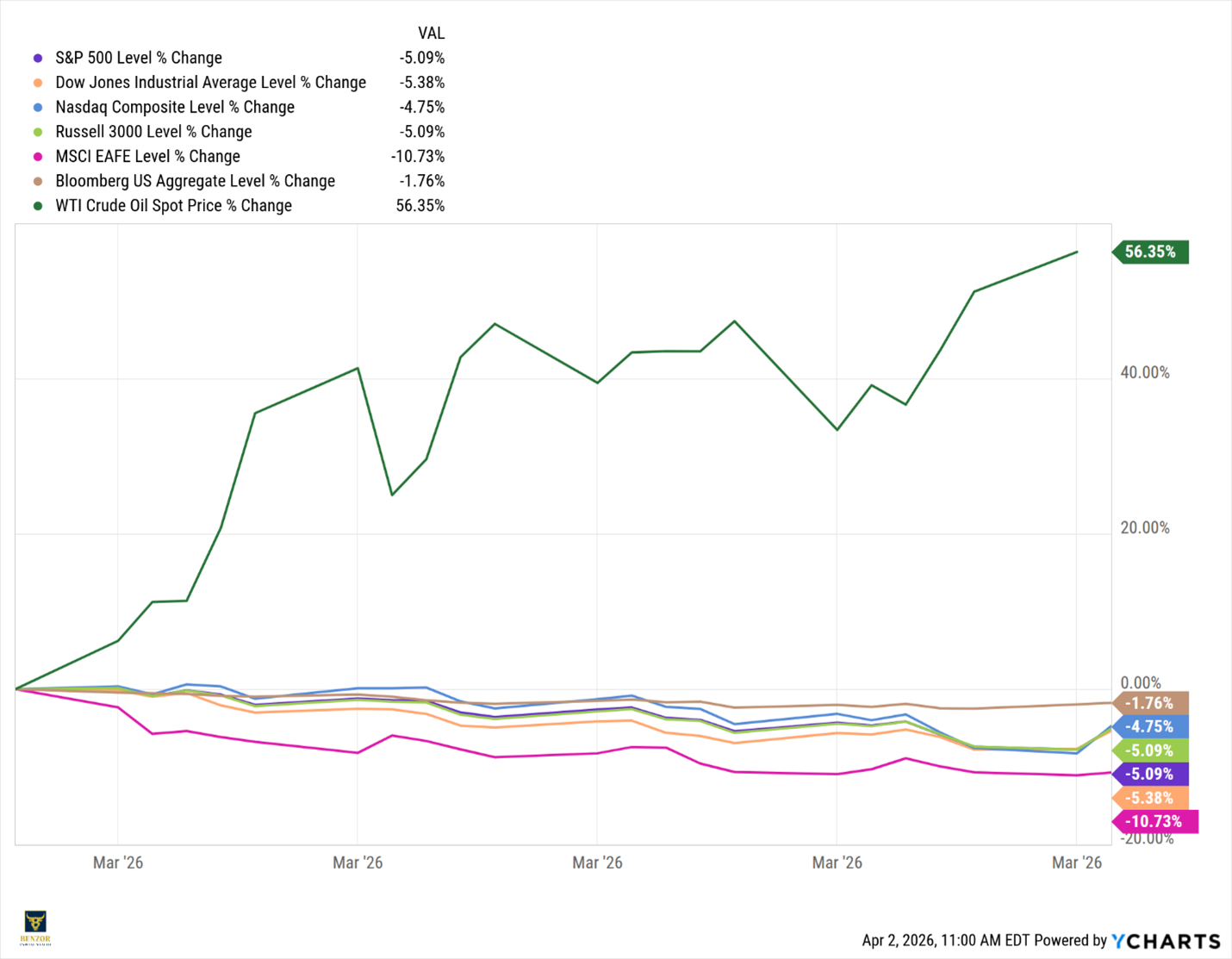
Market Performance (Month-to-Date)
S&P 500: -5.09%
Dow Jones Industrial Average: -5.38%
Nasdaq Composite: -4.75%
Russell 3000: -5.09%
MSCI EAFE: -10.73%
Bloomberg U.S. Aggregate Bond Index: -1.76%
WTI Crude Oil: +56.35%
Equities
U.S. equity markets experienced a broad-based pullback during the month, reflecting a shift toward risk-off positioning across global markets. The decline was driven by escalating geopolitical tensions, a sharp increase in oil prices, and evolving expectations around inflation and interest rate policy. The magnitude of the drawdown across major indices suggests a broad repricing of risk rather than isolated sector weakness.
Growth-oriented sectors, particularly technology, faced heightened volatility and downside pressure, while declines extended across mid- and small-cap segments, indicating reduced market breadth and weaker overall participation. The rise in oil prices added to inflation concerns, placing additional pressure on valuations and contributing to uncertainty around the interest rate outlook.
International equities also moved lower and underperformed U.S. markets, as global risk sentiment weakened amid geopolitical developments, currency dynamics, and rising energy costs, highlighting the global nature of the current risk environment.
Fixed Income
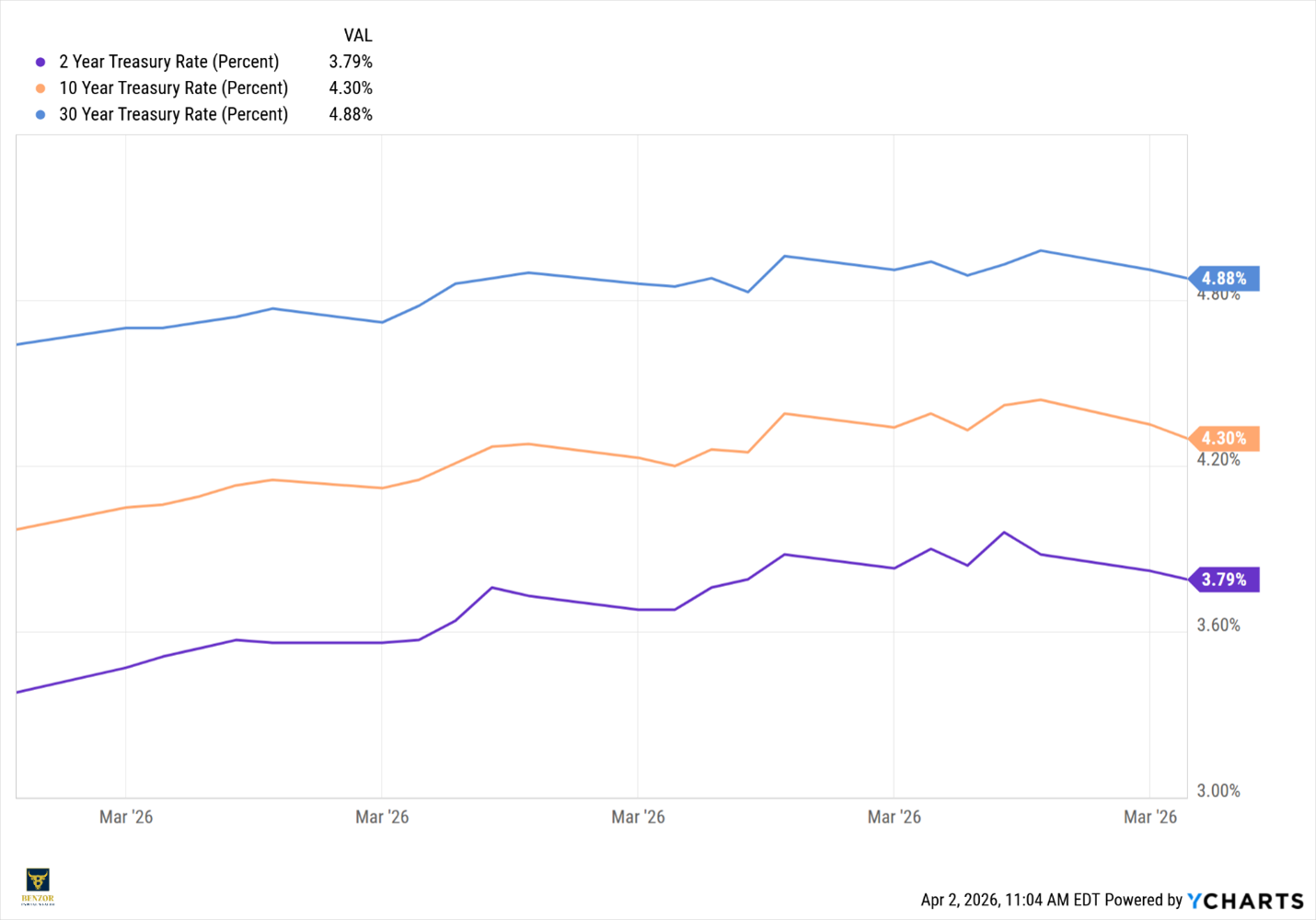
Fixed income markets declined modestly during the month, with bond prices pressured by rising inflation expectations and upward movement in yields. Rate volatility remained elevated as investors reassessed the path of monetary policy considering persistent inflation data and external risks, particularly those linked to energy prices.
Despite the equity market drawdown, bonds did not provide a strong diversification benefit, reflecting continued sensitivity to inflation dynamics and uncertainty around future rate cuts. Credit markets, however, remained relatively stable, with spreads generally contained, supported by solid corporate fundamentals and limited signs of stress across credit conditions.
Commodities
Energy markets moved significantly higher during the month, driven by escalating geopolitical tensions and concerns around potential supply disruptions in key producing regions. Oil prices rose sharply, with WTI crude increasing over 30% and briefly moving above $100 per barrel, reflecting elevated geopolitical risk premiums.
The surge in energy prices contributed to higher inflation expectations and played a meaningful role in shaping overall market sentiment, reinforcing concerns around inflation persistence and its impact on both monetary policy and asset valuations.
Earnings Reports and Forward Guidance
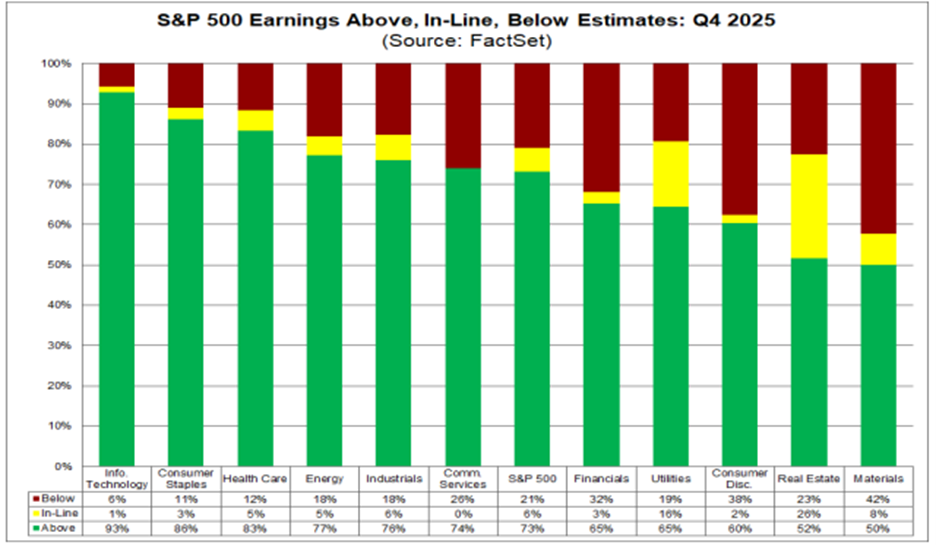
Q4 2025 earnings season has largely concluded, with results reflecting continued corporate resilience despite elevated macro and geopolitical uncertainty. The blended earnings growth rate came in at 13.2% year-over-year, marking the fifth consecutive quarter of double-digit earnings growth and reinforcing the strength of the current earnings cycle. Growth was supported by a combination of steady revenue expansion and stable profit margins, indicating that corporate performance remains broadly driven by underlying demand rather than solely cost efficiencies. Approximately 74% of companies reported earnings above estimates, while 73% exceeded revenue expectations, with beat rates remaining broadly in line with long-term averages.
At a broader level, earnings quality remained solid, with margins holding up despite ongoing input cost pressures and higher financing costs. Corporate commentary also highlighted continued investment in technology, automation, and productivity initiatives, suggesting that businesses remain focused on long-term efficiency and growth despite a more uncertain macro backdrop. Market attention has now shifted toward Q1 2026 expectations and forward guidance, with earnings growth projected to remain in the low double-digit range, which would extend the current expansion trend into a sixth consecutive quarter.
Sector Highlights
- Information Technology: Continued to lead earnings performance, supported by strong demand for AI infrastructure, cloud services, and enterprise software, with operating leverage supporting margins
- Industrials: Delivered strong results, benefiting from infrastructure spending, improved supply-chain conditions, and steady demand across transportation and logistics segments
- Communication Services: Showed solid performance driven by digital advertising and platform-based growth, though results remained somewhat uneven across companies
- Materials: Performance remained mixed, with pricing discipline and cost management helping offset ongoing commodity price volatility
- Financials: Results were supported by stable net interest income and improved capital markets activity, with credit conditions remaining broadly stable
- Utilities: Delivered steady performance, reflecting regulated business models and stable demand conditions
- Consumer Staples: Continued to provide defensive earnings stability, with consistent demand across essential goods
- Real Estate: Performance remained modest, with interest rate sensitivity continuing to influence sector dynamics
- Energy: Results were more volatile, reflecting fluctuations in commodity prices, though capital discipline continues to support cash flow stability
- Consumer Discretionary: Showed signs of moderation, with increasing consumer selectivity and price sensitivity impacting performance
- Health Care: Delivered stable results, supported by defensive demand characteristics and steady utilization trends
Forward guidance trends remain balanced but cautious, with companies emphasizing stable demand conditions alongside continued investment in productivity, automation, and technology. While the number of companies issuing negative guidance continues to exceed those issuing positive guidance, this remains consistent with historical patterns. Management commentary reflects a measured outlook, with investor focus centered on the sustainability of earnings growth, margin durability, and corporate spending trends into 2026.
Tax Time in the US
The 2026 tax filing season is underway, with approximately 164 million returns expected by the April 15 deadline and over 60 million returns already processed. Average refunds are trending higher year-over-year and are typically distributed within approximately three weeks, contributing to near-term liquidity injections into both the economy and financial markets.
This period is typically associated with elevated portfolio activity, as investors realize gains and losses, rebalance positions, and adjust allocations ahead of filing deadlines.
Tax-related cash flows also play a role in shaping broader market behavior, with refund-driven liquidity supporting consumer spending, particularly in discretionary categories. This incremental spending can provide a near-term tailwind to economic activity and corporate revenues, particularly in consumer-facing sectors.
In addition, seasonal dynamics during tax season can create short-term dislocations across equities and fixed income markets. In fixed income, elevated issuance relative to reinvestment demand can influence pricing and yield dynamics, while in equities, repositioning activity can lead to temporary volatility. Broader fiscal expectations, including potential policy support and tax-related incentives, continue to reinforce domestic economic activity and capital allocation toward U.S.-focused sectors.
Housing Market
The housing market continues to face affordability pressures, with elevated home prices and borrowing costs limiting buyer activity despite some recent improvement in interest rates. Mortgage applications declined notably during the month, reflecting a pullback in demand as higher financing costs and economic uncertainty weigh on buyer sentiment.
Home prices continue to appreciate modestly, with estimates ranging from approximately 0.5% to 2.2%, indicating that pricing remains supported despite softer transaction volumes. This resilience is largely driven by a persistent imbalance between supply and demand, with housing inventory remaining below historical norms across many regions.
Structural supply constraints—including limited new construction, higher input costs, and low turnover in existing homes—continue to restrict available inventory, preventing a more meaningful adjustment in prices. As a result, even with weaker demand, the market has not experienced a significant correction in home values.
Mortgage rates have recently moved closer to, and in some cases below, the 6% level, providing incremental relief to prospective buyers after a prolonged period of elevated rates. These rates remain closely tied to movements in the 10-year U.S. Treasury yield, reflecting longer-term inflation and growth expectations rather than short-term policy rates.
Buyer behavior has shifted toward greater selectivity and affordability sensitivity, with demand increasingly concentrated in specific price segments and regions. While overall housing activity remains subdued relative to prior cycles, improving rate conditions and stable underlying demand suggest a gradual normalization in activity rather than a rapid recovery.
BCW Stance
Equity markets have experienced a broad-based repricing, driven more by external risk factors and shifting sentiment than by a deterioration in underlying fundamentals. Corporate earnings remain resilient, supported by stable demand trends and continued investment in productivity and innovation. As a result, we view recent volatility as a reassessment of risk rather than a structural shift in the economic backdrop.
In fixed income, elevated yields continue to present attractive income opportunities, though near-term performance remains sensitive to inflation dynamics and interest rate expectations. We remain mindful of duration positioning and the role of fixed income as both a source of income and portfolio diversification.
Corporate earnings continue to provide an important foundation for markets, with results remaining broadly resilient and supported by stable demand and margin discipline. As we move into the upcoming earnings season, attention is shifting toward Q1 results and forward guidance, which will be key in assessing the durability of the current earnings cycle.
We continue to emphasize diversification across asset classes and sectors, while maintaining a selective approach within equities. Market leadership remains concentrated, making it important to balance exposure between growth-oriented investments and more defensive or value-oriented segments that can provide stability in a higher volatility environment. We also see value in maintaining disciplined allocations across portfolios, ensuring that positioning remains aligned with long-term objectives while allowing for opportunistic rebalancing as market conditions evolve. Overall, we continue to advocate for a long-term, goal-oriented investment approach, focused on consistency, discipline, and maintaining appropriate exposure across changing market cycles.