


Nicholas Benzor
Principal Planner & Chief Executive Officer
Table of Contents
- Tariff Talk
- Fed & Inflation
- AI & Software Stocks
- Geopolitics
- Earnings
- Market Overview
- BCW Stance
February 2026 Market Commentary
Benzor Capital Wealth
Tariff Talk
On February 20, 2026, the U.S. Supreme Court ruled 6–3 in Learning Resources, Inc. v. Trump that most global tariffs imposed under the International Emergency Economic Powers Act were unlawful, reaffirming that broad tariff authority resides with Congress rather than the executive branch under Donald Trump. In response, the administration issued an executive order implementing a temporary 10% global tariff under Section 122 of the Trade Act of 1974 (valid for up to 150 days), while signaling potential use of Sections 232 and 301 for more targeted, sector-specific tariffs going forward.
Import-heavy industries began assessing potential refund claims tied to the invalidated tariffs, with industry estimates suggesting refunds could total $170–$175 billion if litigation proves successful. Several large firms, including FedEx, initiated legal action seeking reimbursement. International reaction was mixed: some countries welcomed the legal clarity, while key trading partners such as the EU, UK, and Japan expressed concern over continued trade-policy uncertainty and its implications for existing agreements.
The ruling reintroduced tariff risk into the macroeconomic backdrop, particularly for sectors dependent on global supply chains such as manufacturing, technology hardware, and automotive. While the decision removed immediate pressure from broad-based tariffs, markets now expect future measures to be more selective, signaling a recalibration of trade policy rather than a full retreat. Investors continue to monitor legislative responses, potential investigations, and negotiations around longer-term tariff frameworks. Trade uncertainty may keep cost pressures elevated for certain imports, complicating the inflation outlook. Corporates with significant import exposure are reassessing supply chains and cost projections, particularly in industrials, chemicals, and energy-intensive sectors. Equity markets experienced episodic volatility tied to tariff headlines, though broader market direction remained primarily driven by earnings fundamentals.
Fed & Inflation
The Federal Reserve maintained a cautious, data-dependent stance through February following December’s rate cut, signaling no urgency for further easing as policymakers assess incoming inflation and labor data. January inflation data, released February 13, showed headline CPI at approximately 2.4% year-over-year and core CPI near 2.5%, confirming continued but gradual disinflation while remaining above the Fed’s long-term target.
Labor-market data for January, released February 11, showed nonfarm payrolls rising by roughly 130,000 and the unemployment rate at approximately 4.3%, pointing to easing labor tightness rather than a sharp deterioration. Market expectations increasingly shifted
toward a near-term policy pause, with investors pricing rates to remain unchanged through the March meeting.
However, January Producer Price Index (PPI) data released February 27 came in stronger than expected, adding renewed inflation concerns. Headline PPI rose +0.5% month-over-month and +2.9% year-over-year, while core PPI (excluding food and energy) increased +0.8% month-over-month and +3.6% year-over-year. The upside surprise was driven primarily by services inflation, which rose meaningfully during the month.
In contrast, goods prices declined by 0.3% month-over-month, and energy-related components showed softer trends, reinforcing that the inflation pressure remains largely services-based rather than goods-driven. This distinction is important, as services inflation tends to be more persistent and closely tied to wage dynamics.
Markets reacted cautiously to the PPI release, as stronger producer prices raised concerns that inflation may not cool as smoothly as anticipated, potentially delaying the timing of rate cuts. Fed officials continue to emphasize a balancing act: inflation risks persist, while employment risks are increasingly tilted to the downside, supporting a measured and flexible policy approach. Markets interpreted the broader February data as consistent with a gradual easing path later in 2026 rather than aggressive rate cuts, though rate-sensitive sectors showed increased volatility following the PPI surprise.
AI & Software Stocks
Software stocks faced renewed pressure in February as rapid advancements in generative AI heightened concerns around potential disruption to traditional SaaS business models, particularly among SMB-oriented platforms. Anthropic expanded Claude’s capabilities through enhanced coding functions, API integrations, and enterprise workflow plug-ins, reinforcing the narrative that AI tools can increasingly perform tasks once handled by standalone software applications. Similarly, OpenAI’s ChatGPT continues to offer advanced code generation, automation, and business-process assistance, lowering barriers for small and mid-sized businesses to build internal tools at reduced cost.
Investor concern has centered less on immediate revenue loss and more on long-term pricing power, product differentiation, and customer stickiness, leading to multiple compression across portions of the software sector. Markets have drawn a clearer distinction between AI infrastructure beneficiaries — including semiconductors, data centers, and cloud platforms — and application-layer software companies, with capital rotating toward firms directly monetizing AI compute demand. While many software firms are integrating AI into their own offerings, February trading reflected a repricing phase as
investors reassess which companies stand to benefit from AI adoption versus those potentially facing structural margin pressure.
Geopolitics
Geopolitical risk remained elevated during February, with Middle East developments taking primary focus. Markets were particularly attentive to rising tensions involving Iran, while other geopolitical themes such as Venezuela, China, and Arctic developments moved into the background relative to earlier months.
Iran
- Tensions involving Iran intensified significantly following coordinated U.S. and Israeli strikes on Iranian military and strategic infrastructure, marking a meaningful escalation beyond prior indirect confrontations.
- Iran responded with retaliatory missile and drone attacks across the Gulf region, targeting U.S. military bases, allied security installations, and select infrastructure, heightening fears of a broader regional war.
- The expansion of retaliatory strikes into neighboring countries, including states that had previously maintained diplomatic or security cooperation with the United States, increased concerns that the conflict could widen geographically and draw additional regional actors into direct confrontation.
- The United States further increased its military presence in the region, deploying additional carrier strike groups, air defense systems, and advanced aircraft as a deterrent amid rising tensions and ongoing nuclear and missile-related disputes.
- Energy markets reacted sharply, with crude oil prices rising as geopolitical risk premiums expanded and traders priced in the threat of supply disruptions through critical transit routes such as the Strait of Hormuz, a key corridor for global crude exports.
- While diplomatic channels remain open, sustained military positioning and retaliatory actions have elevated uncertainty, leaving global markets sensitive to further escalation and potential spillover into broader economic and inflation dynamics.
Venezuela
- U.S. interdictions of sanctioned oil shipments linked to Venezuela continued to generate regional tension.
- While energy-related headlines persisted, Venezuela-related developments played a secondary role compared with Middle East dynamics.
China
- Broader U.S.–China strategic tensions remain present, particularly across trade, technology, and security issues.
- However, China-related developments were not a primary driver of market volatility during the month relative to Iran-focused headlines.
Greenland / Arctic
- Strategic competition surrounding Arctic access and Greenland remains ongoing in the background.
- Military positioning and NATO activity in the region continued, though these developments were not a dominant market driver during the period.
Earnings
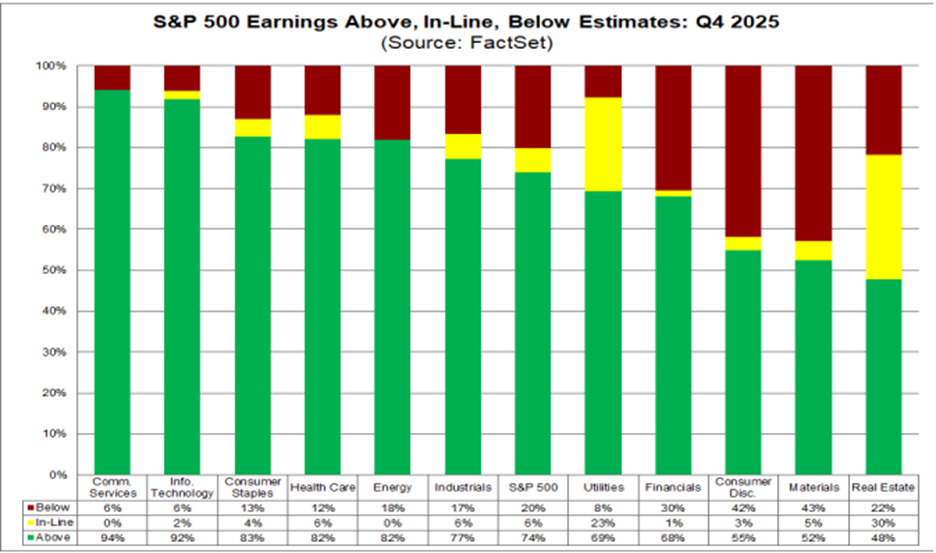
Among S&P 500 companies, approximately 74% of index constituents have reported Q4 2025 results so far, according to FactSet. The blended year-over-year earnings growth rate for the quarter stands at 13.2%, which, if maintained, would mark the fifth consecutive quarter of double-digit earnings growth for the index. Of the companies that have reported, 74% delivered a positive EPS surprise and 73% reported a positive revenue surprise. These beat rates are broadly in line with longer-term averages, indicating continued corporate resilience despite macro uncertainty. The relatively balanced EPS and revenue surprise rates suggest that earnings growth is being supported by both top-line expansion and margin stability rather than solely cost-cutting measures.
Sector Highlights
- Financials: One of the stronger-performing sectors this reporting cycle, with earnings supported by resilient net interest income, improved capital markets activity, and continued expense discipline. Results reflect stable credit conditions and healthy balance sheet positioning.
- Information Technology: Continues to demonstrate earnings momentum, driven by sustained investment in AI infrastructure, cloud services, and enterprise software. Operating leverage and productivity gains remain supportive of margin performance.
- Industrials: Results have been supported by infrastructure spending, easing supply-chain pressures, and steady demand across transportation and logistics-related areas, contributing to stable earnings growth.
- Materials: Performance has been mixed but generally resilient, reflecting improved pricing discipline and cost controls despite ongoing commodity price volatility.
- Consumer Discretionary: Early results suggest continued resilience in travel, leisure, and experience-oriented spending, though management commentary indicates increasing consumer selectivity and price sensitivity.
- Consumer Staples & Healthcare: Delivered steady, defensive earnings largely in line with expectations, providing balance and stability within overall index performance.
- Energy: More uneven relative to other sectors, reflecting fluctuations in commodity prices, though capital discipline and shareholder return strategies continue to support cash flow stability.
- Communication Services: Remains comparatively softer this earnings cycle, with growth trailing broader index expansion and select company-specific pressures weighing on performance
Forward Outlook
For Q1 2026, 31 S&P 500 companies have issued negative EPS guidance, while 38 have issued positive guidance, indicating a relatively balanced outlook. Investors continue to focus not only on headline beats but also on corporate spending trajectories — particularly in AI infrastructure, automation, and productivity initiatives — as indicators of forward earnings durability.
Market Overview
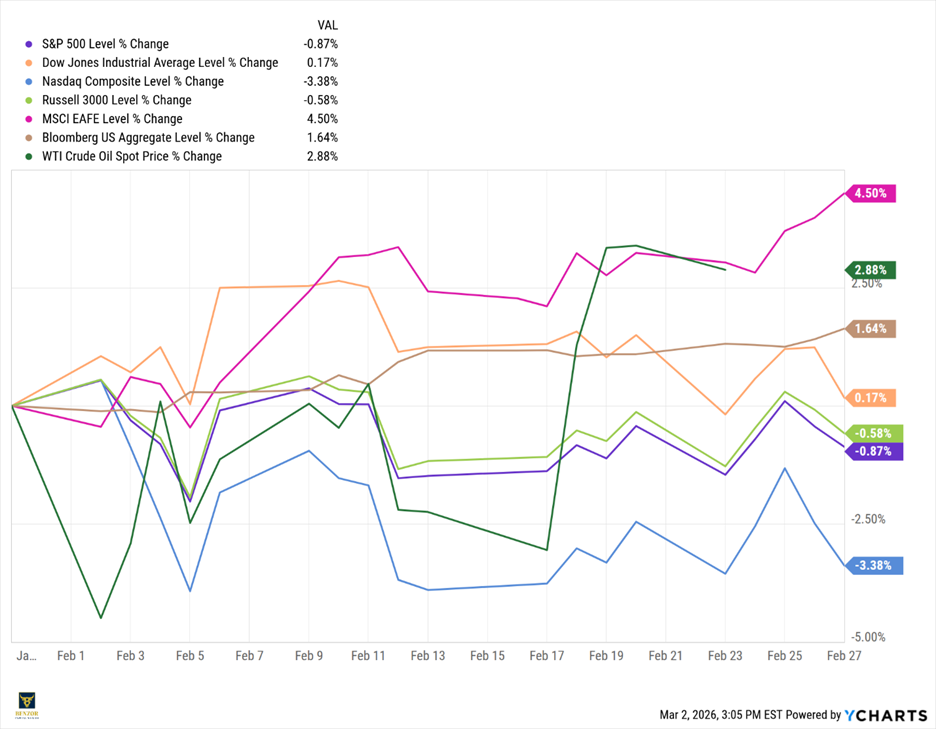
Market Performance (Month-to-Date)
S&P 500: -0.87%
Dow Jones Industrial Average: +0.17%
Nasdaq Composite: -3.38%
Russell 3000: -0.58%
MSCI EAFE: +4.50%
Bloomberg U.S. Aggregate Bond Index: +1.64%
WTI Crude Oil: +2.88%
Equities
U.S. equity markets delivered mixed performance during the month, reflecting a transition from broad-based momentum toward more selective, fundamentals-driven leadership. Volatility increased as investors reacted to earnings dispersion, renewed tariff discussions, evolving expectations around Federal Reserve policy, and escalating geopolitical tensions in the Middle East.
Growth-oriented sectors, particularly segments within technology and software, faced pressure amid AI-related disruption concerns, valuation sensitivity, and renewed inflation fears following stronger-than-expected producer price data. In contrast, value-oriented and more defensive areas demonstrated relative resilience, supported in part by energy strength and safe-haven positioning as oil prices moved higher.
International equities showed relative strength, supported by attractive valuations, currency dynamics, and diversification appeal as U.S. markets faced heightened inflation and geopolitical sensitivity.
Fixed Income
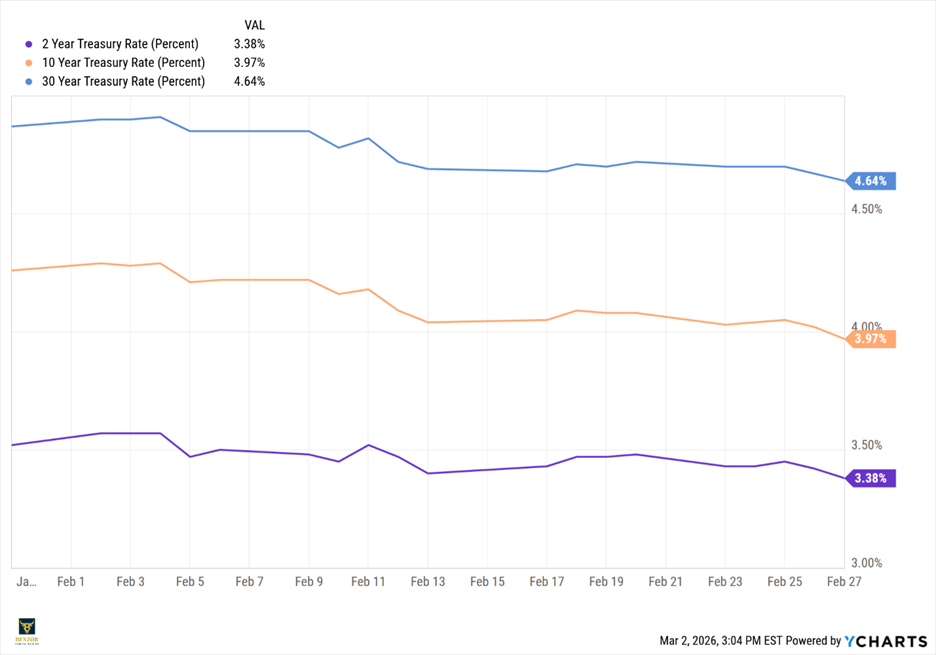
Fixed income markets experienced steady but cautious conditions as Treasury yields remained relatively range-bound. While expectations for a near-term Federal Reserve pause remained intact, stronger-than-expected PPI data and rising energy prices introduced renewed uncertainty around the pace of potential rate cuts.
Moderating labor-market data provided some offsetting support, while geopolitical tensions contributed to intermittent safe-haven demand for Treasuries. Credit markets remained generally orderly, though spreads showed sensitivity to shifts in inflation expectations and broader risk sentiment.
Commodities
Energy markets strengthened during the month as geopolitical tensions intensified following U.S.–Israel strikes on Iran and subsequent retaliatory actions across the Gulf region. Crude oil prices moved higher as markets priced in expanded risk premiums tied to potential disruptions through key transit routes such as the Strait of Hormuz.
Precious metals also gained support amid heightened geopolitical uncertainty and renewed inflation concerns. Gold, in particular, benefited from safe-haven demand as investors sought protection against potential regional escalation and persistent services-driven inflation pressures. Industrial metals were comparatively more measured, reflecting a balance between geopolitical risk and ongoing global growth expectations.
While commodity price movements reflected precautionary risk pricing rather than confirmed supply disruptions, elevated energy and metals prices reintroduced inflation sensitivity into broader markets and added complexity to the macroeconomic outlook.
BCW Stance
Earnings continue to provide a constructive backdrop for markets, with companies reporting results that have exceeded expectations this quarter. While markets continue to digest strong results, investor attention has increasingly shifted toward the sustainability of capital expenditures, particularly AI-related spending, and the timing of returns on those investments. Concerns around potential overspending and return-on-investment visibility have contributed to valuation sensitivity within select growth sectors.
The recent stronger-than-expected PPI reading, particularly within services, reinforces the importance of geographic diversification. Markets reacted cautiously to the inflation surprise, as concerns resurfaced that price pressures could prove more persistent and delay rate normalization. Additionally, rising energy prices amid escalating tensions in the Middle East introduce incremental upside risks to headline inflation, further complicating the policy outlook.
At the same time, international markets have demonstrated relative strength and continue to trade at more attractive valuations compared to U.S. equities. Given valuation differentials and differing sector compositions, international exposure provides diversification benefits amid inflation uncertainty. In line with this, we have been steadily increasing exposure to international equities within portfolios where appropriate, reflecting both diversification benefits and longer-term valuation opportunities.
Our approach remains grounded in disciplined, diversified portfolio construction. We continue to balance growth and value exposures, maintain prudent fixed income allocations amid evolving rate expectations, and position portfolios to participate in long-term earnings expansion while managing near-term volatility. In an environment characterized by shifting policy dynamics, geopolitical developments, and rapid technological change, diversification remains central to our investment framework.