


Nicholas Benzor
Principal Planner & Chief Executive Officer
Table of Contents
- A strong finish and a hopeful start
- Fed cuts and the “balance of risks”
- Inflation and employment: cooling, not collapsing
- Santa Claus rally and what it means
- Geopolitics move to center stage
- 2025 scorecard: a volatile but rewarding year
- Upside drivers and downside risks
- Benzor Capital Wealth’s stance
January 2026 Market Commentary
Benzor Capital Wealth
A strong finish and a hopeful start
Equity markets closed 2025 on a high note, setting the stage for what could be another solid year in 2026. Investors were rewarded for staying invested through volatility, and the new year opens with both opportunity and a fresh set of risks to monitor.
As 2026 begins, Benzor Capital Wealth is focused on a few key drivers:
- Fed rate cuts and the evolving interest‑rate path
- The balance between inflation and unemployment
- Upcoming U.S. midterm elections
- Rising geopolitical tensions (Venezuela, Greenland, China, Russia‑Ukraine)
- Market growth expectations and earnings trends
Fed cuts and the “balance of risks.”
In December, the Federal Reserve cut the federal funds rate by another 25 basis points, citing a cooling labor market, moderating inflation, and a shift in the “balance of risks.” The FOMC statement emphasized optionality, signaling the Committee is not pre‑committing to a fixed path of future cuts but will instead respond to incoming data.
The Fed’s December 2025 Summary of Economic Projections points to 2026 expectations of:
- Real GDP growth of 2.3%
- Unemployment averaging 4.4% in Q4
- Headline PCE inflation at 2.4% and core at 2.5%
- A year‑end fed funds rate near 3.4%
Taken together, these projections suggest modest re‑acceleration in growth, a stable labor market, continued disinflation, and only incremental additional easing in policy through 2026.
Inflation and employment: cooling, not collapsing
Fed Chair Jerome Powell has described labor market conditions as gradually cooling, noting that unemployment has edged up to around 4.4% while job gains have slowed and hiring difficulties have eased. The Fed now characterizes the near‑term backdrop as one in which inflation risks are tilted to the upside while employment risks are tilted to the downside—a challenging mix for policymakers.
Inflation remains somewhat elevated relative to the Fed’s 2% target, but policymakers project a continued glide path lower, with PCE inflation expected to fall from 2.9% in 2025 to 2.4% in 2026 and then to 2.0% thereafter on a median basis. This path, if realized, would support the case for a gradual, data‑dependent easing cycle rather than an aggressive series of cuts.
Santa Claus rally and what it means
The traditional “Santa Claus Rally” was in full effect to close 2025, with markets surging into year‑end and helping catapult risk assets into 2026. Historically, the last five trading days of December and the first two of January have seen the S&P 500 rise about 80% of the time, with average gains around 1.3%—stronger than typical periods.
While a positive Santa Claus Rally has often preceded solid full-year returns (around 10.4% on average versus about 6.1% when it fails), recent years have produced mixed outcomes, underscoring that this is an interesting indicator, not a guarantee. For Benzor Capital Wealth clients, this reinforces the importance of discipline and long-term planning rather than trading around seasonal patterns.
Geopolitics move to center stage
Geopolitical developments are already shaping the early 2026 narrative and will likely remain front and center for markets.
- Venezuela:
In a once‑in‑a‑century operation, the United States removed Nicolás Maduro from office and brought him to trial in the Southern District of New York, an event unique since the capture of Manuel Noriega in 1990. Energy markets reacted quickly, with companies like Valero, Chevron, and SLB—firms with existing or prior Venezuelan exposure—positioned to ramp production as infrastructure is modernized. The Trump administration framed this move as a national security interest to protect American citizens from the continued drug smuggling into the United States that Maduro and his administration had a direct hand in. The administrations also stated that the effort to update Venezuela’s oil infrastructure will return profits to both the people of Venezuela and American stakeholders. - Greenland:
The Trump administration has made negotiations with Greenland a top national security priority for 2026, focusing on shipping‑lane security and the region’s untapped natural resources. U.S. policymakers argue that strategic investment could unlock significant economic benefits for the citizens of Greenland over time. - China & Russia:
Tensions with China remain elevated, with ongoing tariffs and South China Sea activity adding complexity to one of the world’s most important economic relationships. Meanwhile, the Russia‑Ukraine war continues, with both sides suffering heavy losses even as leaders meet in pursuit of a deal that remains elusive, but appears closer than in prior years.
These developments introduce both potential tailwinds (for select sectors such as energy and defense) and new risks that investors must monitor closely.
2025 scorecard: a volatile but rewarding year
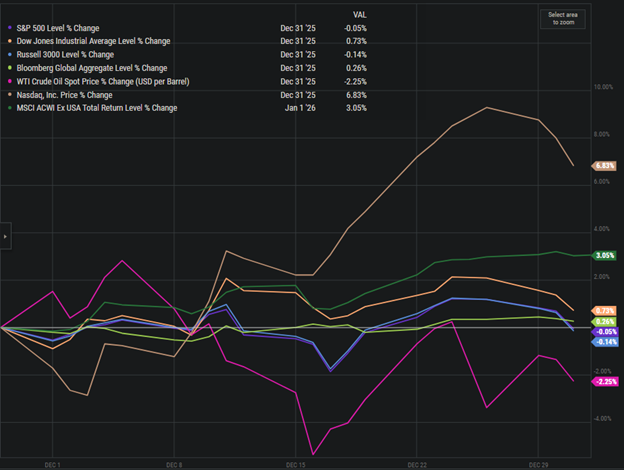
Despite frequent bouts of volatility, 2025 ultimately delivered another year of strong gains for diversified equity investors. December itself was mixed across asset classes, while full‑year returns were broadly positive across major indices.
December 2025 performance:
- S&P 500: ‑0.05%
- Dow Jones Industrial Average: +0.73%
- Russell 3000: ‑0.14%
- Bloomberg U.S. Aggregate Bond Index: +0.26%
- WTI Crude: ‑2.25%
- Nasdaq: +6.83%
- MSCI ex‑US: +3.05%
Full‑year 2025 performance:
- S&P 500: +16.39%
- Dow Jones Industrial Average: +12.97%
- Russell 3000: +15.67%
- Bloomberg U.S. Aggregate Bond Index: +8.17%
- WTI Crude: ‑20.96%
- Nasdaq: +25.94%
- MSCI ex‑US: +33.11%
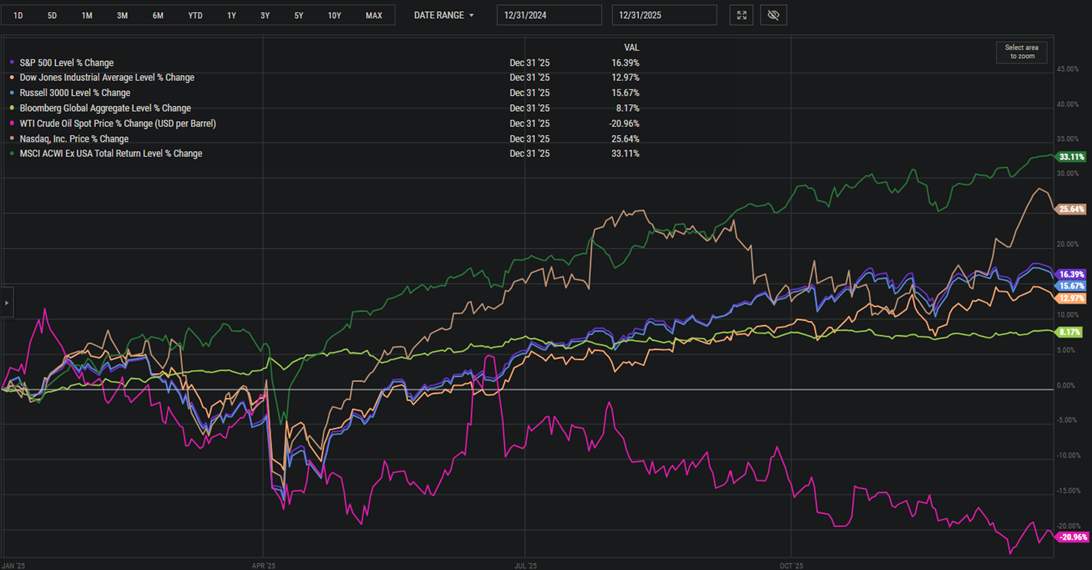
For long‑term investors, 2025 reinforced a familiar theme: volatility is the price of admission for equity‑like returns, and staying invested through uncertainty was again rewarded.
2026 market expectations
Wall Street’s early 2026 forecasts call for another constructive year, though with more modest upside and wider uncertainty bands.
Analyst and strategist expectations include:
- Yardeni Research’s survey of roughly 20 strategists shows an average S&P 500 year‑end 2026 target around 7,555, implying ~10% upside from early‑January levels.
- LPL Financial, as cited by Investopedia, pegs the average target near 7,269, suggesting about 5% upside from recent highs.
- More bullish firms, including Deutsche Bank and others, see potential for the S&P 500 to approach 8,000, supported by strong earnings, buybacks, and AI‑driven productivity gains.
- Morgan Stanley’s Global Investment Committee projects roughly 10% gains and a level near 7,500 if double‑digit earnings growth materializes.
- A CNBC survey of major Wall Street firms finds a median target around 7,650, implying roughly 11–13% gains depending on the starting level.
On balance, the Street is optimistic but increasingly focused on earnings quality, valuations, and policy as key determinants of whether these targets are achieved.
Upside drivers and downside risks
From Benzor Capital Wealth’s perspective, the 2026 landscape features clear potential catalysts alongside important risks.
Key upside drivers:
- Ongoing investment in artificial intelligence and automation, which may enhance productivity and margins across sectors over time
- Looser monetary policy as the Fed continues a gradual easing cycle
- Potential pro‑growth fiscal and regulatory developments in the U.S. and abroad
Key downside risks:
- Elevated valuations, especially among mega‑cap technology names, leaving less margin of safety if earnings disappoint
- Policy shocks, trade tensions, or geopolitical escalation (particularly in China and Eastern Europe)
- A weaker‑than‑expected labor market or slower global growth
- The possibility that market enthusiasm around AI proves ahead of realized earnings benefits, leading to renewed volatility or a correction even in an otherwise positive year
Benzor Capital Wealth’s stance
For Benzor Capital Wealth, 2025 was defined by volatility, a new administration reshaping global relationships, and sizable dislocations that ultimately gave way to another year of double‑digit equity gains. Investors who resisted the urge to react emotionally and instead adhered to long‑term plans were rewarded.
Looking ahead, 2026 begins with geopolitics front and center, but Benzor Capital Wealth believes the year will more fundamentally be shaped by AI‑driven efficiency gains that extend beyond large‑cap leaders to small and mid‑sized companies. Midterm elections in the U.S. will almost certainly introduce additional noise beginning in the summer and will dominate headlines into year‑end.
Benzor Capital Wealth’s current base case is for another year of market growth in both U.S. and international equities, with an expected S&P 500 return of approximately 8% in 2026. The firm continues to monitor macro conditions, geopolitics, and sector‑specific trends closely in order to provide not only long‑term growth opportunities but also holistic financial solutions across each client’s full balance sheet and life goals.
Sources
- Wall Street Expects a Solid 2026 for Stocks. But the ‘Risks Are Growing’
- Wall Street’s 2026 forecasts are rolling in — and some see the S&P 500 hitting 8,000
- Ycharts Graphs
- Stock Market Bull Case 2026: Will Gains Continue? | Morgan Stanley
- Here’s where the stock market is headed in 2026, according to Wall Street’s top strategists
- S&P 500 2026 Forecasts: Will the Rally Continue?
- Attempting to predict the economy in 2026 : Planet Money : NPR