

Introduction
August 2025 has been a pivotal month for global markets, with investors weighing a cooling U.S. labor market, steady consumer inflation, and firmer wholesale price pressures against growing expectations for monetary easing. At the same time, corporate earnings have largely surprised to the upside, while trade negotiations and political developments continue to add layers of uncertainty. Together, these dynamics are shaping a market environment where opportunity and caution coexist, making portfolio positioning and risk management more important than ever.

Nicholas Benzor
Principal Planner & Chief Executive Officer

Sanskar Raheja
Investment and Financial Planning Intern

Loveth Obozokhai
Investment and Portfolio Analyst Intern
The U.S. labor market showed continued signs of softening in July. The economy added 73,000 jobs, well below expectations of 110,000–120,000. Compounding concerns, prior months’ revisions were significant, with May and June combined revised down by 258,000 jobs, reflecting weaker hiring momentum than initially reported.
Job gains were concentrated in health care and social assistance, while losses were notable in manufacturing, government, and professional services. The unemployment rate rose to 4.2% (from 4.1%), and labor force participation declined to 62.2%, the lowest since late 2022. Meanwhile, weekly jobless claims were lighter than expected, though continuing unemployment claims came in higher, underscoring potential pressure in the labor market.
Inflation held steady at 2.7% year-over-year, unchanged from June, suggesting the Federal Reserve’s policy is balancing progress on inflation with rising risks to employment.
Adding to the inflation picture, the Producer Price Index (PPI) for final demand rose 0.9% month-over-month in July, the largest increase since January 2025. On a 12-month basis, the PPI rose 3.3%, the strongest gain since February 2025. This firming of wholesale prices signals potential continued inflationary pressures upstream in the supply chain. Key drivers included machinery and equipment wholesaling, processed foods, diesel fuel, and unprocessed foodstuffs, partly offset by a 1.8% decline in gasoline prices.
Federal Reserve & Interest Rate Outlook
The annual Jackson Hole Symposium provided important clues for monetary policy. Chair Jerome Powell’s remarks struck a dovish tone, signaling that the Fed is increasingly concerned about the labor market’s cooling trend. He emphasized that while inflation risks remain tilted to the upside, the balance of risks is shifting toward employment.
Markets interpreted this as a strong signal for a policy pivot. Rate cut expectations for September jumped to over 90%, marking what would be the first cut since December 2024—a development welcomed by both equity and bond markets.
In a separate development, on August 25th, President Trump called for the ousting of Fed Governor Lisa Cook, citing alleged false information on past mortgage applications in Michigan and Georgia. This move may signal another major shakeup in Fed leadership and, at minimum, an impending legal battle between the administration and Governor Cook’s legal team. Critics have already described the push as an unprecedented attack on the Fed’s independence, particularly as it coincides with Trump’s continued public pressure on the central bank to accelerate interest rate cuts.
Second-quarter earnings season has been stronger than anticipated, with 82% of S&P 500 companies beating expectations (as of August 22). Overall earnings growth is running at 7.4%, setting a positive tone for the remainder of the year.
Sector Leaders:
- Communication Services: +45.8% earnings growth, led by companies like Warner Bros. Discovery.
- Information Technology: +21.3%, fueled by AI innovation and robust tech demand.
- Financials: +13.1%, supported by margin improvements.
- Health Care: +7.9%, boosted by Pfizer, Eli Lilly, and Amgen.
- Consumer Discretionary: +5.3%, rebounding after previous weakness.
Underperformers:
- Energy: –26.5% earnings contraction on weaker oil prices and revenue compression.
- Utilities: +1.4%, reflecting slower defensive growth.
- Materials & Consumer Staples: Weak performance, with subpar earnings growth and low beat rates.
Looking ahead, analysts expect moderate but steady earnings growth, with leadership likely to remain in Technology, Communication Services, and Financials.
Global trade tensions remain in flux:
- China: A 90-day extension until November 10th was agreed, focusing on rare earth exports to the U.S. in exchange for a partial rollback of U.S. countermeasures. While progress, structural disputes remain unresolved.
- India: The U.S. imposed a baseline 10% reciprocal tariff on most imports, with higher country-specific rates (11%–50%) tied to ongoing purchases of Russian oil. Negotiations are ongoing, though no major new agreements have been announced.
The administration is simultaneously engaging 18 countries, including the EU, Brazil, South Korea, Thailand, and South Africa, with outcomes expected later this year.
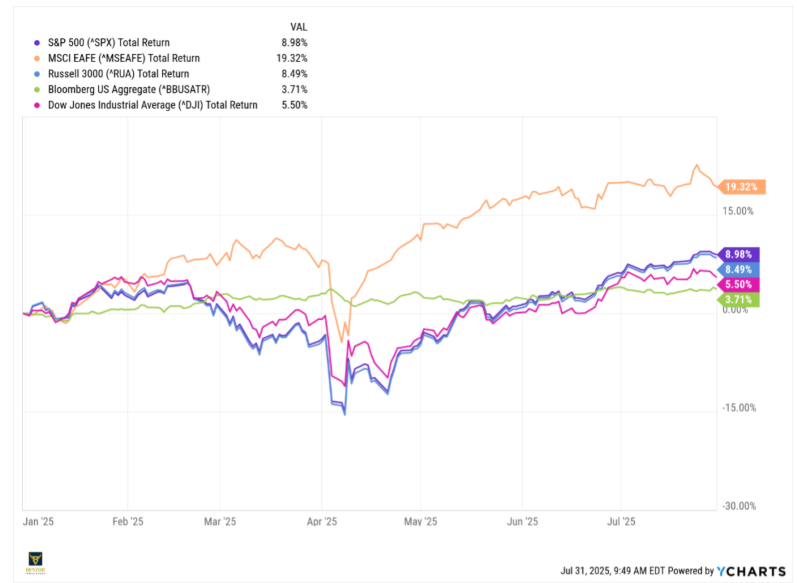
Market Performance (Month-to-Date as of Aug. 26, 2025)
- S&P 500: +1.58%
- Dow Jones Industrial Average: +2.61%
- Russell 3000: +1.75%
- Bloomberg Global Aggregate Bond Index: +1.15%
- Oil Prices: –8.31% MTD (Spot price decline underscored Energy sector weakness)
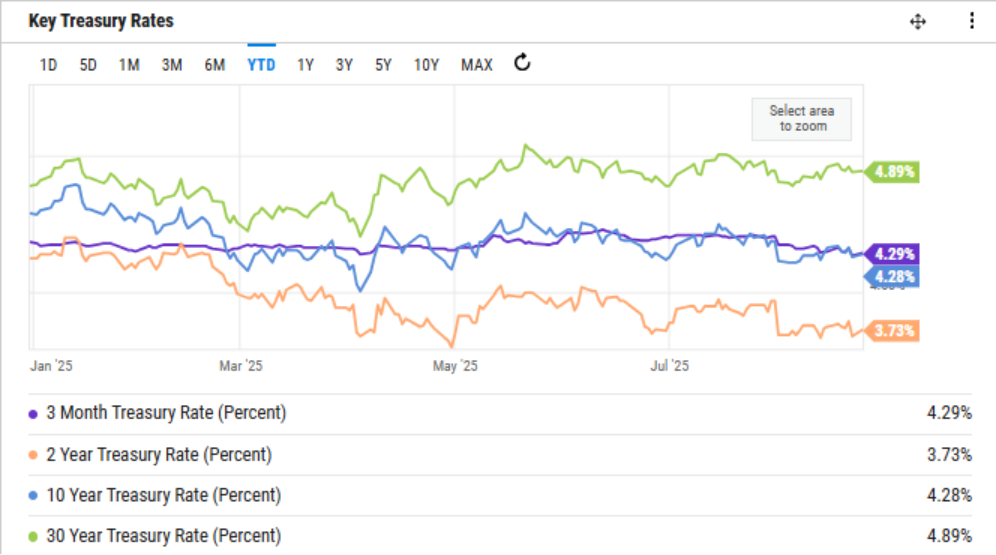
Treasury yields reflect shifting expectations of monetary easing:
- 3-Month: 4.29%
- 2-Year: 3.73%
- 10-Year: 4.28%
- 30-Year: 4.89%
The flattening in shorter maturities suggests markets are already pricing in anticipated Fed cuts, while long-term yields remain elevated on structural inflation concerns.
Private credit is becoming increasingly accessible to retail investors, broadening the opportunity set outside traditional public markets. This trend may provide new avenues for portfolio diversification as institutional-style strategies filter down to individual investors through retirement investment offerings through their respective employers.
The investment backdrop is shifting toward lower rates, which should provide a tailwind for growth-oriented sectors:
- Technology, Communication Services, and Consumer Discretionary are positioned to benefit from cheaper borrowing, innovation momentum, and resilient consumer demand.
- Financials may face margin compression from lower rates, though stronger lending activity could offset the drag.
- Energy faces continued uncertainty, with commodity volatility and geopolitical risks weighing on the sector.
- Utilities and Consumer Staples are expected to deliver modest growth but may face margin pressure, though they could also benefit from a more stable macroeconomic environment.
- Small- and mid-cap companies, which are more sensitive to financing costs, stand to benefit meaningfully from easier monetary policy, supporting a potential rotation into broader equity markets.
Final Thoughts
August highlighted a clear transition point for both the economy and the markets. A slowing labor market, firmer wholesale price pressures, and dovish signals from the Federal Reserve are setting the stage for potential policy easing in September. Strong corporate earnings in growth-driven sectors have provided reassurance, even as energy, trade disputes, and political uncertainties continue to pose risks.
At Benzor Capital Wealth, we view these developments as an opportunity to balance resilience with forward-looking growth. Lower interest rates should benefit innovative and consumer-driven sectors, while diversification across asset classes—including alternatives such as private credit—can help buffer volatility. As always, our focus remains on navigating changing market conditions with discipline and clarity, ensuring that client portfolios are well-positioned not just for today’s environment, but for the opportunities and challenges
Disclosure: These are the opinions of Nicholas Benzor and not necessarily those of Cambridge, are for informational purposes only, and should not be construed or acted upon as individualized investment advice. The indices mentioned are unmanaged, do not incur fees, and cannot be invested into directly.