

June Market Outlook: Navigating Uncertainty Amid Mixed Signals
As we move through mid-2025, global markets are contending with a complex blend of economic crosscurrents. Easing inflationary pressures and stable labor data have offered some relief to investors, yet renewed geopolitical tensions, evolving trade policies, and looming fiscal challenges continue to cast a long shadow. From the ripple effects of U.S.–China tariff shifts to the escalating oil price volatility spurred by Middle East conflict, each development carries significant implications for inflation, interest rates, and investor sentiment. Against this backdrop, policymakers are treading cautiously, while markets remain sensitive to the balance between short-term resilience and long-term risks. This report explores the key macro drivers shaping June’s market narrative—from inflation trends and Fed policy to fixed income, equity performance, and Benzor Capital Wealth’s strategic positioning.

Nicholas Benzor
Principal Planner & Chief Executive Officer

Sanskar Raheja
Investment and Financial Planning Intern

Loveth Obozokhai
Investment and Portfolio Analyst Intern
Tariffs, Trade & Inflation Outlook
Markets entered June with cautious optimism as the U.S.–China 90-day tariff truce held firm, providing temporary relief to investors. Signs of progress in rare-earth negotiations, highlighted by President Trump’s June 11 announcement of a tentative export agreement pending Xi Jinping’s approval, helped ease pressure on the tech and EV sectors
However, underlying tensions resurfaced with the administration’s implementation of the proposed “Universal Tariff” and the formal doubling of steel and aluminum duties to 50%. These moves, which took effect June 4, have significantly raised concerns about long-term inflationary pressures. Businesses importing intermediate goods are facing rising costs, prompting fears that these increases will cascade through supply chains.
While May’s CPI data (+2.4% YoY headline, +2.8% core) showed limited immediate impact from tariffs, economists caution that cost-push inflation is likely to emerge in the coming months. June’s PMI and producer surveys have already indicated that manufacturers are beginning to pass on higher input costs, reinforcing expectations that inflation could reaccelerate in the second half of 2025.
Amid these developments, the Federal Reserve held interest rates steady in June, signaling a more cautious stance. Policymakers are now grappling with the dual challenge of slowing growth and resurgent inflation risks, prompting debate over the timing and extent of any potential rate cuts.
Oil Prices & Geopolitical Risk
Crude markets surged nearly 20% in June, fueled by escalating tensions between Israel and Iran. The rally peaked mid-month following coordinated U.S. and Israeli airstrikes on Iranian nuclear sites and Tehran’s retaliatory missile strike on the Al-Udeid air base in Qatar. Brent briefly spiked to $80/bbl, and WTI touching $77, before retreating on news of a tentative U.S.-brokered cease-fire. Still, prices remain volatile, with Brent and WTI now trading in the high-$60s range.
The geopolitical flashpoint centers on Iran’s threatened closure of the Strait of Hormuz—a maritime chokepoint for roughly 20% of global oil supply. Though no physical disruption has occurred, Iran’s parliament approved a measure to shutter the Strait, pending review by the Supreme National Security Council. Note: The Strait has never been closed, even during the Gulf War it remained fully operational and functional.
Analysts remain divided on the likelihood of a full closure of the Strait. Some estimate a greater-than-even chance of at least partial disruption, which could drive Brent crude above $110. In more severe scenarios, prices could surge to $120–130/bbl. However, the prevailing view remains more measured, with expectations that in the absence of a major supply disruption oil will range between $60 and $67 into 2026. Beyond crude benchmarks, the broader economic consequences are being closely monitored. A sustained rise in oil above $100/bbl could add 0.7–2% to U.S. headline inflation, with gasoline potentially climbing by 75 cents to $1 per gallon. Globally, major energy importers and inflation-sensitive economies across Asia-Pacific could face renewed cost pressures.
Market Performance:
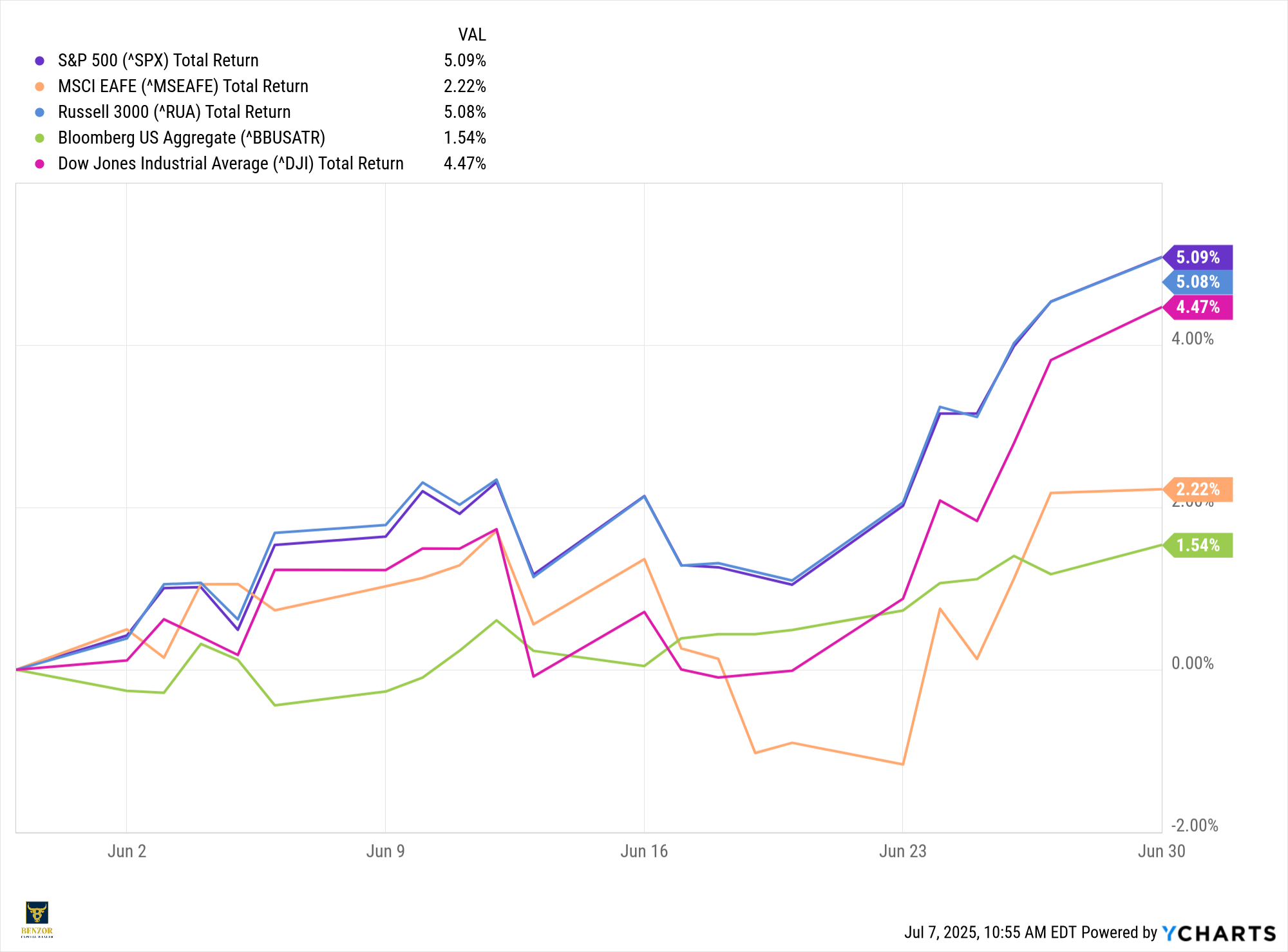
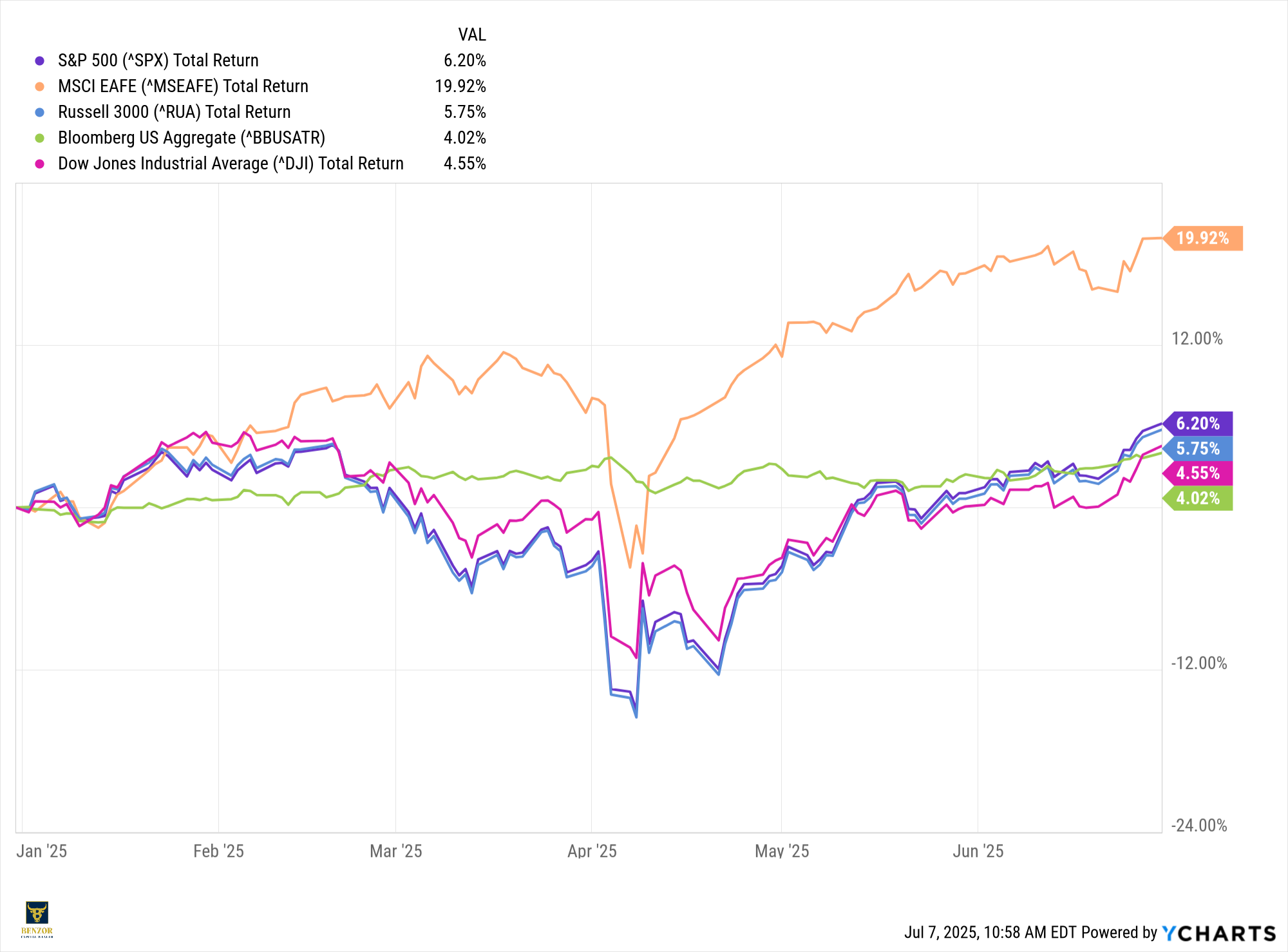
From a technical perspective, markets are maintaining a cautiously bullish stance, with most indices hovering near all-time highs. The S&P 500 has broken above the 6,100 level and is now trading at all-time highs, reinforcing bullish momentum and potentially attracting further upside participation. The Dow and Russell 3000 are also consolidating within upward patterns, positioning them for potential breakouts. The new highs in the S&P may serve as a catalyst for broader market optimism. Unless disrupted by a major macro or policy event, price action is expected to remain upward biased
Visual – U.S. Unemployment Rate and Job Openings
Fixed Income & Interest Rates:
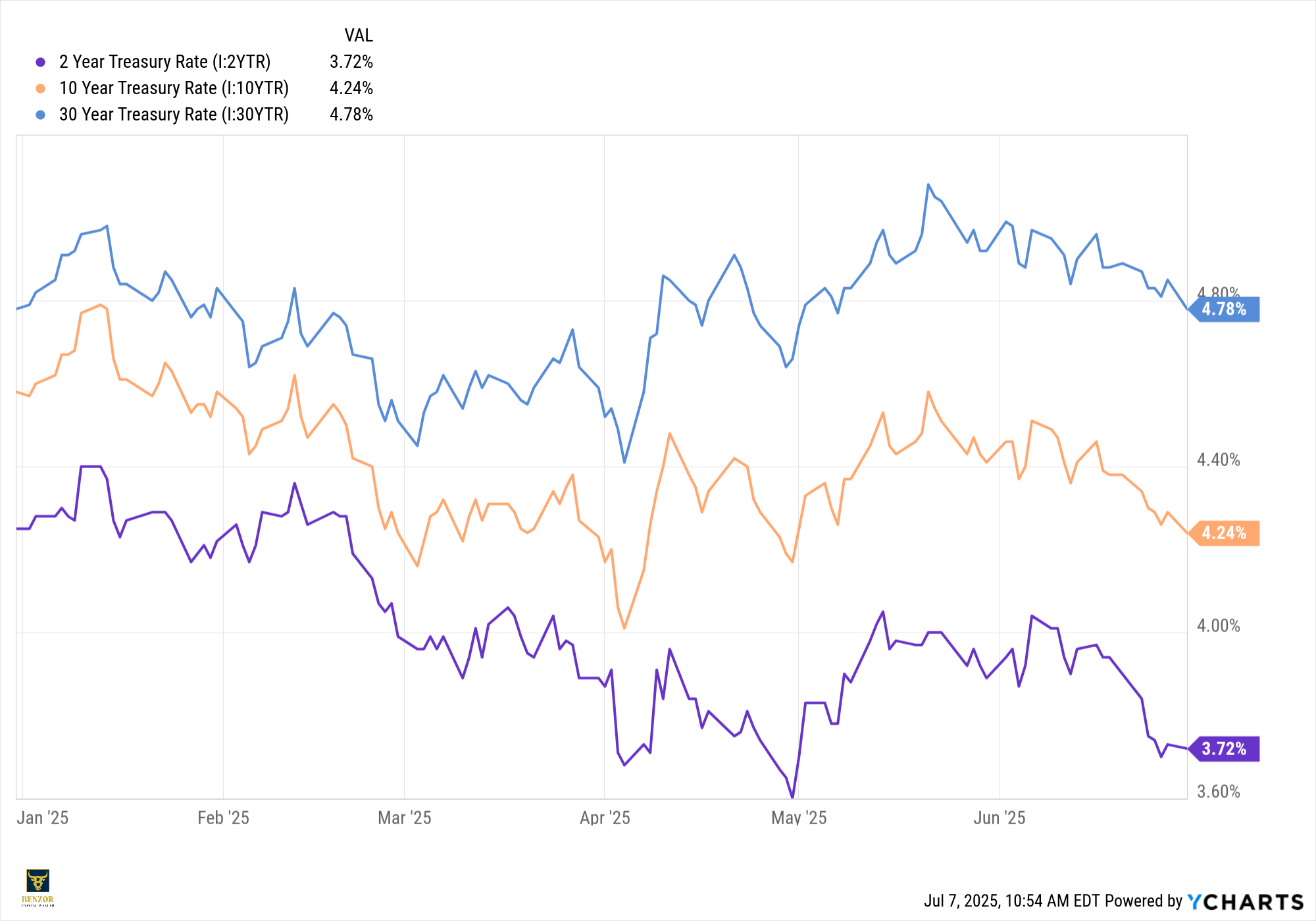
The fixed income market maintained relative stability through June, buoyed by a continued easing in inflation indicators and increasing conviction around potential Federal Reserve rate cuts in the second half of the year. While short- and intermediate-term yields have declined modestly, longer-term rates remain elevated, underscoring persistent structural concerns.
The 2-year Treasury yield declined to 3.72% from 3.89% at the end of May, reflecting rising market confidence in near-term Fed easing as disinflation trends hold and growth momentum moderates. The 10-year yield dipped to 4.24%, down from 4.41%, driven by subdued long-term inflation expectations and improved investor sentiment around a soft landing. Meanwhile the 30-year Treasury yield eased to 4.78% from 4.92%, but remains historically elevated, signaling investor caution around long-term debt sustainability, ongoing Treasury issuance, and diminished foreign appetite.
The yield curve steepened slightly during the month, with the narrowing in short-term yields outpacing the moderation in long-end rates. This curve shape continues to reflect a delicate balance between near-term policy shifts and longer-term fiscal imbalances.
Credit markets have remained relatively stable. Investment-grade spreads tightened slightly, supported by solid corporate fundamentals and ongoing investor demand for quality. However, high-yield spreads remain compressed, offering limited compensation for risk at a time when macro uncertainty lingers.
Inflation, Jobs & the Fed
June presented a nuanced but steady economic landscape. The May PCE report, released June 27, showed headline inflation at +0.1% MoM, 2.3%, while core PCE (ex-food & energy) rose to 2.7%, a mild uptick from April’s 2.6%. This suggests inflation remains anchored but is showing signs of modest upward pressure, likely reflecting early impacts from tariffs and energy costs.
Notably, the Fed’s preferred measure, core PCE, matched estimates, yet the slightly higher annual rate weakens the case for an imminent rate cut.
On the labor front, the unemployment rate held steady at 4.2%, reflecting a resilient job market even amid tighter monetary conditions. This stability in employment supports consumer spending but also complicates the Fed’s path as it balances inflation control with labor market health.
At its June 18 meeting, the Federal Reserve held rates steady, maintaining its cautious, data-dependent stance. Chair Powell acknowledged that inflation has moderated but warned that tariffs could drive goods higher over the summer. The Fed’s updated projections now anticipate two rate cuts in 2025 starting in Q3, down from earlier expectations, and raised their core PCE inflation forecast to 3.1%
With the next CPI and jobs reports due in mid-July, the Fed appears content to wait for further clarity before adjusting policy. Markets are increasingly focused on whether the central bank will act preemptively or continue to hold in the face of mixed signals.
Tax Policy & Debt Ceiling
As of the date of posting, the “One Big Beautiful Bill” has been officially passed and signed into law on July 4, marking a major shift in U.S. tax and fiscal policy. The bill, which cleared the Senate by a narrow margin and was quickly approved by the House, includes sweeping changes to the tax code, government spending, and entitlement programs.
One of the most closely watched provisions is the adjustment to the SALT (State and Local Tax) deduction cap. Under the new law, the cap is temporarily raised to $40,000 for joint filers earning under $500,000, effective through 2029, after which it reverts to the previous $10,000 cap. This adjustment is expected to offer meaningful short-term relief to taxpayers in high-tax states such as California and New Jersey, to name a few.
Other key components of the bill include a reduced child tax credit of $2,200 per child, deeper Medicaid spending cuts, and the extension of clean energy tax credits, with a particular focus on nuclear energy development.
From a fiscal standpoint, the bill is projected to reduce federal revenue by approximately $3.3 to $3.5 trillion over the next decade
Investors are closely monitoring the implications, as the legislation could impact consumer spending, municipal finance, and sector-specific performance
Deregulation:
June saw renewed momentum behind the administration’s deregulatory agenda, particularly in the areas of energy, environmental standards, and financial regulation. The White House rolled out a series of proposals aimed at cutting red tape and stimulating investment, including reforms to streamline permitting fossil fuel and energy transmission projects. At the same time, the Environmental Protection Agency moved to rescind recent vehicle emissions targets and water quality regulations, a move that has drawn sharp criticism from environmental groups and sparked legal challenges from several states.
In parallel, financial regulators proposed loosening compliance requirements for small and regional banks, citing the need to boost lending and relieve pressure on community institutions. While these deregulatory efforts are framed as growth-friendly, they have also raised concerns about long-term resilience and sustainability—particularly if environmental standards are softened too aggressively.
From a market perspective, these shifts have provided marginal upside to energy and industrial stocks, although much of the impact appears to be priced in. Investors remain alert to the legal and political headwinds that could shape the final contours of these proposals in the months ahead.
BCap Stance on Market
At Benzor Capital Wealth, we remain constructive in our outlook while mindful of the shifting economic and policy landscape. June reaffirmed the resilience of U.S. markets, with equity indices consolidating gains amid elevated geopolitical tensions and policy uncertainty. Encouraging inflation trends and continued strength in corporate fundamentals support our base case for gradual improvement, particularly as clarity emerges around trade, taxation, and monetary policy.
We continue to favor high-quality equities with strong balance sheets, pricing power, and exposure to long-term innovation. In fixed income, we maintain a disciplined duration stance, focusing on short- to intermediate-term bonds and inflation-sensitive instruments such as TIPS and floating rate notes.
Our portfolios also reflect measured exposure to alternative assets, including private equity, infrastructure, and commodities, which may benefit from near-term volatility and evolving macro trends. These allocations are designed to enhance diversification, capture tactical opportunities, and preserve capital across a range of scenarios.
As we move into the second half of 2025, we remain confident in our positioning but alert to potential market inflection points. Above all, we are committed to guiding our clients’ financial journeys with clarity, care, and conviction—delivering bespoke strategies built not just for today’s markets, but for tomorrow’s goals.
Chart – S&P with levels marked
Chart – Dow Jones with levels marked
Chart – S&P 500, Dow Jones, and Nasdaq comparison
Visual – 10-Year vs 2-Year Treasury Yield Spread (10Y-2Y Spread)