


Nicholas Benzor
Principal Planner & Chief Executive Officer
Table of Contents
- Geopolitical Tensions
- Employment, Inflation, & the Fed
- Earnings Report & Forward Guidance
- Market Performance
- Equities
- Fixed Income
- Commodities
- Housing
- BCW Stance
October 2026 Market Commentary
Benzor Capital Wealth
Geopolitical Tensions
The Middle East remained the dominant geopolitical risk during September, with the ongoing U.S.–Iran conflict continuing to disrupt shipping and energy flows through the Strait of Hormuz. Tensions escalated early in the month as U.S. and Iranian forces again targeted shipping in the Gulf, while Iran threatened further retaliation and announced plans for a new restricted shipping zone. Iran maintained that normal passage through the Strait would depend on an end to U.S. attacks and restrictions, keeping uncertainty elevated around one of the world’s most important energy routes.
Diplomatic efforts continued through Oman and Qatar, with talks focused on establishing a framework governing shipping through Hormuz. However, disagreements over Iran’s proposed role, fees, and the sequencing of potential concessions prevented a broader agreement. Late in the month, Iran proposed a seven-day confidence-building plan that could eventually restore more normal passage through the Strait, but U.S. feedback delivered through Qatari mediators did not result in a breakthrough before month-end.
A second geopolitical risk emerged around the Bab al-Mandab Strait as Iran-backed Houthi forces intensified attacks on Saudi cities and energy infrastructure while advancing along Yemen’s Red Sea coast. Houthi forces captured strategically important territory and islands around the strait, increasing their ability to threaten Red Sea shipping and creating greater uncertainty around a second major global energy chokepoint. Saudi Arabia subsequently sought additional U.S. assistance, with the U.S. providing intelligence and targeting support while stopping short of directly participating in strikes.
Despite the continued conflict, Gulf oil flows improved substantially during September as producers adapted shipping routes and increased exports through alternative channels. This helped ease some immediate concerns around physical crude availability, although shipping risks, insurance costs, and refined-product disruptions remained elevated.
Outside the Middle East, U.S.–China relations remained an important source of uncertainty. President Trump and President Xi met in Washington during September, with the two countries extending their existing tariff truce and reducing tariffs on a portion of bilateral trade. The Russia–Ukraine conflict also remained active, with Russia intensifying attacks on Ukrainian energy infrastructure toward the end of the month.
Going forward, markets will remain focused on progress toward restoring normal shipping through the Strait of Hormuz, whether the Saudi–Houthi confrontation around Bab al-Mandab broadens, and whether temporary progress in U.S.–China trade negotiations develops into a more durable agreement.
Employment, Inflation & the Fed
The Federal Reserve returned to tightening in September, voting 12–0 to raise the federal funds target range by 25 basis points to 3.75%–4.00% under Chair Kevin Warsh. It was the Fed’s first hike since July 2023, and the median projection signals one additional 25 bp increase before year-end. The decision reflected concern that inflation remains too elevated to justify an easier policy stance, even as labor-market softness became more evident.
Inflation data reinforced that concern. August CPI rose 0.4% month-over-month and 3.4% year-over-year, with core CPI up 0.3% (above expectations) and 2.4% year-over-year. Producer prices were hotter still: August PPI rose 0.4% month-over-month and 5.4% year-over-year, driven by a 4.2% jump in energy, including a 24.1% surge in diesel and 21.3% in jet fuel. PPI excluding food, energy, and trade services rose 4.7% year-over-year, suggesting energy costs are feeding into broader pipeline pressures.
Labor-market data were more mixed. Layoffs remained subdued. Initial jobless claims held near 197,000, close to their lowest levels since 1969, and continuing claims fell to 1.70 million, the lowest since March 2023. The August JOLTS report showed job openings slipping to 7.1 million, while hires (5.2 million) and layoffs (1.6 million) were little changed, consistent with a “low-hire, low-fire” labor market.
September payrolls, released in early October, showed a sharper slowdown. Employers added just 29,000 jobs against expectations of nearly 90,000, unemployment ticked up to 4.2%, and July and August were revised down by a combined 60,000. The three-month average fell to roughly 51,000. Wage growth also moderated, with average hourly earnings up 0.1% on the month and 3.0% year-over-year.
The combination leaves the Fed with a difficult trade-off. Higher oil prices are lifting headline and producer inflation and raising operating costs across the economy, while slowing job growth increases the risk that further tightening weighs on activity. The inflationary effect of energy also flowed into the bond market, as investors priced in higher-for-longer rates and Treasury yields rose sharply.
Going forward, the Fed faces competing signals from slowing employment and moderating wages on one side, and elevated energy, tariff, and producer-price pressures on the other. CME FedWatch currently assigns an 80.6% probability that the Fed holds rates unchanged at 3.75%–4.00% at the October 27–28 meeting, compared with a 19.4% probability of another 25-basis-point increase. The probability of an October hike has fallen sharply from roughly 51% a week earlier, following softer employment and inflation data, suggesting markets increasingly expect the Fed to pause in October and potentially resume tightening later in the year.
Earnings Reports and Forward Guidance
Earnings Snapshot
Third-quarter earnings season began in early October with a relatively strong fundamental backdrop, as both analyst estimates and corporate guidance improved during September rather than weakening ahead of reporting season. FactSet expects the S&P 500 to report 29.5% year-over-year earnings growth for the third quarter, up from 26.7% expected at the beginning of the quarter. If achieved, this would represent a third consecutive quarter of earnings growth above 25%.
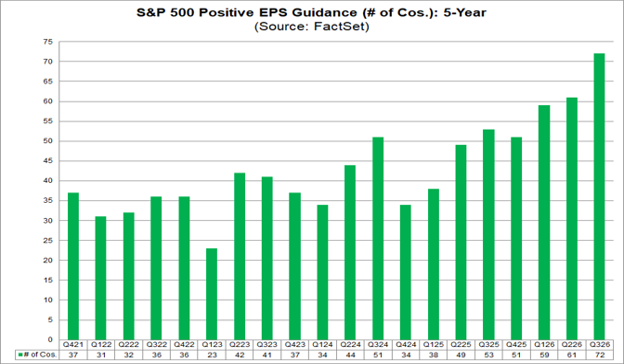
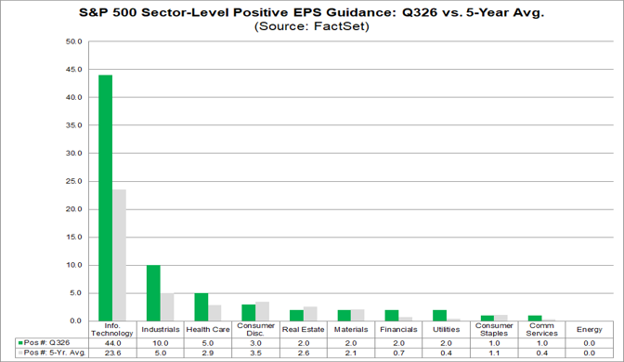
The direction of estimate revisions has been particularly notable. Analysts raised third-quarter EPS estimates by 1.4% between the end of June and the end of September, compared with the typical pattern of downward revisions ahead of earnings season. Corporate guidance has also remained constructive, with positive EPS guidance significantly outnumbering negative guidance and reaching its highest level since FactSet began tracking the data.
Earnings growth is expected to remain broad-based, with all eleven S&P 500 sectors projected to report year-over-year growth. Energy, Information Technology, Communication Services, and Materials are expected to be among the strongest contributors. Revenue expectations have also improved, reinforcing the strength of the underlying earnings outlook.
Expectations beyond the third quarter remain strong, with analysts projecting continued earnings growth through the fourth quarter and full year. At the same time, equity valuations have moderated as earnings expectations improved and market performance became more mixed, providing somewhat greater fundamental support to current index levels.
Market Performace
Equities
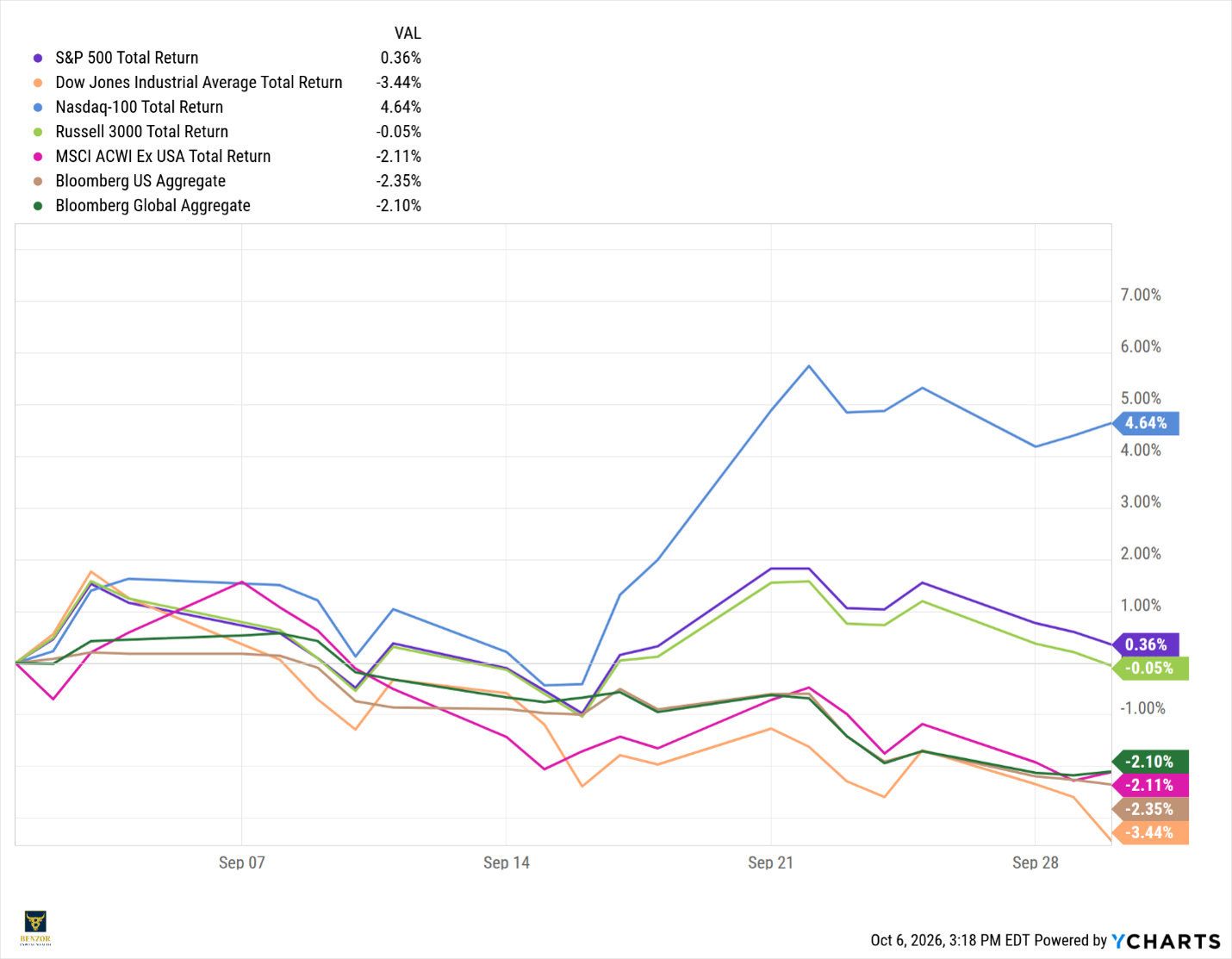
U.S. equity markets were mixed during September as strong performance from large-cap technology offset weakness across more cyclical and rate-sensitive areas of the market. Market participation narrowed considerably compared with August, with much of the month’s strength concentrated in AI-related technology, semiconductors, and mega-cap growth companies.
Growth-oriented equities remained the strongest area of the market as continued enthusiasm around artificial intelligence investment and strong technology fundamentals supported the Nasdaq. In contrast, broader market participation was considerably weaker, with the Russell 3000 essentially flat and the Dow materially underperforming as its lower exposure to high-growth technology limited participation in the strongest areas of the market.
International equities also weakened as higher global yields, elevated energy costs, and geopolitical uncertainty created additional pressure outside the U.S. Rising Treasury yields became an increasingly important headwind during the month, particularly for more rate-sensitive sectors, although large-cap technology remained relatively resilient despite the higher discount-rate environment.
Overall, September highlighted a more concentrated equity market than August, with technology continuing to provide leadership while broader U.S. and international equities struggled to keep pace.
Fixed Income
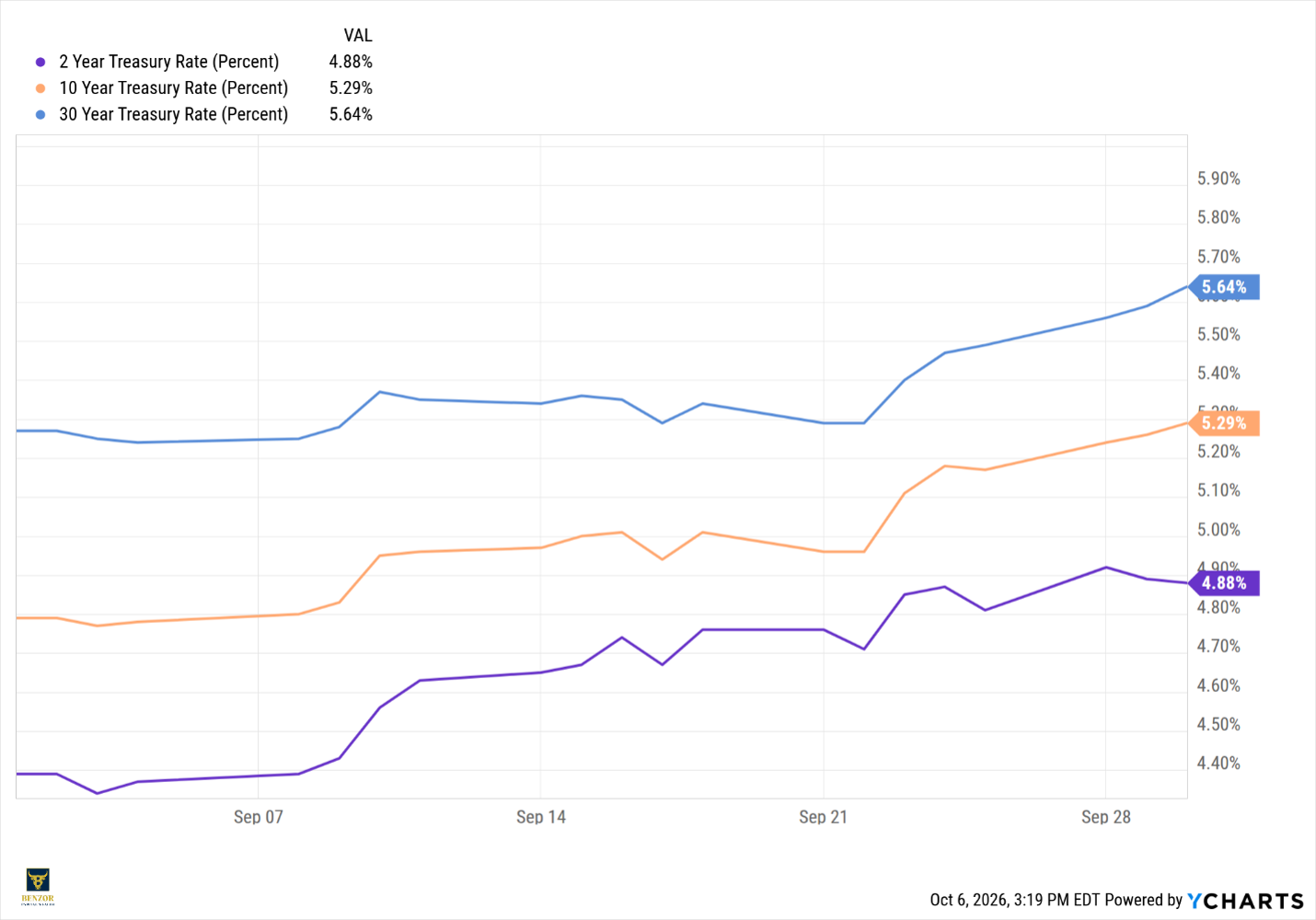
Fixed income markets came under significant pressure during September as investors materially repriced expectations for inflation, Federal Reserve policy, and longer-term interest-rate risk.
The Federal Reserve’s return to tightening reinforced expectations that monetary policy could remain restrictive for longer, reducing confidence that near-term rate cuts would provide support to bond markets. Higher energy prices added to those concerns as Middle East disruptions increased oil, transportation, and production costs, raising the risk that headline and producer inflation remain elevated.
Economic activity also remained relatively resilient during much of the month, reducing expectations that the Fed would need to quickly reverse course. At the same time, Treasury supply and fiscal concerns became an increasingly important component of the selloff as investors focused on large government borrowing requirements and demanded greater compensation to absorb continued debt issuance.
Longer-term yields therefore reflected more than expectations for the next Fed decision. Investors were also demanding additional compensation for persistent inflation, fiscal uncertainty, heavy Treasury supply, and duration risk. The resulting rise in yields placed pressure on broad bond prices and contributed to heightened volatility across fixed income.
The move was also global rather than isolated to the U.S., with sovereign yields rising across several developed markets as investors reassessed inflation, government borrowing, and the likelihood that interest rates remain elevated.
Overall, September’s fixed-income weakness reflected a combination of higher-for-longer Fed expectations, energy-driven inflation pressure, resilient economic activity, and growing concerns surrounding government debt supply.
Commodities
Energy markets remained highly sensitive to geopolitical developments during September, particularly changing expectations surrounding Iran, the Strait of Hormuz, and broader Middle East shipping conditions.
Oil prices remained volatile as improving Gulf exports periodically eased concerns around physical supply, while renewed military escalation and continued uncertainty around shipping access maintained a geopolitical risk premium. The importance of energy extended well beyond commodity markets, as higher oil and refined-product prices increased transportation and production costs and contributed to broader inflation pressures.
Rising energy costs also influenced Federal Reserve expectations by making progress toward the Fed’s inflation target more difficult and increasing the likelihood that monetary policy would remain restrictive for longer. This relationship flowed directly into fixed income, where higher inflation expectations increased the compensation investors demanded for holding longer-duration bonds and contributed to the rise in Treasury yields.
Overall, the relationship between geopolitical risk, oil prices, inflation expectations, Federal Reserve policy, and Treasury yields remained one of the most important cross-asset themes during September.
Performance Snapshot — September 2026
- S&P 500 Total Return: +0.36%
- Dow Jones Industrial Average Total Return: -3.44%
- Nasdaq-100 Total Return: +4.64%
- Russell 3000 Total Return: -0.05%
- MSCI ACWI ex USA Total Return: -2.11%
- Bloomberg U.S. Aggregate Bond Index: -2.35%
- Bloomberg Global Aggregate Bond Index: -2.10%
Housing
The U.S. housing market remained under pressure during September as rising Treasury yields pushed mortgage rates higher and continued to constrain affordability and transaction activity. The average 30-year fixed mortgage rate moved back above 7% by month-end, reversing part of the improvement seen earlier in the summer and creating another headwind for potential buyers.
Existing-home sales remained weak as elevated financing costs continued to restrict affordability and discourage homeowners with low existing mortgage rates from moving. Housing inventory nevertheless continued to improve, reaching its highest level since 2019 and reducing some of the extreme competition that had characterized the market in recent years.
The new-home market remained comparatively resilient. Builders continued to rely on price reductions, mortgage-rate incentives, and other concessions to support demand, while the median new-home price declined from year-earlier levels. This highlighted the growing divergence between the new and existing-home markets, as builders have greater flexibility to adjust pricing and financing terms than individual homeowners.
Residential construction remained mixed. Single-family housing starts improved, while weaker multifamily activity and declining permits pointed to continued caution among developers. Elevated financing costs, material prices, and affordability concerns remain significant constraints on new construction.
Overall, September continued to highlight the housing market’s affordability problem. Demand has not disappeared, but elevated mortgage rates and home prices continue to restrict existing-home activity, while builders increasingly rely on incentives to keep new-home demand moving. Going forward, the direction of mortgage rates remains the key variable, with lower Treasury yields potentially improving affordability and transaction volumes while a higher-for-longer rate environment would likely keep housing activity subdued.
BCW Stance
As we move into the final quarter of 2026, our outlook on the markets remains cautiously optimistic. We recognize that geopolitical tensions, persistent inflationary pressures, elevated interest rates, and uncertainty surrounding Federal Reserve policy continue to present meaningful risks. However, we also believe that beneath these challenges lies a fundamental strength in corporate America that should not be overlooked.
Corporate earnings growth remains encouraging, with many high-quality companies demonstrating an ability to improve operational efficiency, protect profit margins, and generate strong free cash flow. At the same time, advancements in artificial intelligence, automation, and other cutting-edge technologies are creating compelling opportunities for businesses to streamline processes, enhance productivity, and drive long-term profitability. We believe companies developing these innovations, as well as those successfully integrating them into their operations, are well-positioned to benefit from these transformative trends.
Ultimately, we remain optimistic about the long-term opportunities presented by corporate innovation, operational efficiency, and sustainable earnings growth, while recognizing that valuations and disciplined risk management remain critical. As markets navigate the remainder of 2026, we believe maintaining a diversified portfolio of high-quality investments, supported by strong fundamentals and a long-term perspective, will remain essential to navigating uncertainty and capturing opportunities for growth.